
BlueLinx Holdings: Escaping the Lumber Cycle One Deal at a Time
BlueLinx ranks #12 on MDM's 2026 building-materials list. Its real strategy is a decade-long bet to out-grow commodity lumber's boom-bust swings.
Part of Distributor Playbooks — strategy teardowns of every company on the MDM Top Distributors lists.
BlueLinx Holdings lands at #12 on MDM's 2026 Top Distributors list for building materials, on $3.0 billion in 2025 revenue. That placement undersells the more interesting fact: BlueLinx has spent the better part of a decade trying to make that revenue number matter less than what generates it, because the company that Georgia-Pacific spun off in 2004 was built on the most volatile product category in the entire vertical.
A carve-out with a commodity problem
BlueLinx exists because Georgia-Pacific decided in 2004 it no longer wanted to own the distribution warehouses attached to its mills. Senior managers, backed by Cerberus Capital Management, bought the division and put it on the NYSE that December as BXC. The predecessor operation traced back to 1954, when Georgia-Pacific ran a network of plywood warehouses; by the time of the spinoff that had grown to more than 130 locations. Cerberus stayed the controlling shareholder for over a decade, trimming its stake by roughly 3.9 million shares in a 2017 secondary offering as the company stabilized.
What Georgia-Pacific handed off, though, was fundamentally a lumber and panel distributor: plywood, OSB, dimensional lumber, gypsum, the framing-and-sheathing products that move construction starts and get crushed on price whenever a housing cycle turns. That business is huge and necessary, but it is also brutally cyclical and thin-margin, as the 2021 lumber price spike and subsequent collapse demonstrated across the entire industry. A distributor whose fortunes rise and fall with framing lumber futures is a hard business to run predictably, and it is the business BlueLinx started as.
The specialty pivot is the strategy
The clearest read on how BlueLinx competes now is what it has bought and built since. The 2018 acquisition of Cedar Creek Holdings from Charlesbank Capital Partners doubled the company's footprint and, more importantly, weighted it toward specialty products: siding, trim, moulding, millwork, outdoor living, roofing, specialty flooring, decorative panels. Those categories carry gross margins that structural commodity lumber cannot touch, and they don't reprice overnight the way OSB futures do.
The pattern kept repeating. Vandermeer Forest Products in 2022 pushed BlueLinx further into the West and further into specialty categories. The Disdero Lumber acquisition in November 2025, a roughly $96 million deal funded entirely from cash on hand and described by the company as immediately accretive, extended the same western specialty build-out again. In April 2026 BlueLinx rolled out TruExterior siding and trim across a dozen of its markets, and it has been expanding a distribution partnership with Oldcastle APG that doubled the number of locations carrying RDI railing products from eight to sixteen. None of these moves individually would qualify as a bold strategic swing. Stacked together over eight years, they are the strategy: use scale in commodity structural products to fund a steady march toward higher-margin, less-cyclical specialty lines, one regional or category bolt-on at a time.
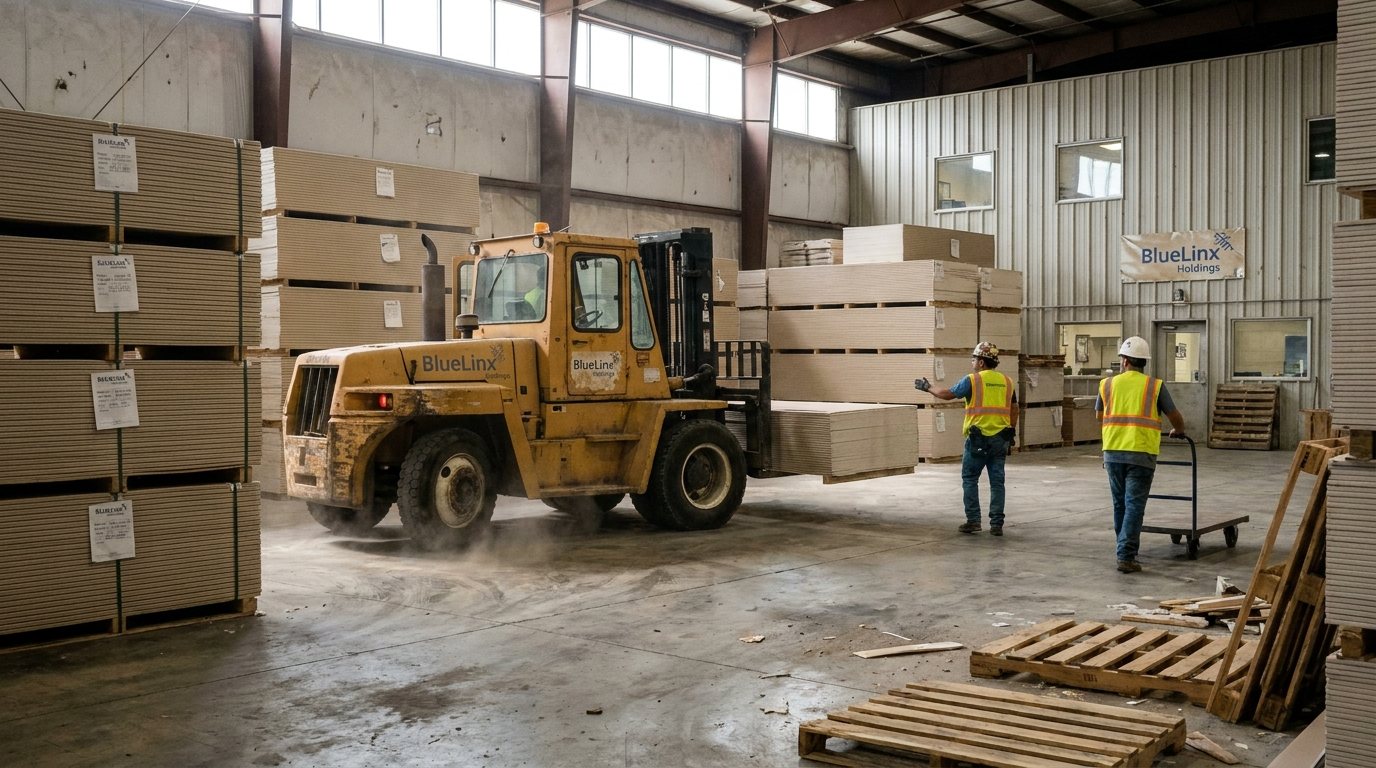
Today the company runs more than 60 distribution facilities, a private fleet of over 700 trucks, and relationships with more than 750 suppliers serving 15,000-plus customers, according to its own company fact sheet. That is scale built for the original commodity business, redeployed to carry a different product mix.
The tension nobody at BlueLinx will call a tension
Here is the honest strategic bet, stated plainly: BlueLinx has not exited structural products, and it cannot. Lumber, panels, and gypsum remain the volume base that makes 60-plus distribution centers economical to run, the freight that fills those 700 trucks, and the relationship anchor with home centers and dealer cooperatives that specialty sales ride alongside. The company is simultaneously trying to grow away from commodity exposure and depending on that same commodity exposure for the scale that makes the specialty business viable. Its first-quarter 2026 results made the tension visible in the numbers: net sales of $731 million and a gross margin near 16%, but a net loss of $1.5 million even as adjusted EBITDA held at $23.5 million, a gap that tracks with how choppy structural pricing has been through the housing downturn of the mid-2020s.
The company's own capital allocation shows it is betting on the pivot rather than the base: $37.7 million in share repurchases through 2025 and acquisitions funded from a balance sheet carrying $659 million to $726 million in liquidity across the year, rather than debt-fueled scale plays. That is a distributor telling you, with its checkbook, which half of its business it thinks will define its next decade. Leadership continuity matters here too. CEO Shyam Reddy has overseen the Vandermeer and Disdero deals, and the December 2025 handoff of the chief commercial officer role from Mike Wilson to internal promote Leo Oei suggests the strategy is meant to outlast any single executive's tenure, not pivot again with new leadership.
For a company built on plywood warehouses in the 1950s and cut loose from a paper giant in 2004, the through-line is not the wood. It is the willingness to keep buying its way out of the parts of the business it can't control the price of.
This piece is part of an ongoing series examining the strategic operating models of North America's largest distributors, the companies whose branches, fleets, catalogs, and data quietly keep entire industries supplied.