
Boeing Distribution: How Two Buyouts Built an Aerospace Giant
Boeing Distribution ranks #6 in fasteners on the 2026 MDM Top Distributors list. Here's how an airframe maker ended up owning its own parts channel.
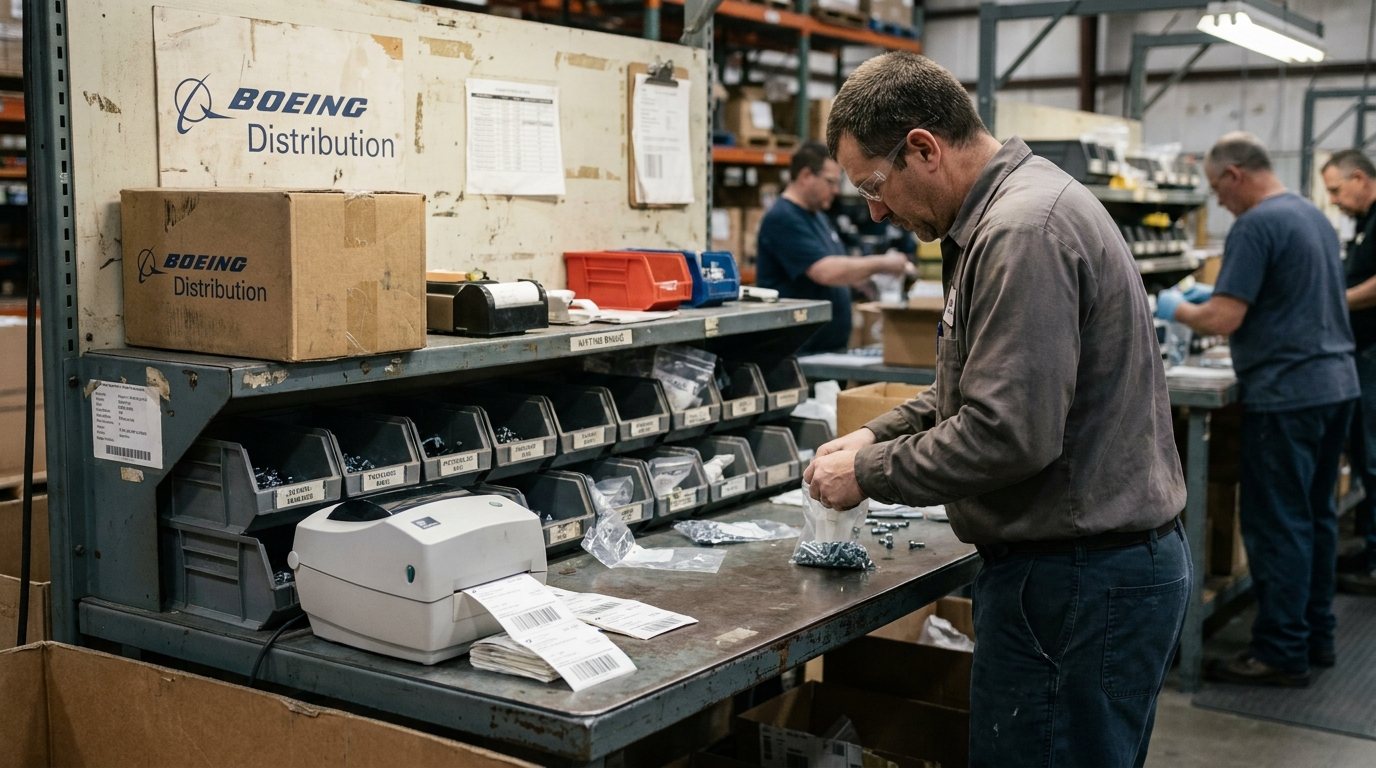
Part of Distributor Playbooks — strategy teardowns of every company on the MDM Top Distributors lists.
Boeing Distribution lands at #30 on Industrial Supply and #6 in Fasteners on MDM's 2026 Top Distributors lists, Modern Distribution Management's annual ranking of North America's largest distribution companies. That placement alone is unremarkable. What's unusual is who is standing behind the number: the company that builds the airplane also owns the channel that sells the parts to keep it flying.
A Dallas company built the model first
Boeing didn't invent this business. Aviall did. Founded from roots stretching back to 1932, Aviall grew into, by its own description at the time, "the largest independent provider of new aviation parts and related aftermarket services in the aerospace industry," running service centers across North America, Europe and Asia and distributing roughly 700,000 catalog items sourced from about 220 manufacturers, according to Boeing's 2006 acquisition announcement. Aviall's pitch to airlines and MROs wasn't manufacturing. It was inventory management: hold the batteries, hoses, wheels, brakes and paint that hundreds of suppliers made, and let operators call one number instead of two hundred.
Boeing bought that model outright. The deal closed September 20, 2006, at $48 a share, $1.7 billion in equity plus roughly $448 million in assumed debt, with Boeing framing it as a way to expand its Integrated Materials Management program inside a $25 billion aviation parts and services market. Aviall kept operating under its own name for over a decade, a wholly-owned subsidiary that looked, to most customers, like an independent parts house.
The bet that doubled it: KLX, 2018
Then Boeing did it again, bigger. In October 2018 it paid $4.25 billion for KLX Inc.'s Aerospace Solutions Group, its largest acquisition since McDonnell Douglas in 1997, according to reporting on the rebrand from Aviation Week. KLX brought a second, overlapping distribution network into the fold right as Boeing Global Services was chasing a target of $50 billion in services revenue within a decade. The company folded KLX into Aviall rather than running two parallel supply chains, and by 2019 parts distribution and integrated supply chain work were already a meaningful slice of Boeing Global Services' $18.5 billion in annual revenue.
Erasing two names to build one
What followed was less an acquisition story than an integration story, and it took three more years to finish. In February 2019, Boeing renamed KLX to Boeing Distribution Services Inc. In July 2019, Aviall's legal entity became Boeing Distribution Inc. By January 2020, Boeing announced it would retire the Aviall name entirely, telling the trade press the move would "streamline our presence along with our processes and operations." Then-Boeing Global Services CEO Ted Colbert pointed to synergies in used serviceable material and additive manufacturing that only made sense once the two networks reported to one balance sheet. A company built by two takeovers over 12 years spent the next three quietly making itself look like it had only ever been one.
The insight: the airframe maker owns its own aftermarket
Here's the part that doesn't show up on the About page. Look down the rest of the MDM fastener list and you find independents (Fastenal), family-controlled operators, and PE-consolidated roll-ups. Boeing Distribution is neither. It is a captive channel, wholly owned by the same company that designs the airplanes its parts go into, competing for third-party manufacturers' fastener and hardware volume against distributors that have no such conflict of interest.
That's a genuinely different model, and it cuts both ways. It gives Boeing Distribution something almost no independent competitor can match: guaranteed proximity to OEM engineering data, a captive base of Boeing operators who already have to buy Boeing-specified parts, and a parent with enough balance sheet to buy its way to scale twice in twelve years rather than grinding out branch openings one at a time. The trade-off is trust. Every non-Boeing fastener manufacturer that lists with Boeing Distribution is handing shelf space and customer data to a channel partner whose parent competes with them on the airframe side. It works because aerospace parts distribution runs on certification and traceability rather than brand loyalty, so a manufacturer's relationship with Boeing Distribution can stay commercially separate even while Boeing wears two hats in the same supply chain.
What "fasteners" actually means here
Boeing Distribution's #6 fastener ranking isn't about screws stamped with the Boeing logo. It's a hardware and standard-parts business, aerospace bolts, rivets, nuts, and consumable fastening products sourced from the same kind of multi-manufacturer catalog Aviall built decades ago, sold alongside the company's broader aerospace, defense and business-aviation parts lines. That's a materially different customer base than the industrial and MRO buyers who drive Fastenal or Würth's fastener revenue, which is part of why the same MDM report puts Boeing Distribution at #30 in the far larger Industrial Supply category rather than higher up either list.
Modernizing a business built by acquisition
The integration work hasn't stopped. Boeing Distribution spent the past year rolling out a new enterprise resource planning system to unify data across the combined businesses and, in November 2025, launched a single unified ecommerce platform replacing separate portals inherited from the Aviall and KLX eras, with AI-assisted part search and real-time inventory visibility across commercial, business aviation and defense customers. Distribution Strategy Group's analysis of the launch framed it plainly: distribution has stopped being a support function inside Boeing and become a strategic asset in its own right, nearly two decades after the company first decided to own the channel instead of just supplying it.
| Year | Event |
|---|---|
| 1932 | Aviall's predecessor roots begin in aviation parts |
| 2006 | Boeing acquires Aviall for $1.7B |
| 2018 | Boeing acquires KLX Aerospace for $4.25B |
| 2019 | KLX renamed BDSI; Aviall renamed BDI |
| 2020 | Aviall brand formally retired |
| 2025 | Unified ecommerce platform launches |
Distribution rarely gets the headline in aerospace, where the airplane gets all the attention. But somewhere behind every one of Boeing's deliveries is a catalog, a warehouse and a fastener bin that has to be right, and that quieter business has its own history worth knowing.