
Boise Cascade: The Lumber Giant That Sold Its Own Name
Boise Cascade ranks #9 on MDM's 2026 building-materials list. Its real story is a near-liquidation, a buyout, and a name it had to buy back.
Part of Distributor Playbooks — strategy teardowns of every company on the MDM Top Distributors lists.
Boise Cascade lands at #9 on Modern Distribution Management's 2026 Top Distributors list for building materials, the trade press's annual scorecard of North America's largest distribution companies. That ranking undersells how strange the company's path to that shelf position actually was. Twice in its history, Boise Cascade came close to not existing as an independent company at all, and the version trading on the NYSE today is, legally speaking, not the same corporation that built the name.
A merger that nearly diversified itself to death
The company was formed in 1957 when Cascade Lumber Company of Yakima, Washington merged with Boise Payette Lumber Company under CEO Robert Hansberger, according to Wikipedia's account of the company's history. It grew fast: more than 100 retail lumber outlets by the end of 1958, plus a new paper mill in Wallula, Washington the same year.
Then it grew in the wrong direction. Through the 1960s, Hansberger pushed Boise Cascade into concrete plants, textiles, motor homes, even cruise lines, chasing the conglomerate logic that was fashionable at the time. The stock rode that story to $77 a share by 1969. It was worth $15 two years later. Hansberger resigned in October 1972 with the shares near $11, and the company was reportedly close enough to the edge that liquidation was a live option.
What saved it was retreat, not innovation. Incoming CEO John Fery spent the next 15 years walking the diversification back, refocusing on building materials and paper and closing or selling every retail outlet by 1987. That decision, to become boring on purpose, is the first hinge point in the story: a company that had just been punished for spreading into cruise lines chose to double down on plywood and lumber instead of doubling down on growth-by-acquisition. It's the same discipline distributors are still relearning today whenever a hot adjacent category tempts them off their core line.
The buyout that made the name disappear, then come back
The stranger chapter came three decades later. In 2003, Boise Cascade Corporation acquired OfficeMax, the office-supply retailer. In 2004, Madison Dearborn Partners bought the original paper and forest-products business, the actual mills, lumber, and building-materials operations, out from under the parent for roughly $3.2 billion in assumed debt, spinning it into a new private company it named Boise Cascade LLC. The public shell that had done the OfficeMax deal kept going as OfficeMax Incorporated.
That is the detail worth sitting with: the Boise Cascade distributing building materials today is not a continuous descendant of the 1957 merger in the corporate sense. It is a 2004 private-equity carve-out that had to reassemble the original business under the original name after that name had been legally attached to an office-supply chain. Few companies on any MDM list have a founding story with this particular kink in it, and it rarely surfaces outside SEC filings, but it explains a certain conservatism in how the company has behaved since: sell timberland (1.6 million acres went in 2005), spin off what's left of paper as the publicly traded Boise Inc. in 2008 to pay down the buyout debt, and only then, on February 6, 2013, take the pared-down lumber-and-panels business public on the NYSE under the ticker BCC.
What came out the other side: a distributor with two jobs
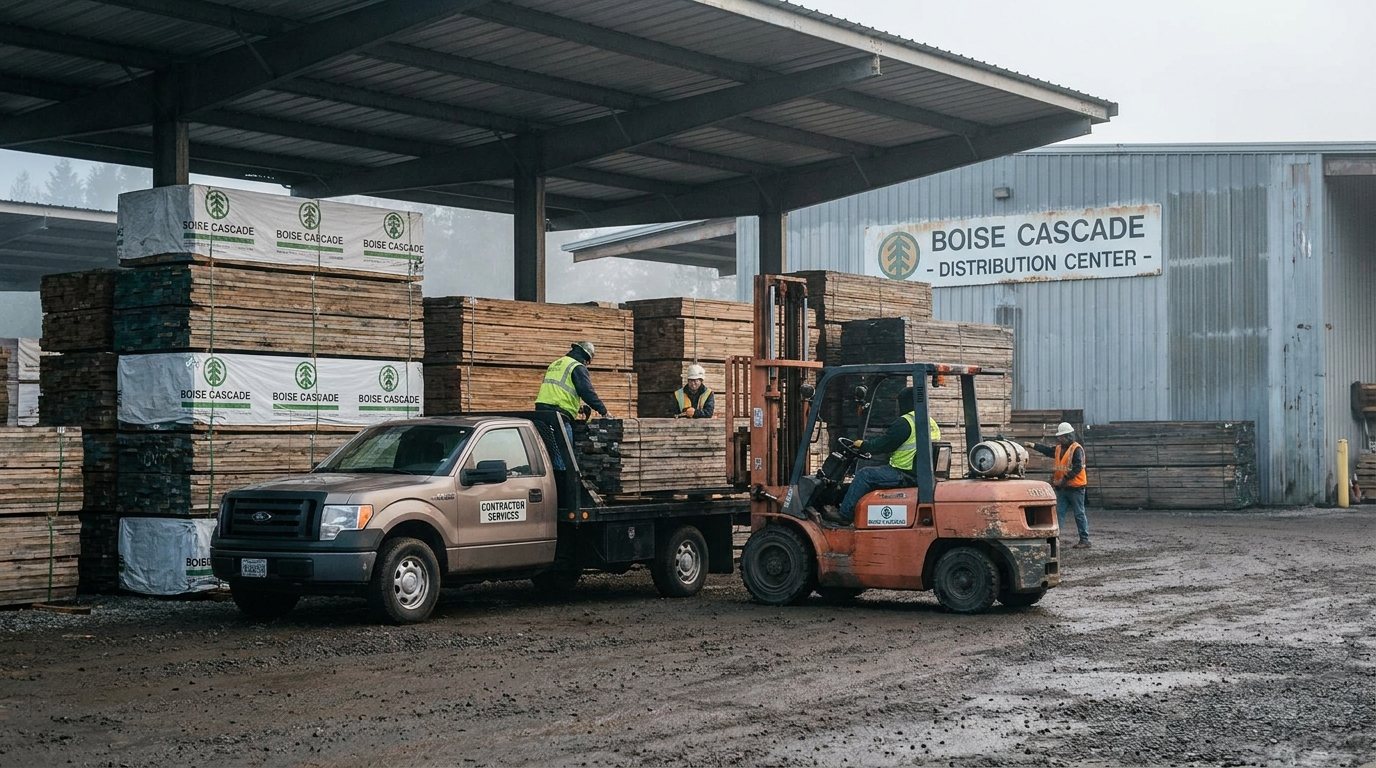
The company that emerged from that sequence runs two segments that depend on each other in an unusual way. Wood Products manufactures engineered lumber, structural panels and mass timber (AJS and BCI joists, Versa-Lam and Versa-Stud LVL, BOISE GLULAM) out of mills across the Pacific Northwest, the Southeast, and one in New Brunswick, Canada. Building Materials Distribution runs 35 branches nationwide moving that same output, alongside metal, cement, decking, doors and millwork sourced from other manufacturers, out to dealers, home centers and industrial accounts, per the company's own description of its business.
That second segment isn't just a captive sales arm for the first. If BMD only stocked Boise-manufactured EWP, dealers would source everything else, doors, cement, decking, elsewhere and give the whole relationship to a full-line competitor. So BMD has to behave like a genuinely neutral wholesaler, carrying other manufacturers' lines credibly enough to earn the general-line business, even while its parent's mills are the reason the division exists. That tension, between being a factory's outlet and being an honest broker for the rest of the aisle, is what turned a byproduct of vertical integration into the country's largest wholesale building-products distributor rather than just a shipping department.
The scale shows up in the numbers. Consolidated revenue came in at $6.40 billion for fiscal 2025, per company results reported through StockTitan, with roughly 6,000 employees across North America and Jeff Strom, a 20-year company veteran, installed as CEO in March 2026. Modern Distribution Management's 2026 report put the distribution business's fiscal 2025 revenue at $5.9 billion, good enough for ninth on the building-materials list.
The trade-off nobody puts on the résumé
Running the buyout-and-reclaim playbook left the company without a founding-family story or an old logo it's protected for a century, the kind of heritage that other distributors on the same MDM list use as brand shorthand with dealers. What it has instead is a demonstrated willingness to sell off nearly all of itself, twice, when the balance sheet demanded it, and to reassemble a leaner version each time. For a distributor, that history is arguably more useful to a dealer network than nostalgia: it says the company has already stress-tested what it's willing to give up to stay solvent, and the answer wasn't the branch network.
Distribution runs on unglamorous machinery, catalogs, branch networks, freight lanes, and the data that ties them together, and Boise Cascade's history is a reminder that even that machinery survives corporate near-death experiences when the underlying relationships are worth rebuilding around.