
CED: The Electrical Distributor That Won't Merge Its Names
CED ranks #5 among U.S. electrical distributors per MDM, yet runs 700-plus branches that still trade under the names of the companies it bought.
Part of Distributor Playbooks — strategy teardowns of every company on the MDM Top Distributors lists.
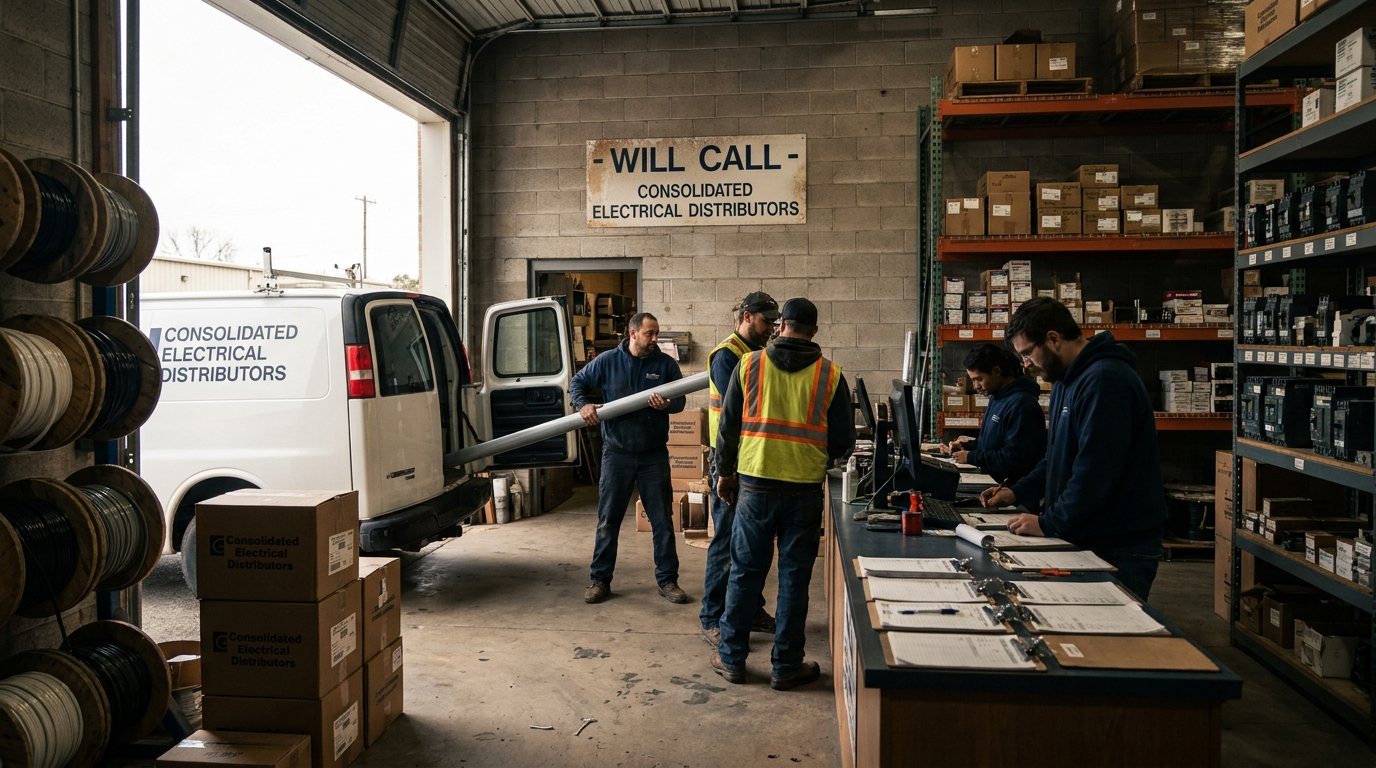
Walk into an electrical supply counter in Yorba Linda, another in Bay City, Michigan, and a third in Maryland Heights, Missouri, and you will read three different names painted on the door. Different counter staff, different customer relationships built over decades, different local reputations. All three checks eventually clear through the same company in Irving, Texas. That company, Consolidated Electrical Distributors, lands at #5 on Modern Distribution Management's 2026 Top Distributors list for the electrical vertical, a two-spot slide from #3 in 2025. Most contractors who buy from it every week have never heard the parent name. That is not an accident. It is the strategy.
A quiet giant with a loud history
CED traces its roots to 1957, when Richard Worthy started The Electric Corporation of San Francisco with two locations in California. The pivotal moment came in 1964, when Richard D. Colburn bought the company and renamed it Consolidated Electrical Distributors, according to CompaniesHistory.com's account. Colburn ran it until his death in 2004, at which point his son Keith took over. Kurt Lasher now serves as President and CEO, but the Colburn family has held the equity for six decades.
That single fact is the unique wrinkle in this story. CED now runs more than 700 locations across the country with roughly 7,500 employees and estimated 2024 revenue near $5.5 billion, per Forbes, good for roughly 3 percent of a $115 billion U.S. electrical distribution market. In a sector where the largest players are publicly traded multinationals (Sonepar is French-owned, WESCO trades on the NYSE) or private-equity roll-ups cycling toward an exit, CED is still a family-owned business answering to nobody but itself. Forbes lists it as a private company with no ticker and no shareholder deck to manage. That alone would be a mildly interesting footnote. What makes it a real strategic choice is what CED does with that independence: it uses it to let go of control at the branch level, on purpose.
The acquisition that doesn't consolidate
Most distribution roll-ups follow a familiar script. Buy the local company, fold it into the parent brand, standardize the systems, cut the overlap, move on. CED inverts that. When it acquires an independent distributor, the target typically keeps its name, its management team, and its customer relationships intact, operating as a semi-autonomous profit center inside the larger network rather than getting absorbed into a single corporate identity.
The pattern shows up acquisition after acquisition. Frost Electric Supply, a Maryland Heights lighting and industrial supply house founded in 1909, still trades as Frost. Parrish-Hare Electrical Supply's four Texas locations became a CED subsidiary rather than a rebrand. Bayou Electric, picked up in November 2024, kept its single-location identity. Recent history:
| Year | Acquisition |
|---|---|
| 2019 | Frost Electric Supply, Nu-Lite Electrical Wholesalers, Sun Valley Electric |
| 2021 | Wildcat Electric Supply |
| 2022 | Amperage Electrical Supply |
| 2024 | Parrish-Hare Electrical Supply, Bayou Electric |
None of these made headlines outside trade press, which is itself characteristic. CED does not chase the kind of splashy, press-released mega-merger that rivals use to signal scale to Wall Street. It has no Wall Street to signal to. It buys quietly, keeps the sign on the building, and lets the branch keep running the way its customers already trust.
Why the model works, and where it strains
The logic is straightforward once you see it: an electrical distributor's real asset is not warehouse square footage, it is the relationship between a counter person and a contractor who has been buying from that same face for fifteen years. Strip the local name off the door and you risk stripping the reason the contractor kept coming back. CED's decentralized structure treats each acquired branch as a going concern worth preserving rather than raw material to be processed into a single national brand.
That structure has a real cost, and it is worth naming plainly rather than papering over. Running 700-plus independently managed locations means CED inherits a patchwork of legacy systems, inconsistent digital ordering experiences, and fragmented product data across brands that were built by different owners with different habits long before CED bought them. A contractor who orders from a CED-owned branch in Texas and another in Michigan may find two entirely different web experiences, two different catalogs of attributes, two different ideas of what a complete product record looks like. Centralizing that without breaking the local relationships that make the model work in the first place is the genuine strategic tension sitting underneath CED's growth. Competitors who consolidated harder solved the data problem faster and paid for it in customer churn. CED solved the churn problem and is still working through the data problem.
The bet, stated plainly
CED's wager is that a loose federation of trusted local names, held together by shared buying power and a family that has stayed out of the way for sixty years, beats a single polished national brand. The MDM ranking says the bet has paid off at scale. The harder test, as the company adds branch after branch, is whether it can keep every one of those local names feeling as sharp and current as the day it was bought.
This is the fourth entry in Anglera's Distributor Playbooks series, a closer look at the operators who make the unglamorous plumbing of distribution, the branches, the catalogs, the data behind every part number, the actual competitive edge.