
Chewy: The Pet E-Commerce Bet Built From Pets.com's Wreckage
Chewy ranks #40 on NRF's Top 100 Retailers with $12.60B in 2025 U.S. sales. Here is how a hand-written note strategy beat the ghost of Pets.com.
Part of Retailer Playbooks — history-first profiles of every company on the NRF Top 100 Retailers list.
Chewy lands at #40 on NRF's Top 100 Retailers 2026 list, the National Retail Federation's annual ranking compiled with Kantar, with $12.60 billion in 2025 U.S. retail sales. That number belongs to a category most retail history books had already closed: online pet supplies, a business the dot-com crash supposedly proved impossible.
The ghost it had to walk past
In 2000, Pets.com became the crash's most famous casualty, a sock-puppet mascot burning through $300 million before the company folded inside two years. For the next decade, "online pet retailer" was shorthand for bad unit economics. Heavy bags of dog food are expensive to ship, margins are thin, and repeat purchases only pay off if a company can actually keep customers.
Ryan Cohen didn't ignore that history. He built directly against it. Cohen founded the company in June 2011 with Michael Day, reportedly after struggling to find supplies for his poodle, Tylee, and pulled on customer-service instincts from his father Ted's glassware import business, according to Wikipedia's account of Cohen's career. The original name was Mr. Chewy.
The idea sounded exactly like the thing that had just failed. Cohen pitched it to more than 100 venture capital firms. All of them passed. It took until 2013 for the first outside check to arrive, a $15 million investment from Volition Capital, per the same account.
What the rejected pitch actually contained
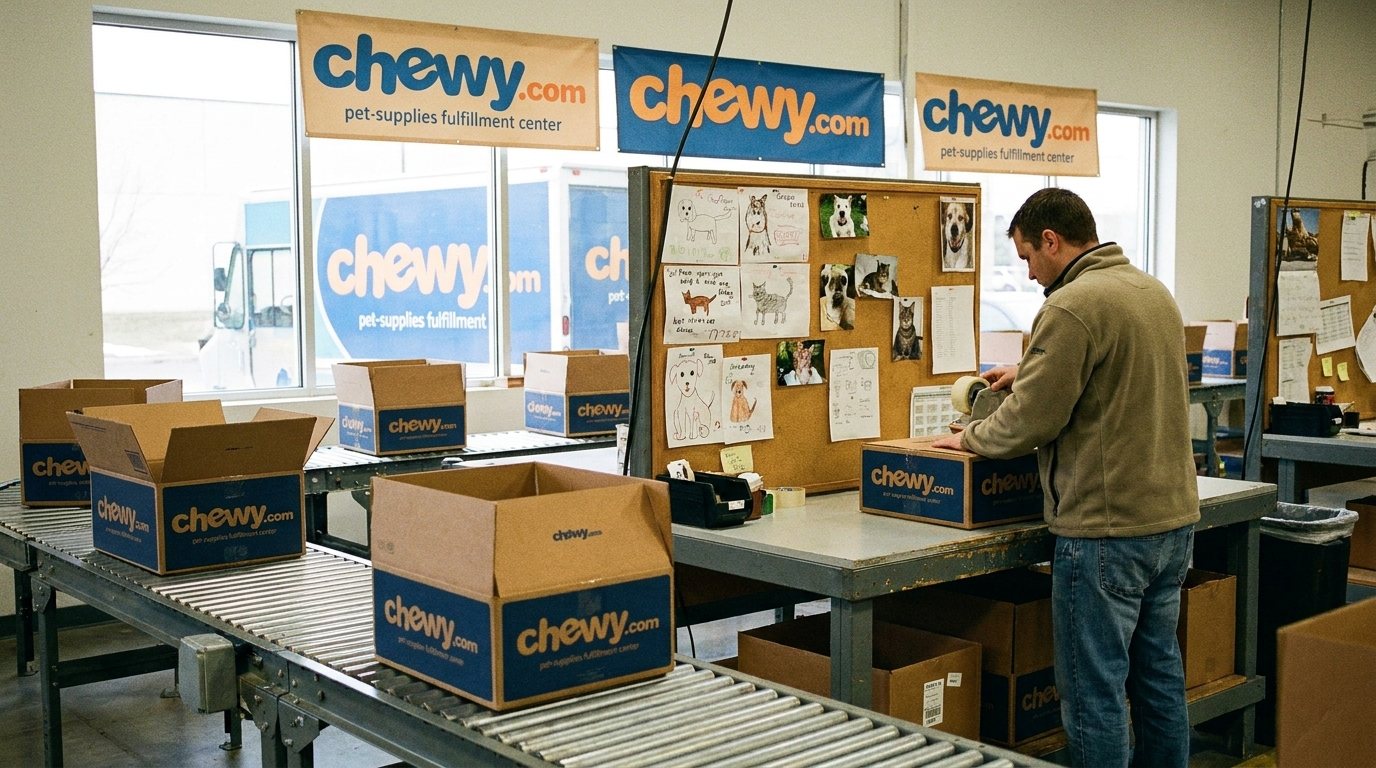
The bet under the bet was that Amazon-grade logistics could be paired with a kind of customer attention no logistics company bothers with: hand-written holiday cards, pet portraits mailed to customers, flowers sent when a pet died. Those gestures cost real money per order in a low-margin category, which is precisely why they were hard to copy. A competitor optimizing for efficiency would cut them first.
That's the piece worth naming plainly, because it's easy to miss if you only read Chewy's own framing: the company treated its highest-cost-per-unit behaviors as the moat, not the overhead to trim once it got big. Chewy's own about page still describes the goal as matching "e-commerce" scale with "the same high-touch, personalized service you should expect of the best local neighborhood pet store," in the words of CEO Sumit Singh. That line reads like marketing copy until you trace it back to a founder who was rejected 100 times for proposing exactly that trade-off.
It worked. By 2016, Chewy was the largest pet e-commerce retailer in the country, on roughly $900 million in annual sales, according to Wikipedia's summary of Cohen's tenure. By 2017, the company held around 51% of online pet food sales and had crossed $2 billion in revenue, per Wikipedia's company history.
The acquisition that looked like an ending
PetSmart bought Chewy for $3.35 billion in April 2017, at the time the largest e-commerce acquisition ever completed. Cohen stayed on as CEO of what remained a largely independent unit, and revenue kept climbing, from $2.1 billion to $3.5 billion between 2017 and 2018. Sumit Singh, who had joined as COO in 2017 after roles at Amazon and Dell, took over as CEO in March 2018. Cohen departed to, in his words, pursue personal goals, before his name resurfaced a few years later in a very different corner of the market as an activist investor.
Chewy went public on the NYSE in June 2019 under the ticker CHWY at $22 a share, posting $4.85 billion in 2019 net sales, a 40% jump partly fueled by the pandemic pull-forward in pet ownership.
A timeline of the pivotal bets
| Year | Move |
|---|---|
| 2011 | Founded as Mr. Chewy by Ryan Cohen and Michael Day |
| 2013 | First outside funding: $15M from Volition Capital, after 100+ VC rejections |
| 2017 | PetSmart acquires Chewy for $3.35B, then the largest e-commerce deal ever |
| 2019 | IPO on NYSE at $22/share under ticker CHWY |
| 2024 | Chewy Vet Care launches in-person veterinary clinics |
The part that's easy to overlook
Here's the detail that doesn't show up in Chewy's own materials but matters for anyone studying the company as a case study: Chewy has operated as a public company since 2019, but BC Partners, the private equity firm that acquired PetSmart in 2015 and thereby inherited Chewy, still controls roughly 80% of the shares and 98% of the voting power, per Wikipedia's company history. Chairman Raymond Svider represents that stake on Chewy's board. A retailer that trades daily on the NYSE and reports quarterly earnings is, structurally, still a controlled subsidiary of a leveraged buyout. That tension between public-market transparency and private-equity control is unusual enough to be worth naming outright, and it explains some of the capital discipline that shows up in Chewy's margin story without ever appearing in a press release.
The most recent chapter extends the original logic rather than abandoning it. Autoship subscriptions were already 66% of sales by 2018, and the company has since layered on pharmacy fulfillment, telehealth, pet insurance through CarePlus, and, starting in April 2024, in-person veterinary clinics under Chewy Vet Care. Fiscal 2024 net sales reached $11.86 billion. Each addition follows the same pattern set in 2011: find the part of pet ownership that's inconvenient, expensive, or emotionally loaded, and build the infrastructure to make it easy.
Every one of those additions rides on the same unglamorous machinery every retailer depends on: warehouses, catalogs, and the unglamorous data behind them that decides whether the right bag of food reaches the right doorstep on schedule.