
Petco: The Retailer That Went Public and Private Four Times
Petco ranks #79 on NRF's Top 100 Retailers 2026 with $5.77B in U.S. sales. Its real story: four public-private cycles that kept reinventing it.
Part of Retailer Playbooks — history-first profiles of every company on the NRF Top 100 Retailers list.
Petco lands at #79 on the NRF Top 100 Retailers 2026, the National Retail Federation's annual ranking compiled with Kantar, with $5.77 billion in 2025 U.S. retail sales. Most shoppers know it as the place with the fish wall and the vet clinic in the back. Fewer know that the company has been bought, sold, taken private, and re-listed on Wall Street more times than almost any other major American retailer, and that each cycle of ownership churn happens to line up with a real reinvention of what Petco actually sells.
A mail-order business that outlasted the supermarket aisle
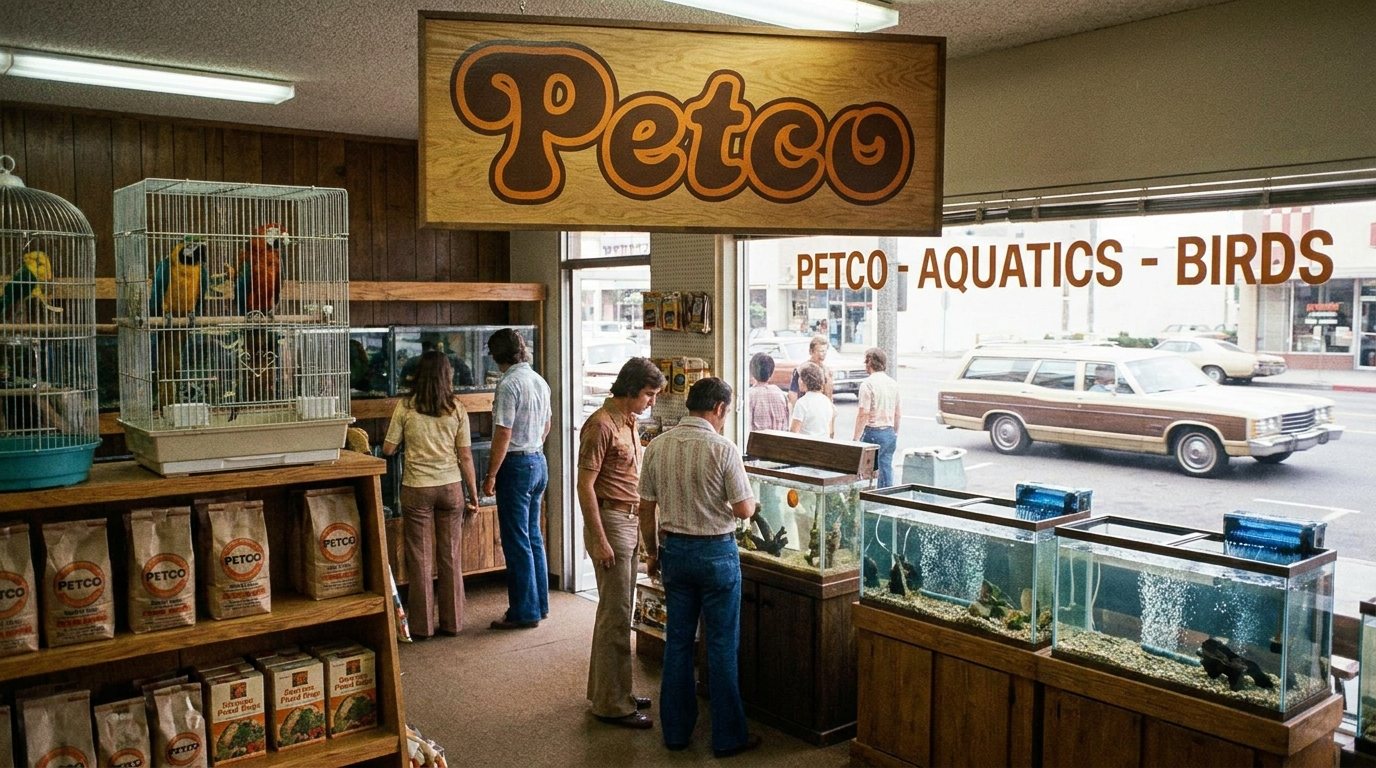
Petco started in 1965 as a mail-order veterinary supply operation in San Diego County, founded by Walter Evans and a handful of associates selling supplies to vets and breeders rather than pet owners. It opened its first retail storefront in La Mesa, California in 1976, then rebranded as Petco in 1979, with the first store carrying the new name opening in Tigard, Oregon in 1980, according to Wikipedia's history of the company.
For most of its first three decades, Petco was one of hundreds of regional pet shops fighting for shelf space against supermarkets, which controlled roughly 95 percent of pet food sales through mass brands like Purina, Alpo, and Kal Kan, per FundingUniverse's company history. The business that would eventually anchor a downtown ballpark was, for a long time, a niche mail-order supplier competing against grocery store end-caps.
The superstore war nobody remembers Petco winning differently
The pivot came from premium pet food. When brands like IAMS, Science Diet, and Nutro launched in the 1980s offering visibly better nutrition, supermarkets couldn't stock them, specialty pet retailers could. By the mid-1990s, supermarket pet food share had collapsed from 95 percent to roughly 50 percent, and Petco was positioned to take the difference.
Brian Devine, who joined Petco in 1990 after 18 years in Toys "R" Us leadership, pushed the company into the superstore format: 15,000-square-foot stores stocking 10,000-plus SKUs, up from the old 3,500-square-foot neighborhood shops. By 1993, superstores outnumbered traditional Petco locations for the first time. But Devine deliberately didn't copy the era's other pet superstore chain, PETsMART, which built 26,000-square-foot boxes in suburban power centers chasing mass-market volume. Petco instead planted smaller, denser stores in upscale neighborhood shopping centers, chasing what Devine called "the specialty retail customer." Two companies invented the same category at the same moment and picked opposite real estate strategies to do it, per FundingUniverse.
The 1998 crash the growth story skips
Petco's first IPO landed in March 1994, and the company used the capital to go on an acquisition tear, nearly 20 chains absorbed through the mid-1990s, 104 stores added in 1997 alone including the 81-store PetCare chain. The stock topped $30 a share by late 1997.
Then integration caught up with ambition. By 1998, Petco's stock had collapsed to around $5, first-half losses topped $8 million, and the company was facing three shareholder class-action lawsuits alleging securities violations, according to FundingUniverse. Management's response, starting in 1999, was to stop buying chains and go back to building stores organically, trading growth-by-acquisition for growth-by-discipline. It's the kind of hard chapter a retailer's own About page tends to skip, but it's also the chapter that taught Petco the lesson its next twenty years would run on: expansion without integration is just debt with extra steps.
The unique pattern: Petco treats capital markets like a rotating door
Here's the thing that doesn't show up in any single history of Petco, only when you line up the whole timeline: this company has gone public, then private, then public, then private, then public again, four separate ownership cycles in under thirty years, more churn than almost any other retailer of its scale.
| Year | Event |
|---|---|
| 1994 | First IPO on NASDAQ (PETC) |
| 2000 | Taken private by Leonard Green & Partners and TPG for $600M |
| 2002 | Second IPO on NASDAQ (PETC) |
| 2006 | Taken private again by Leonard Green and TPG for $1.8B |
| 2016 | Bought by CVC Capital Partners and CPPIB for ~$4.6B |
| 2021 | Third IPO on NASDAQ, new ticker WOOF, renamed Petco Health and Wellness Company |
Private equity firms recycle retailers all the time. What's rarer is what Petco actually did with each turn of the wheel: every cycle funded a distinct reinvention, not just a balance sheet reshuffle. The 1994 IPO paid for the superstore rollout. The 2016 buyout and 2021 relisting paid for a pivot from pet supply store to pet health company, in-store veterinary clinics (105 of them by 2021), the Vital Care subscription service, the 2015 purchase of online retailer Drs. Foster and Smith, and a cleanup of the product assortment that banned shock collars in 2020 and stripped artificial ingredients from private-label food in 2018, per Wikipedia. Each new owner didn't just refinance the company. They picked a new business for it to be.
Ownership as strategy, not just structure
Petco also leaned on brand infrastructure that had nothing to do with store count. It bought the naming rights to San Diego's downtown ballpark for $60 million over 22 years in 2004, then extended the deal through at least 2027 in 2021 with a Padres-player pet-wellness campaign woven in, according to Wikipedia's entry on Petco Park. A stadium name is a strange thing for a company mid-reinvention to invest in, unless you understand that Petco has always used big, visible bets to signal what era it's entering next.
The most recent chapter has been rockier: reports in 2023 flagged the company approaching credit stress, CEO Ron Coughlin departed in March 2024, and Joel Anderson, formerly CEO of Five Below and a longtime Walmart executive, took over that September to steady the business. Whether this becomes cycle five of the public-private relay or the first stretch where Petco just holds still is the open question for anyone watching the ticker.
Every era of Petco's business, mail order, superstore, veterinary chain, subscription health platform, still runs on the same unglamorous plumbing: knowing exactly what's on the shelf, what's in the warehouse, and what's true about every SKU in between.