
PetSmart: The Warehouse Chain That Bought Its Own Disruptor
PetSmart ranks #56 on NRF's Top 100 with $7.81B in 2025 U.S. retail sales. Its real story is a founder ouster, a near-death 1997, and buying Chewy outright.
Part of Retailer Playbooks — history-first profiles of every company on the NRF Top 100 Retailers list.
PetSmart lands at #56 on the National Retail Federation's Top 100 Retailers 2026 list, with $7.81 billion in 2025 U.S. retail sales. The number undersells the company. PetSmart did not just sell pet food at scale. It invented the pet superstore, nearly killed itself twice, and then made one of the strangest acquisitions in modern retail: buying the company built to put it out of business.
A warehouse with no name recognition
Jim and Janice Dougherty opened the first two Pet Food Warehouse stores in Phoenix in 1987, backed by roughly $1 million in startup capital that included money from Phillips-Van Heusen Corporation, the shirtmaker. The pitch was simple and unglamorous: bulk pet food at discount prices, sold out of a stripped-down warehouse box, the same formula Price Club and Sam's Club were proving worked for groceries and general merchandise. By 1988 the chain had grown to seven stores across Arizona, Colorado, and Texas. It was also losing money, according to the company history compiled by Funding Universe.
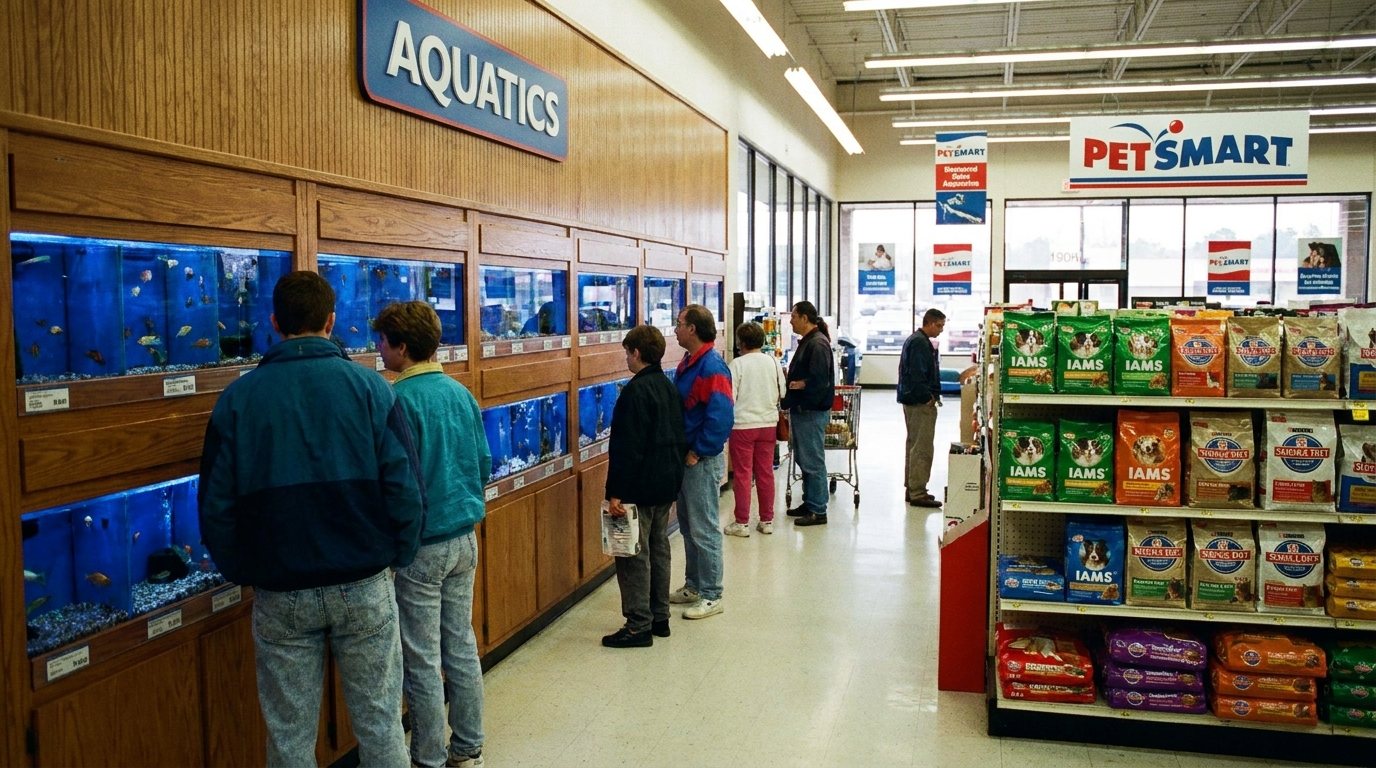
In 1989, with the company $1.8 million in the hole, the board did what boards do to founders who cannot fix what they started: it removed Jim and Janice Dougherty, kept them on briefly as consultants, and installed Samuel J. Parker, a 19-year veteran of Jewel supermarkets. Parker ripped out the warehouse aesthetic. He put in tile floors, wider aisles, and real lighting. He pushed the assortment past 7,500 items and added grooming and adoption programs. The results were immediate: 12 stores by the end of 1989, 29 by 1990, 48 by 1991, with sales climbing from $15.9 million to $58.2 million in that stretch, according to Funding Universe. PETsMART, as it rebranded, went public on NASDAQ in July 1993 on the back of its first profitable year.
Buying the competition, then almost drowning
Parker's PETsMART spent the mid-1990s buying nearly everyone in its path: Pet Food & Supply in 1993, the 31-store PetZazz chain for $81.3 million in 1994, and rival Petstuff's 56 superstores in 1995, per Funding Universe. It also pushed overseas, acquiring the UK's Pet City chain in 1996. That deal, along with acquisition costs and a botched merchandising system rollout, produced a $34.4 million net loss in 1997. The stock collapsed. The board adopted a poison-pill defense in August of that year, and Parker returned as CEO to stop the bleeding, according to Wikipedia's account.
Philip Francis took over as CEO in 1998 and ran what the company literally called a "back to basics" program: retrain employees, fix inventory, rebuild customer trust before chasing growth again. It worked. PETsMART opened its 500th store in 1999, launched PETsMART.com that June, and by 2000 was running nearly 530 stores across the U.S. and Canada on $2.2 billion in sales, even as it quietly shed the failed UK operation. In 2005 the company dropped the stylized capitalization and became simply PetSmart, rebuilding its marketing around the idea of the "pet parent," a framing that treated pet ownership as something closer to family life than a shopping category.
Services as the moat online could not cross
The detail that made PetSmart durable through two decades of e-commerce disruption is the one least visible in a sales figure: it stopped competing purely on merchandise and started competing on things a warehouse cannot ship. Grooming arrived in 1989. In-store veterinary clinics, launched under the VetSmart name and later rebranded through the Banfield Pet Hospital partnership, put a licensed vet inside the retail footprint. PetsHotel boarding and Doggie Day Camp followed. None of that shows up on Amazon's product page. It is the part of the business that requires a physical store, a trained staff, and a customer who is willing to drive there, which is exactly the part a pure online competitor cannot replicate no matter how fast its shipping gets.
Buying the company built to kill it
By 2015, PetSmart itself became the acquisition target: a consortium led by BC Partners took the company private in an $8.7 billion leveraged buyout, the largest private equity retail deal on record at the time. Two years later, PetSmart made the acquisition that defines its modern story. Ryan Cohen had built Chewy from a 2011 startup into an online pet retailer doing roughly $2 billion in revenue, capturing more than half of U.S. online pet food sales. Both PetSmart and rival Petco courted Chewy for a merger. Cohen chose PetSmart's all-cash offer specifically because it let Chewy keep operating as a separate business, according to Wikipedia's history of Chewy. PetSmart paid $3.35 billion in 2017, at the time the largest acquisition of an e-commerce company ever recorded.
Here is the part that rarely makes it into a retail retrospective: PetSmart did not buy Chewy to fold it into its own operations. It bought Chewy, left it alone under its own management, and let it run as an independent growth engine while loading the parent company with the debt to pay for it. Chewy went public in 2019 under ticker CHWY, and the two companies formally separated in 2020. The retailer that once out-competed its rivals by consolidating them onto its own shelves ended up growing its most valuable modern asset by deliberately keeping it off those shelves. That is the unusual maneuver worth naming plainly: PetSmart's biggest strategic win of the last decade was not a store format or a merchandising bet. It was recognizing that the disruptor was worth more intact than absorbed, and structuring the deal to prove it.
Today PetSmart operates well over 1,600 stores across North America under CEO Ken C. Hicks, still owned by BC Partners, competing in a category it effectively created almost 40 years ago against the company it once owned outright.
Every retailer in this series eventually runs into the same unglamorous truth: the winners are the ones who figured out, ahead of everyone else, how to move goods and information at a scale their category had never seen. PetSmart's version of that lesson came wrapped in a leash aisle and a leveraged buyout.