
How City Electric Supply Grew by Cloning Branches, Not Buying Rivals
City Electric Supply ranks #8 among U.S. electrical distributors on MDM's 2026 list, built almost entirely through organic branch openings, not acquisitions.
Part of Distributor Playbooks — strategy teardowns of every company on the MDM Top Distributors lists.
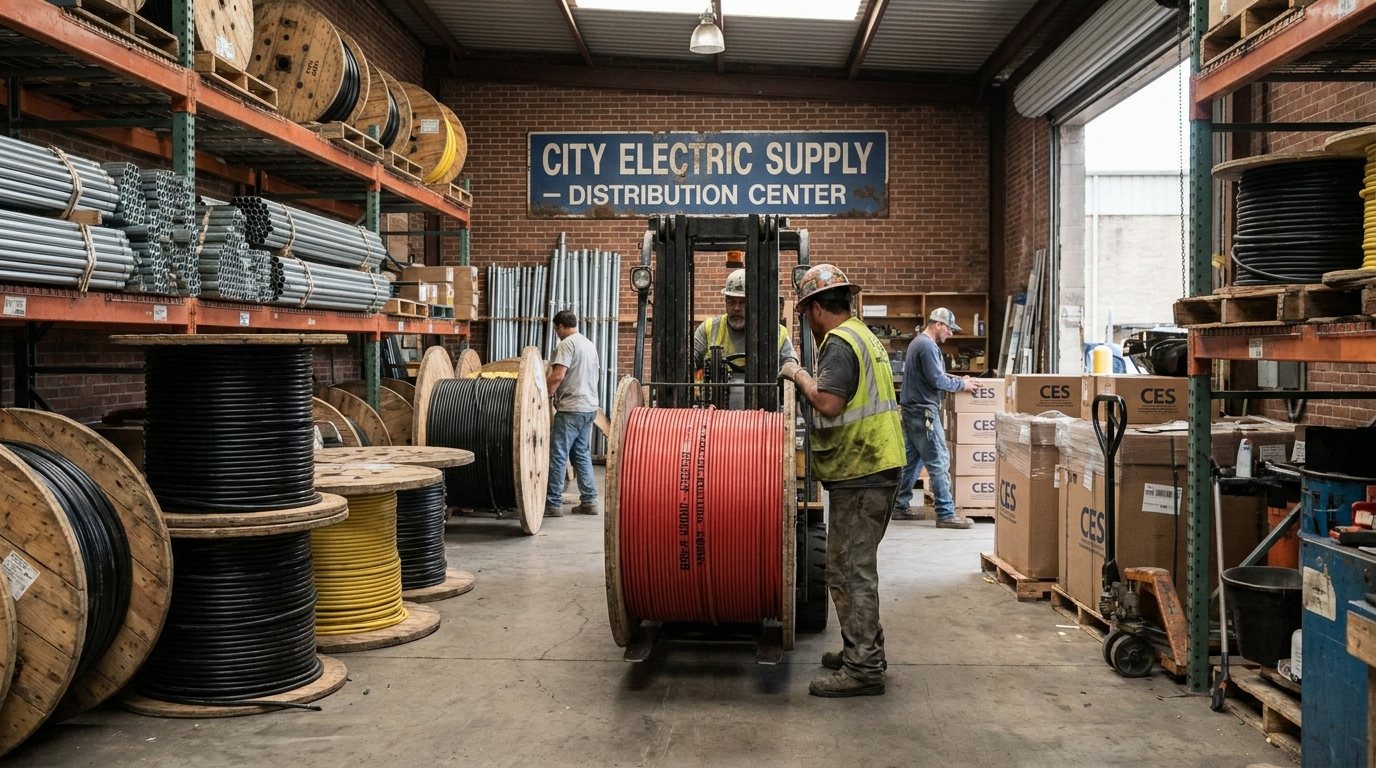
City Electric Supply sits at #8 on Modern Distribution Management's 2026 Top Distributors list for electrical, a category dominated by public giants and private-equity roll-ups. CES is neither. It is a third-generation family business that has spent seven decades scaling the same way it started: one branch at a time, opened rather than bought.
That distinction matters more than it sounds. Electrical distribution has consolidated hard over the past two decades, with large players growing chiefly by acquiring smaller regional wholesalers and folding them into a common ERP and buying group. CES took the opposite path, and its position in the top ten of its category despite that choice is the story worth examining.
A wholesaler bought in Coventry, 1951
The company traces to 1951, when Tom Mackie, a British RAF veteran, took over a small electrical wholesale business in Coventry, England, and began expanding it into a chain under the name City Electrical Factors, or CEF, according to Wikipedia's account of the company. CEF grew into the dominant electrical wholesaler in the UK over the following three decades, a position it still holds with a network approaching 400 branches there today, per City Electric Supply Australia's company history.
The pivotal bet came in 1983, when the Mackie family took the branch model across the Atlantic and launched City Electric Supply in the United States, as detailed by SlashGear's explainer on the relationship between the two companies. CES and CEF have operated as sibling companies ever since: same family, same operating playbook, separate legal entities tuned to their own regulatory and supply markets. CES later carried the model to Australia in 2007 and now runs branches in Canada, Ireland, Spain and Gibraltar as well.
Scale without a shopping list
Here is the part that stands apart from the rest of the vertical. Most large electrical distributors, from national players to regional consolidators, have used acquisition as their primary growth lever for years, buying up independent wholesalers to add branch density and category depth quickly. Nothing in CES's public record, trade coverage, or company history suggests it has followed that path. Instead it has grown to more than 650 branch locations across 31 U.S. states and Puerto Rico, and to over 1,400 branches worldwide, according to the company's LinkedIn profile and the CES Australia history page, largely by replicating a standard branch format in new territory after new territory.
That is a slower way to grow than buying a competitor's book of customers and staff overnight. It is also a more controllable one. Every branch opens with the same layout logic, the same supplier relationships, and the same reporting lines back to a single ownership structure, rather than inheriting a patchwork of legacy systems and cultures from an acquired company. The tradeoff is real: organic branch-building caps how fast CES can enter a market compared with a rival writing a check for an incumbent, and it means CES has had to build density county by county rather than buying it wholesale. For a company competing against roll-ups with acquisition war chests, staying in the top ten nationally on that model alone is the notable fact.
Family ownership in a sector that consolidated around it
CES is now led by Thomas Hartland-Mackie, grandson of founder Tom Mackie, who serves across both the U.S. and UK businesses, with MDM's own company profile listing him as President and CEO of City Electric Supply specifically. The company describes itself as third-generation family-owned, a detail confirmed on its LinkedIn page alongside a headcount of more than 4,500 employees.
That ownership structure is the quieter half of the same insight. While competitors across electrical, and distribution more broadly, have spent the last twenty years selling to private equity, going public, or getting absorbed into larger platforms, CES has stayed a private, family-controlled operator through three generations of leadership. The branch-cloning growth model and the family ownership reinforce each other: a company answering to a family's multi-generation horizon, rather than to a fund with a five-to-seven-year hold, can afford to grow store by store instead of chasing the faster, messier math of a roll-up. It is a bet that patience compounds, and the MDM ranking suggests it has, so far, been right.
The culture underneath the branch count
The operating detail that shows up consistently in company materials is an internal promotion culture: senior leadership across CES and CEF is described as built almost entirely from people who started in branch-level roles, with performance-based incentives tied to branch results. That matters because a branch-cloning strategy only works if there is a reliable pipeline of people who can run a new branch the same way the last one was run. CES appears to have built that pipeline as deliberately as it built the branch count.
Where this leaves the vertical
Electrical distribution rewards two very different playbooks: buy the density or build it. Sonepar, Rexel, and the merged WESCO-Anixter platform have largely chosen the former. City Electric Supply, still answering to the family that started it in a single Coventry storefront in 1951, has chosen the latter, and a top-ten spot on MDM's 2026 electrical list says the slower path still scales.
Distribution's biggest strategic choices rarely show up in a press release. They show up in how a company decides to open its six-hundredth branch, and whether its catalog and pricing hold together when it does.