
Colonial Electric Supply: The Distributor That Restarted Itself
How Colonial Electric Supply, No. 35 on MDM's 2026 electrical list, rebuilt itself from a dead company and stayed family-owned through two near-misses.
Part of Distributor Playbooks — strategy teardowns of every company on the MDM Top Distributors lists.
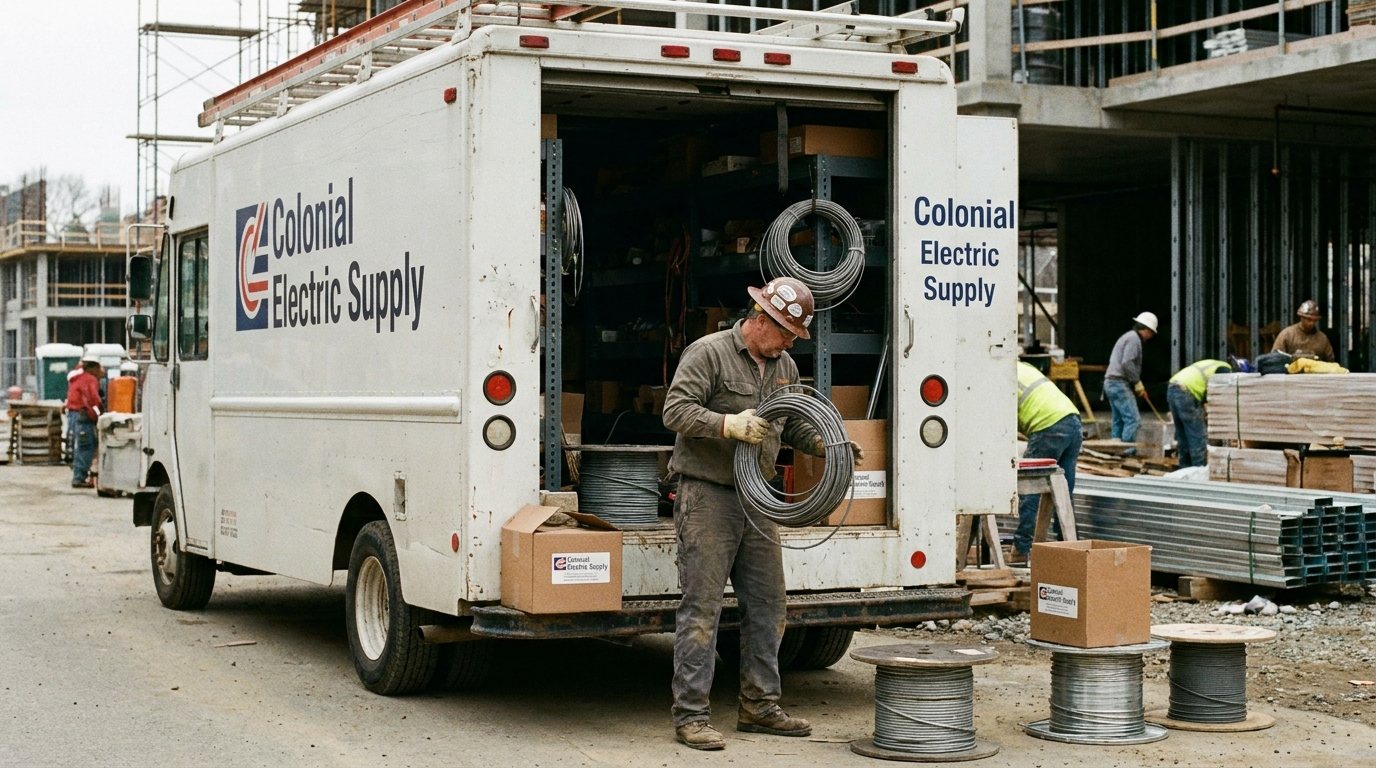
Modern Distribution Management placed Colonial Electric Supply at No. 35 on its 2026 Top Distributors list for the electrical vertical, a ranking earned by a company whose own name is older than its own continuity. The Colonial Electric that exists today, headquartered in King of Prussia, Pennsylvania, is not the direct descendant of the Colonial Electric founded in Philadelphia in 1917. It is a second act, built by a former employee who bought the wreckage and started over. That gap between name and lineage is the real story, and it explains why Colonial remains one of a dwindling number of large, independent, family-run distributors in a vertical that has otherwise been rolled up by strategics and private equity.
The first Colonial died in 1970
The original Colonial Electric opened at 10th and Vine in center-city Philadelphia in 1917, an industrial electrical distributor serving the city through two world wars and the growth of American manufacturing. It closed in 1970 for the most ordinary reason a family business fails: the founding family's heirs lost interest and walked away. No scandal, no bankruptcy filing, just a business that had outlived the family's appetite to run it.
A salesman buys back a corpse
Two years later, Joe Bellwoar, who had been the original company's top salesman, restarted the business under a near-identical name, appending the word "Supply" to distinguish the relaunch. Banks would not extend him credit for a company with a dead predecessor and no assets, so he borrowed personally from his father, his attorney brother, and a customer at Scott Paper Company. In 1976 he moved the operation to King of Prussia, mostly to shorten his own commute. The timing turned out to be strategic rather than lucky: King of Prussia grew into one of Philadelphia's largest suburbs, sitting at the junction of three interstates, which is close to the ideal footprint for a regional distributor running overnight delivery.
The near-sale that didn't happen
The pivotal moment came in the 1990s, during the first wave of consolidation that thinned out independent electrical distribution nationally. A health scare put Joe Bellwoar's ownership in question, and a sale to a national competitor was on the table. Instead, his nephew Peter and his three sons, Jay, David, and Steven, arranged financing and made a counter-offer, buying majority control themselves rather than letting the business pass to an acquirer. That decision, made under real financial pressure and not from a position of strength, is the hinge the rest of Colonial's history swings on.
The insight: independence chosen twice, not inherited once
Most distribution histories describe a company founded once and defended ever since. Colonial's arc is different, and it is worth stating plainly: this business has had to choose independence over an exit at least twice, first when Bellwoar rebuilt it from nothing in 1972, and again in the 1990s when the family bought out a looming sale rather than accept one. In a sector where Sonepar, Rexel, and WESCO (absorbing Anixter along the way) have spent two decades consolidating regional players, staying private and family-run is not a default state Colonial slipped into. It is a decision the family has re-made under duress, more than once, when selling would have been the easier and arguably more lucrative path.
How the model runs today
Colonial now operates through four divisions rather than one storefront: the core electrical supply business, Colonial Teltek for outside-plant and telecom connectivity, Colonial Major Projects for large commercial jobs, and Bright Light–Annapolis Lighting for retail lighting design. Company materials describe dozens of stocking branches and lighting design centers concentrated in Pennsylvania, New Jersey, New York, Maryland, and Delaware, with shipping reach into nearly every state, backed by more than $25 million in on-hand inventory and a 24/7 customer service center.
Scale is the honest limit of the family-owned model, and Colonial's answer to it is membership in IMARK Electrical, an independent distributor buying group that won the company its Purchasing Power award for 2022–2023. Buying groups exist precisely so that independents can approximate the purchasing leverage of a Sonepar or Rexel without merging into one. In 2023 Colonial also outsourced its EDI operations to IDEA Exchange Managed Services, citing industry-wide staffing shortages in electronic data interchange. VP of Systems Paul Waters said the appeal was a team that "understands our business and knows our trading partners," a small but telling admission that even a century-old distributor now rents out pieces of its back-office data infrastructure rather than staffing it in-house. Those unglamorous systems, EDI, catalogs, order accuracy, matter more to a distributor's survival than most of its marketing ever will.
A third succession, already underway
In June 2025, trade press covering the company reported that Colonial is actively preparing its next generation, naming Kevin, Riley, Patrick, Griffin, and Joe Bellwoar as family members being brought into the business alongside current owners Jay, David, and Steven. That makes succession planning, not acquisition or geographic expansion, the strategic story Colonial itself chose to put in front of the industry in 2025. For a company that has already had to rescue itself from closure once and from a forced sale once, treating the next handoff as a deliberate, multi-year process rather than an emergency is itself a change in posture.
The trade-off that doesn't go away
Family control has a cost that buying groups and outsourced EDI can blunt but not erase. Every generation has to actively choose reinvestment over a payout, and the temptation to sell into a strategic's premium only grows as national consolidators get larger. Colonial's bet, repeated across three generations now, is that continuity and culture are worth more than whatever a Sonepar or WESCO would pay for the branches and the customer list. Nothing about that bet is guaranteed to survive a fourth generation that didn't live through the 1970 shutdown or the 1990s buyout. So far, it has held.
Every distributor on lists like MDM's is really a bet on unglamorous infrastructure, held together over decades: the branch network, the line card, the data behind both, and the people willing to keep rebuilding it when it breaks.