
Crescent Electric: The Distributor That Never Renames What It Buys
Crescent Electric ranks No. 13 on MDM's 2026 electrical distributor list. Its real strategy: buy strong regional players and keep their names.
Part of Distributor Playbooks — strategy teardowns of every company on the MDM Top Distributors lists.
Crescent Electric Supply Company lands at No. 13 on the electrical vertical of MDM's 2026 Top Distributors, Modern Distribution Management's annual accounting of North America's largest wholesale distributors. It is a family-owned business that has now run for more than a century out of a small city on the Illinois-Iowa border, and in 2025 it did something it had never done before: hired a CEO from outside the company, outside the family, and outside electrical distribution entirely.
A century-old business that still answers to a family
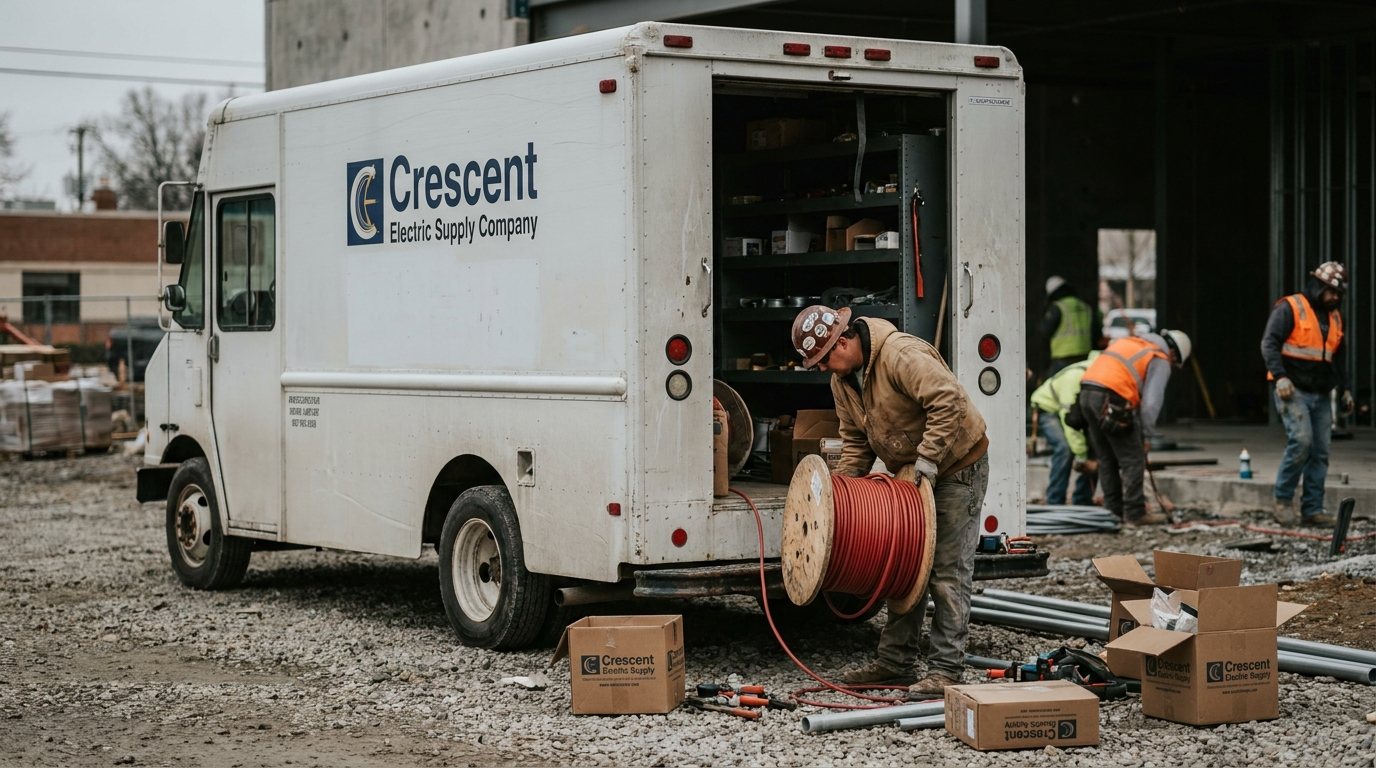
Crescent was founded on April 15, 1919, in Dubuque, Iowa, by electrical contractor Titus B. Schmid, who reportedly started the company to give local contractors faster access to inventory than the distant suppliers of the era could offer. The company later moved its headquarters across the river to East Dubuque, Illinois, where it still sits today. Over more than 100 years it grew into one of the largest independent electrical distributors in the country, operating more than 140 branches across 28 states according to Crescent's own company overview, while remaining privately controlled rather than selling to a strategic acquirer or private equity.
That matters because the top of the electrical distribution vertical is not full of companies like Crescent. It is a scale business dominated by publicly traded and globally owned giants. A century-old, family-controlled independent competing at that altitude is the exception, not the rule, and it is worth naming as the thing that makes Crescent's story different from most of the peer set on the MDM list.
The insight: it buys distributors and leaves them alone
The clearest evidence of how Crescent actually operates shows up in its acquisition history. When Crescent agreed to buy Spokane-based Stoneway Electric Supply in 2012, then-CEO Marty Burbridge told the trade press that "Stoneway will continue to operate under the Stoneway name and brand with the same employees, leadership team, suppliers and customers," according to Crescent's press release archive. Stoneway had been founded in 1974, ran 16 branches across Washington, Idaho and Oregon, and did about $130 million in sales the year before the deal closed.
That was not a one-off courtesy quote. As of Crescent's 2025 leadership announcement, the company describes itself as operating eight regional brands, among them BA Supply, Interstate Electric Supply and Stoneway Electric, more than a decade after the Stoneway deal closed. A distributor that had simply wanted the customer list and the branch leases would have folded Stoneway into the Crescent name years ago. Instead Crescent runs what amounts to a holding structure: a house of regional brands with local reputations, local sales relationships and local names, sitting on one balance sheet and one back office.
That is the strategic choice worth naming plainly. Most roll-ups in distribution eventually consolidate everything under a single national identity, because a unified brand is cheaper to market and easier to explain to Wall Street. Crescent has had over a decade of chances to do that with Stoneway alone and has not taken it. The bet is that a contractor in Spokane trusts "Stoneway" more than "Crescent," and that the trust is worth more than the marketing efficiency of erasing it.
Then, in 2025, the first outsider at the top
For 106 years Crescent's leadership came from inside the company or inside the family orbit. That changed on October 1, 2025, when Penny Cotner became president and CEO, following the departure of predecessor Scott Teerlinck (who left for electrical manufacturer Atkore) and an interim stretch led by Kristi Dahlke. Cotner spent 12 years at Infinite Electronics, the last seven as its CEO, and before that held roles at Arrow Electronics and on NASA's International Space Station program. Board chair Mike Sullivan called her "a growth-minded leader whose experience, vision, and operational discipline will guide Crescent through its next chapter of growth," per the same company release. Cotner, notably, described Crescent in her own remarks as "a respected family-owned company," confirming the ownership structure has not changed even as the leadership chair has.
The tension is worth sitting with rather than smoothing over. Cotner's background is in electronic components distribution, a business with its own logic around SKUs, sourcing and channel management, not the branch-and-truck world of conduit, wire and switchgear that Crescent's contractor customers live in. The board is betting that operational discipline transfers across verticals faster than industry-specific knowledge can be taught. That bet could look prescient in three years, or it could be the moment a family board learns the hard way that distribution is a business of relationships as much as process. Crescent has also kept promoting from within elsewhere: two internal executives, Ryan Micheletto and Justin Hall, were elevated to national vice president roles in March 2026, suggesting the company is layering outside leadership on top of an internal bench rather than replacing it.
What the model is actually protecting
Put the two threads together and Crescent's strategy reads less like nostalgia and more like a hedge. The multi-brand structure protects the local trust that took Stoneway, BA Supply and the rest decades to build. The 2025 CEO hire protects the parent company's operating discipline as it competes against distributors many times its size. Both moves say the same thing: Crescent is trying to stay independent and family-owned by getting better at the parts of the business that scale, so it never has to trade away the parts that don't.
Every branch in that network runs on a catalog, and every catalog runs on data that has to be right before a truck ever leaves the yard. That unglamorous layer is where distribution strategy actually gets tested, long before it shows up on an MDM ranking.