
How Ellsworth Adhesives Wins by Selling Its Rivals' Products
Ellsworth Adhesives made MDM's 2026 Specialty Adhesives list by refusing to pick a chemistry side, stocking 50+ competing adhesive brands under one roof.
Part of Distributor Playbooks — strategy teardowns of every company on the MDM Top Distributors lists.
Ellsworth Adhesives shows up in the Specialty Adhesives category of Modern Distribution Management's 2026 Top Distributors list, the trade publication's annual ranking of North America's largest wholesale distributors. MDM did not disclose the Germantown, Wisconsin company's 2025 revenue, which is itself a small data point about a business that has stayed private and unusually quiet for a company that calls itself the world's largest distributor of adhesive products. The more interesting fact is what Ellsworth actually sells: not one adhesive brand, but nearly all of them, including brands that spend their own marketing budgets trying to beat each other.
A distributor that stocks its own competition
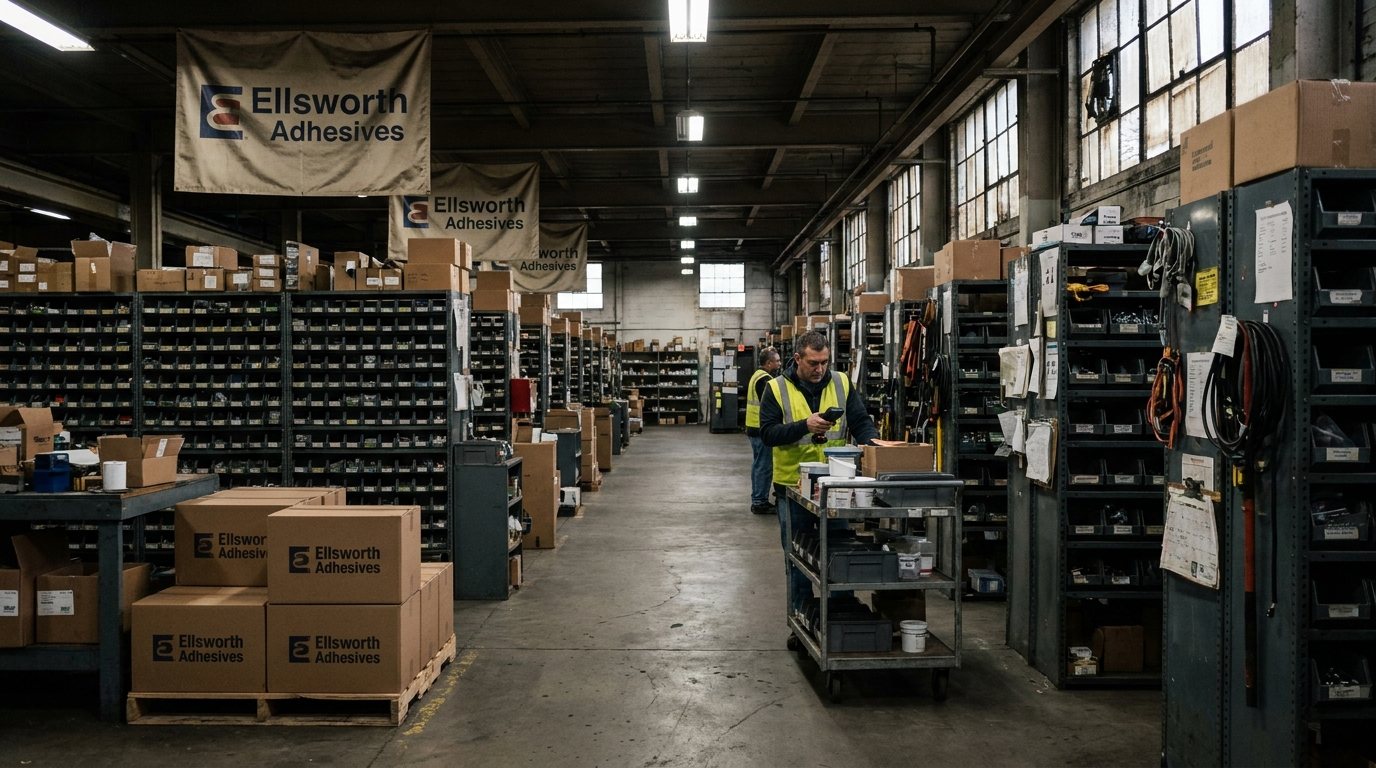
Most specialty distributors pick a lane and defend it. Ellsworth does something less intuitive: it carries 3M, Dow/Dow Corning, Henkel Loctite, Dymax, Parker LORD, Bostik, Sika, Glue Dots, HumiSeal, and DuPont's MOLYKOTE line side by side, more than 50 manufacturer lines in total, many of them direct chemical rivals in the same bonding, sealing, and coating categories. A structural adhesive buyer choosing between a 3M epoxy and a Henkel Loctite epoxy for the same joint is choosing between two products sitting on the same distributor's shelf.
That is the company's real position in the channel. Ellsworth is not a 3M reseller or a Henkel reseller. It is the neutral party a design engineer calls when the question is not "which 3M product" but "which chemistry, from any manufacturer, actually holds this bond." Carrying the full competitive set is what makes that credibility possible. A single-brand rep can only ever recommend their own catalog. Ellsworth's sales force can recommend across all of them, which is a different, harder-to-fake kind of trust to build with an engineering customer.
The sales force is the product
Ellsworth backs that position with more than 200 Engineering Sales Representatives, what the company calls ESRs rather than account managers or reps. That naming choice matters. The job is specification work: matching a customer's substrate, cure time, temperature range, and production line speed to a chemistry, then following the part through qualification. It is closer to applications engineering than to order-taking, and it is the reason a company selling commodity-adjacent chemicals can charge for something other than price.
This is also the part of the business a pure e-commerce catalog cannot replicate. Any of Ellsworth's manufacturer partners could, in theory, sell direct online at a lower price. What they mostly cannot do cheaply is put 200-plus engineers in front of customers who need a bonding problem solved before a product ships, across every industry from electronics to medical devices to industrial assembly, in 21 countries.
The unglamorous services that create switching cost
Underneath the technical sales layer sits a second business that rarely gets discussed: custom formulation, custom packaging, inventory management, and converting, run in part through Ellsworth's KitPackers division. Once a distributor is repackaging a manufacturer's bulk adhesive into a customer's exact cartridge size, kitting it with applicators, and holding safety stock against a production schedule, switching to a different supplier stops being a pricing decision and becomes a re-engineering project. That is where a specialty distributor's margin actually lives, and it is a much stickier moat than any single product line.
Betting on where the chemistry gets harder
Ellsworth's recent moves point toward the highest-complexity end of its own category rather than the broadest. In 2025 the company partnered with 3M to distribute one-part epoxies built for small, high-strength electronic and device assemblies, and it is exhibiting at MD&M West 2026, the medical device manufacturing trade show, showing dispensing automation and ISO 10993-listed adhesives for implantable and device-contact applications. Medical device bonding is about as far from commodity industrial glue as the category gets: tight biocompatibility requirements, small batch sizes, and customers who will pay for a distributor that can hold their hand through qualification. That is a rational place for a technical-sales-driven distributor to push, because it is exactly where the ESR model is worth the most and price competition matters the least.
The tension worth naming
The uncomfortable version of this strategy is that Ellsworth's entire value proposition depends on customers still needing a human between them and the manufacturer's catalog. Adhesive manufacturers already sell direct online for standard products, and as engineering teams get more confident specifying their own chemistry, or as AI-assisted product search gets better at doing it for them, the "neutral specifier" role gets thinner. Ellsworth's answer, so far, is to keep moving toward the applications where specification is genuinely hard and DIY sourcing is genuinely risky: medical devices, precision electronics, mission-critical bonds. It is a sound bet, but it is a bet, not a permanent moat. The company has been making it since 1974, when Paul and Patsy Ellsworth started the business on the same premise that a customer with a bonding problem would rather talk to someone who knows all the chemistries than guess at one.
Distribution rarely gets credit for the parts that never show up in a press release: the catalog that spans fifty competing brands, the rep who knows which epoxy actually holds, the packaging line that turns a drum into a customer's exact cartridge. Ellsworth's placement on MDM's list is a reminder that in a lot of industrial categories, that unglamorous depth is still the whole game.