
Endries International: The Fastener Distributor Buying Its Rivals
Endries International ranks #10 in fasteners on MDM's 2026 Top Distributors list. How a family-run Wisconsin bolt shop became its own roll-up engine.
Part of Distributor Playbooks — strategy teardowns of every company on the MDM Top Distributors lists.
Endries International announced four acquisitions in a 25-month stretch between late 2023 and late 2024. That is not a company padding a growth chart before a sale. It is a company acting as the consolidator in a sector where consolidation usually happens to the small operator, not because of it. Modern Distribution Management ranks Endries #10 among fastener distributors and #40 in industrial supply on its 2026 Top Distributors list, on 2024 revenue north of $500 million.
From a basement to Class C
The company's origin is almost quaint next to what it became. Bob and Patricia Endries started Bob Endries Auto Specialties in the basement of their home in Brillion, Wisconsin, in 1970, selling auto parts. The pivot that mattered came in 1975, when the business moved into industrial fasteners. By 1984 it had already built its first formal inventory management program for OEM customers, a decade before "vendor-managed inventory" became a category label the rest of the industry would adopt.
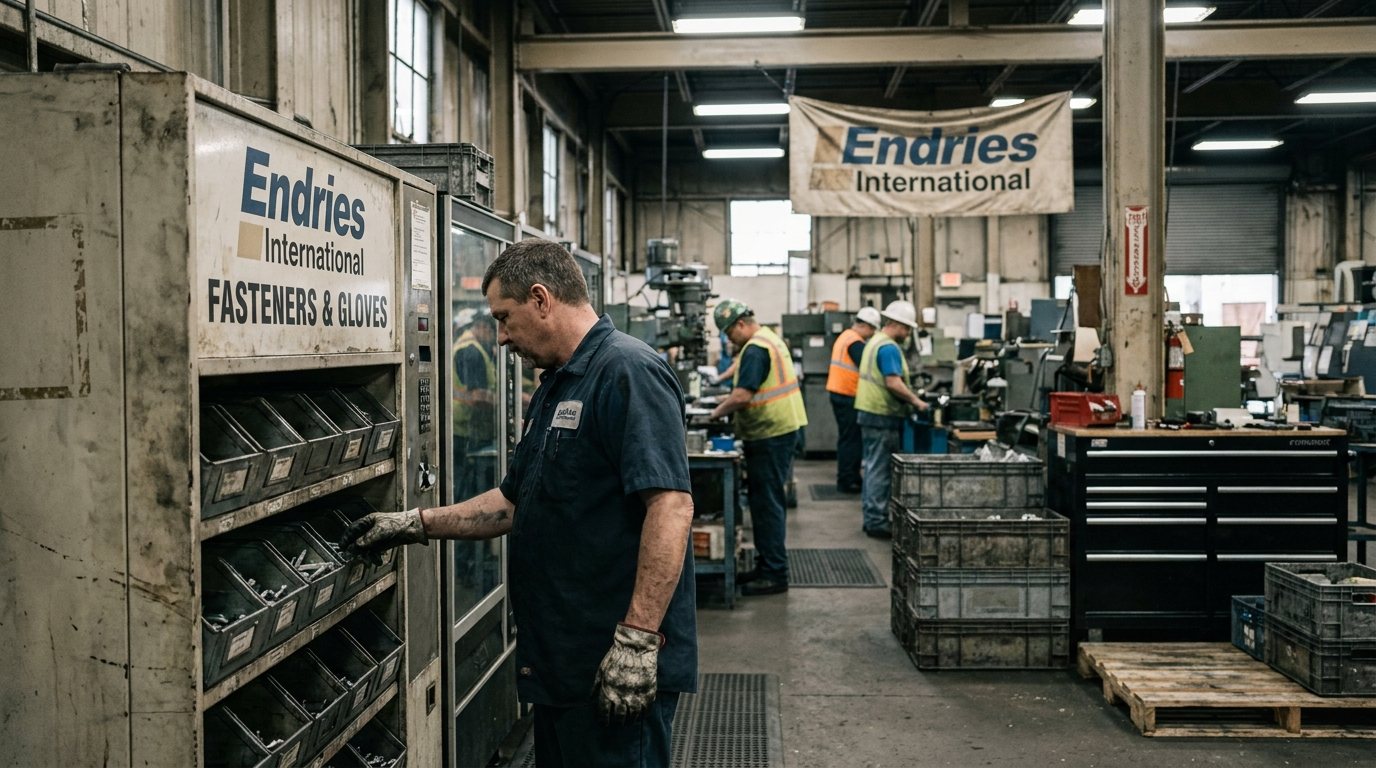
Fasteners look like a commodity from a distance: nuts, bolts, washers, pins. Up close they are the textbook case for what distributors call Class C components, the small, low-unit-cost parts that consume a wildly disproportionate share of a manufacturer's procurement labor relative to their dollar value. A missing $0.03 washer stops a production line as completely as a missing $30,000 motor. Endries built its business around owning that headache, not around competing on unit price.
Succession without a sale
Founder Bob Endries handed the president's role to his son Steve in 2004, a transition Global Fastener News covered at the time, when the company ran roughly 70 branches, 6 distribution centers and 450 employees. That kind of father-to-son handoff is common in family fastener distribution. What is less common is what happened next: the family didn't stay in the operating chair. Steve Endries now sits as chairman, and the CEO's office has been run by non-family professional managers, most recently Dan Crociata, a former CFO promoted to the top job in May 2025 when Michael Knight stepped down, per the company's own leadership transition announcement.
That is the insight worth naming plainly: fastener distribution has largely consolidated into two buckets over the last two decades, PE-backed platforms rolling up regional players, or small family shops that eventually sell into one of those platforms. Endries has done neither. It has stayed privately controlled by the founding family at the governance level while running the acquisition playbook usually reserved for outside capital, buying the smaller companies instead of becoming one of them.
The acquisition engine, dated
Between November 2023 and November 2024 alone, Endries closed on Viscan Group, Ace Bolt & Screw, Blue Chip Engineered Products and ServTronics, according to the company's own news archive. Assembly Fasteners followed, adding a 1984-founded Florida latch-and-hardware specialist to the roster. Each of the eight brands the company has absorbed, including Store Room Fasteners, Industrial Products Company and les attaches Viscan, still carries its own name in the field.
| Acquisition | Announced | Specialty added |
|---|---|---|
| Viscan Group | Nov 2023 | Fastener distribution, Quebec |
| Ace Bolt & Screw | Mar 2024 | Regional fastener supply |
| Blue Chip Engineered Products | Jul 2024 | Custom-engineered fasteners |
| ServTronics | Sep 2024 | Aerospace, medical, military fasteners |
| Assembly Fasteners | Nov 2024 | Latches and specialty hardware |
That is a house-of-brands strategy, not a rebrand-and-strip strategy. The acquired companies keep their customer relationships and their name recognition in their niches, while Endries folds their volume into a shared backbone of 26 distribution centers spanning North America and Europe, including facilities in England and the Netherlands, and a catalog that has grown past 800,000 SKUs. New capacity keeps landing behind the deals too: an Algonquin, Illinois distribution center opened in September 2024, and a Fort Worth, Texas facility followed in January 2025.
The technology layer nobody sees
The reason the acquisitions stick is the same reason the 1984 inventory program mattered: Endries doesn't sell parts so much as it sells the elimination of a customer's parts problem. Its PULSE platform, an RFID-based bin and point-of-use replenishment system introduced in 2015, automates reordering on the plant floor so a customer never has to count washers again. Layer in engineering support for fastener specification, kitting and sub-assembly, and quality documentation for regulated sectors like aerospace and medical, and switching away from Endries stops being a pricing decision. It becomes a re-engineering project.
A hard read on the tension
The house-of-brands model is not free of risk. Eight brand names under one roof means eight sets of systems, cultures and customer habits to eventually align, and every acquisition adds integration debt even when the deal itself goes smoothly. A February 2025 brand refresh, updating the corporate logo and messaging across the portfolio, is the first visible sign the company is starting to knit those brands closer together rather than leaving them fully separate forever. How far that consolidation goes, and whether it costs Endries the local trust that made each acquired brand worth buying, is the open question for the next chapter.
For a company still headquartered in the Wisconsin town where it started, the ambition is not subtle. Endries is not waiting to be bought. It is doing the buying, brand by brand, bin by bin, one Class C part at a time.
Distribution's competitive edges rarely live in the showroom. They live in the catalog data, the branch network and the replenishment logic that customers never have to think about, which is exactly why they're worth studying.