
How Fastenal Outgrew Its Own Name and Still Wins
Fastenal ranks #1 in Fasteners on the 2026 MDM Top Distributors list, but fasteners are now under a third of its sales. Here is the model that replaced them.
Part of Distributor Playbooks — strategy teardowns of every company on the MDM Top Distributors lists.
Fastenal sits at #1 in Fasteners, #2 in Safety, #4 in Industrial Supplies and #5 in Industrial MRO on the 2026 MDM Top Distributors lists, the annual ranking from Modern Distribution Management that sizes up North America's largest distributors across 20 verticals. On $8.2 billion in fiscal 2025 revenue, it is one of the few companies that shows up strong across four different product categories at once. That breadth is not an accident. It is the result of a company that quietly stopped being what its name says it is, more than a decade ago, and built its entire operating model around that fact.
The name is a fossil
In 1967, five friends in Winona, Minnesota, pooled $31,000 and tried something odd: vending machines that dispensed nuts and bolts to factory floors. The vending idea flopped almost immediately, industrial buyers wanted a counter and a person, not a coin slot, so founder Bob Kierlin and his partners, later nicknamed the "Fastenal Five," pivoted to a storefront model selling fasteners directly (Wikipedia). The name stuck. The vending idea did not, at least not yet.
Here is the twist worth naming plainly: fasteners made up just 30.7% of Fastenal's sales in 2024, split between OEM fasteners (19.3%) and MRO fasteners (11.4%). Safety supplies were 22.2%. The rest, 47.1%, spans janitorial supplies, tools, cutting tools, hydraulics and pneumatics, material handling, electrical and welding gear (FY2024 earnings release). A company named for one product line now earns most of its money selling everything a factory or jobsite needs to keep running. Competitors that built fastener-only brands never had this option; Fastenal's early, unglamorous decision to become a general industrial counter instead of a specialist gave it the shelf, and later the sales force, to expand into categories its own name never advertised.
The vending machine idea, resurrected and correct
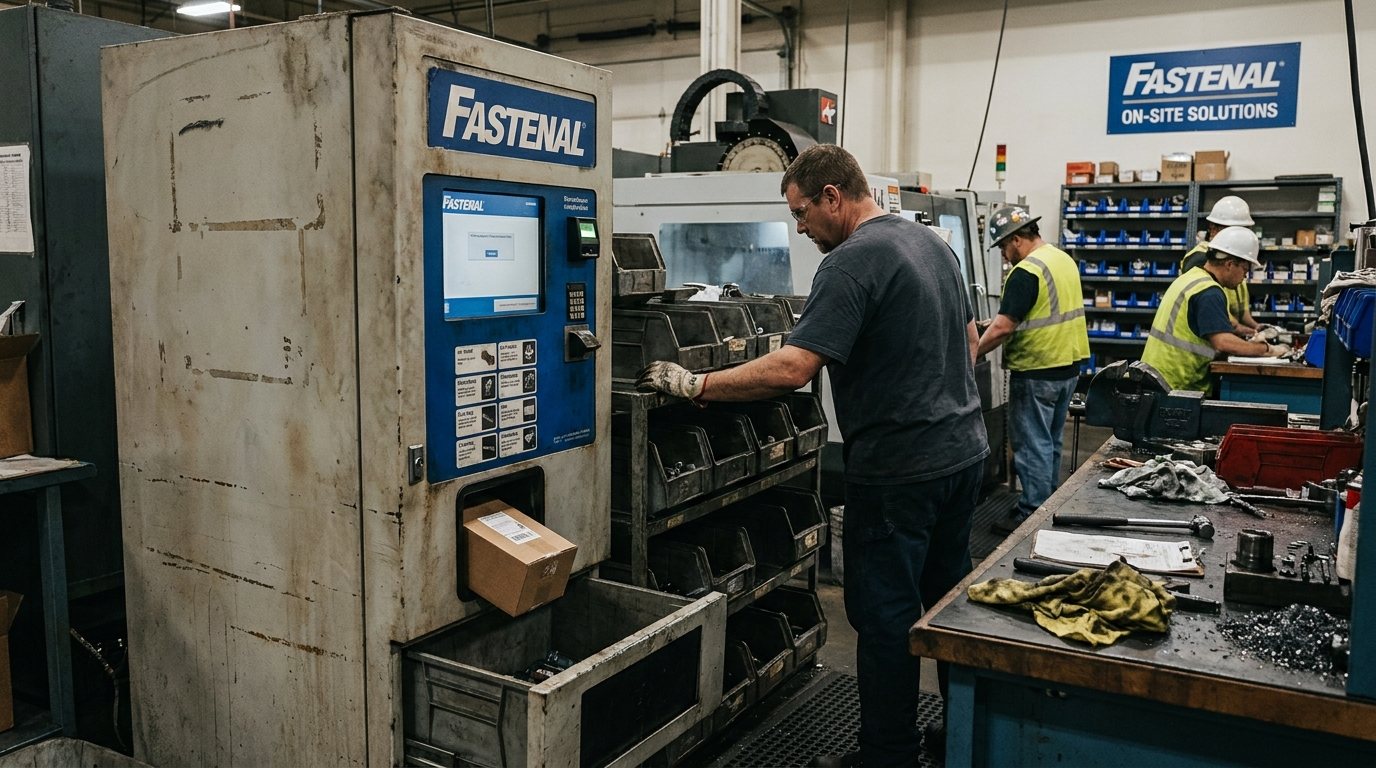
The bigger story is that the vending concept the Fastenal Five abandoned in 1967 came back as the company's central growth engine, just aimed at a different problem. Instead of trying to sell from a machine, Fastenal now gives the machine away and uses it to lock in the account. By the end of 2024 it had installed more than 126,000 weighted FASTBin and FASTVend devices inside customer facilities, up 12.2% for the year, dispensing gloves, fasteners and consumables at the point of use and feeding usage data straight back into replenishment (FY2024 earnings release).
Onsite locations, Fastenal employees embedded full-time inside a customer's own plant, are the more advanced version of the same bet. There were 2,031 active Onsites at year-end 2024, up 11.5% year over year, with management targeting 2,500-plus globally by 2027 or 2028. Combined with vending, this is what Fastenal calls its "Digital Footprint," and it already accounts for the majority of sales, north of 62% in Q4 2024 and targeted at 66-68% sometime in 2025.
Branches shrink so the footprint can grow
The unglamorous companion move was pulling back from the traditional branch network that built the company. Fastenal spent recent years rationalizing its store count, closing several hundred underperforming branches as it concluded that a location near a customer mattered less than a device or a person inside the customer's building (Industrial Distribution). Branch count landed at 1,597 at the end of 2024, essentially flat, while the strategic culling was declared complete. That is a distributor voluntarily shrinking the asset that used to define it, a branch on every corner, to fund the asset that actually produces the switching costs: hardware and headcount that live inside the customer's four walls and are expensive for a rival to displace.
| MDM 2026 category | Fastenal rank |
|---|---|
| Fasteners | #1 |
| Safety | #2 |
| Industrial Supplies | #4 |
| Industrial MRO | #5 |
| Fluid Power | #7 |
| JanSan | #9 |
| Electrical | #38 |
A leadership handoff timed to the model, not around it
Daniel Florness, CEO since 2016, is stepping down on July 16, 2026, handing the role to Jeffery Watts, currently president and chief sales officer. Florness will stay on as a strategic advisor into 2028 (Investing.com). Promoting the sitting sales chief, rather than reaching outside, signals that the board wants continuity in the go-to-market machine specifically, the Onsite and vending sales motion, rather than a strategic reset. Analysts have split on what comes next: one upgrade cites confidence in double-digit growth through 2026, another downgrade flags slowing sales and margin pressure. Both are really arguments about the same question, whether the embedded-footprint model still has runway or is approaching saturation among Fastenal's largest accounts.
The tension worth watching
Embedding staff and hardware inside customer plants is a stickier moat than a branch network, but it is also a slower, more capital- and labor-intensive way to grow, and it concentrates revenue in fewer, larger relationships. A distributor that wins by disappearing into its customers' buildings has less visibility into new logos than one with storefronts on Main Street. Fastenal is betting that depth beats breadth. The MDM rankings suggest the bet is paying off across categories the company's own name never mentioned.
Fastenal's climb from vending-machine flop to embedded-inventory powerhouse is really a story about infrastructure nobody sees: the catalog behind the vending screen, the branch data behind the Onsite decision, the unglamorous plumbing that decides who wins an industrial account long before price ever comes up.