
How W.W. Grainger Wins by Competing Against Itself
Grainger tops MDM's 2026 Industrial, MRO, and Safety rankings by running two opposite distribution models at once, one high-touch, one low-touch.
Part of Distributor Playbooks — strategy teardowns of every company on the MDM Top Distributors lists.
Grainger tops MDM's 2026 Top Distributors lists, ranked first in Industrial Supply, first in MRO, and first in Safety, with FY2025 revenue of $17.9 billion. It also shows up in seven other verticals, from Fasteners to Fluid Power, a spread almost no other distributor matches. The obvious story is scale. The more interesting one is that Grainger built two distribution companies inside one holding company, deliberately pointed at each other, and let them compete.
A motor catalog with a century of momentum
William W. Grainger started the business in 1927 in Chicago, selling electric motors by mail through an eight-page catalog called The MotorBook, filled by Grainger, his sister, and two employees. By 1936 the company had 15 branches. The catalog model held for six decades, then Grainger.com launched in 1995 and began pulling the business toward digital before most industrial distributors took the internet seriously. William's son David took over as CEO in 1974 and ran the company through the transition from catalog seller to branch network to e-commerce platform, a run that gave Grainger something rarer than any single acquisition: continuity of ownership philosophy across three generations of leadership even after the 1967 IPO.
Two segments, two opposite playbooks
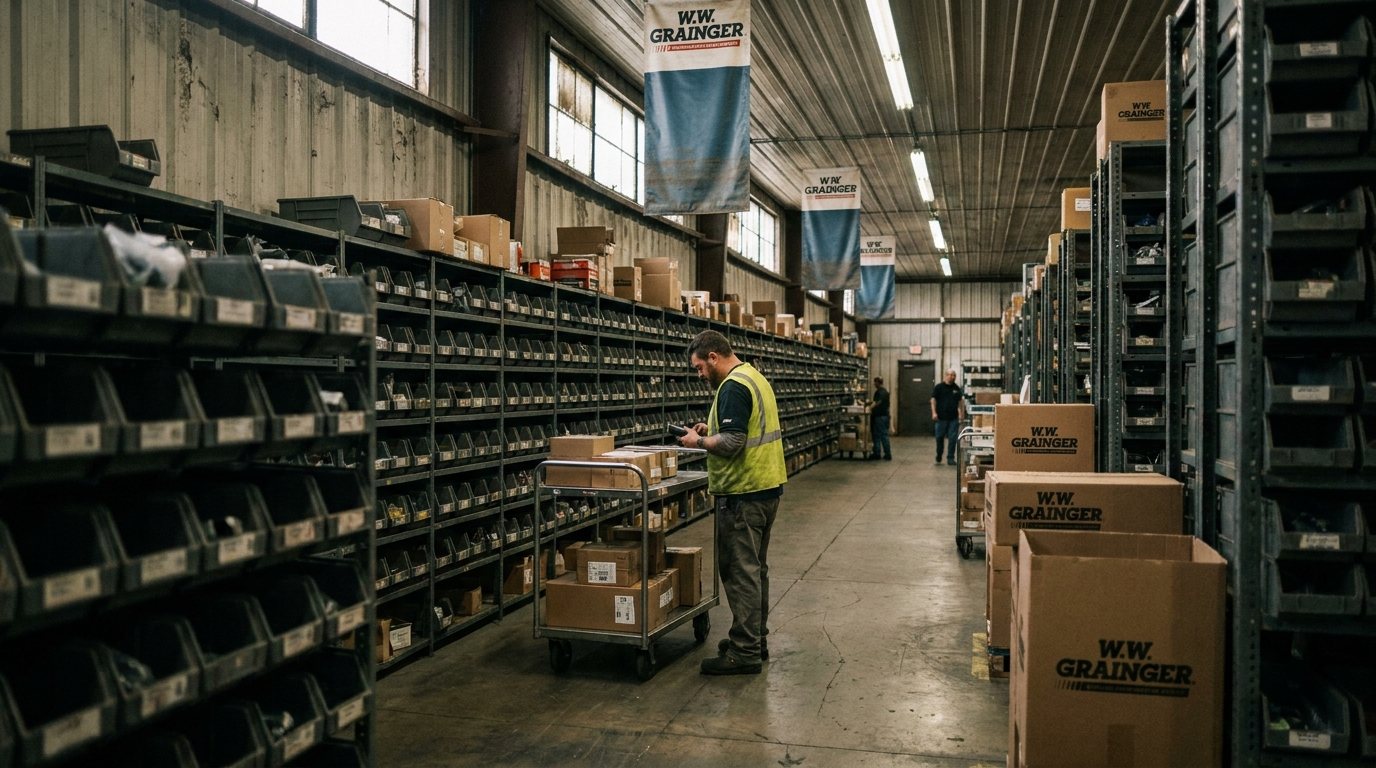
Grainger now reports results in two segments that operate almost nothing alike. High-Touch Solutions is the business most people picture: more than 300 branches across the US and Canada, a technical sales force, and KeepStock, a vending and onsite-inventory program that gets installed inside a customer's four walls and wired into their ERP for automated reordering. It is relationship-heavy and margin-rich, and it is built to be hard to leave once it is embedded.
Endless Assortment is the opposite bet. Zoro.com in the US and MonotaRO in Japan are low-touch, high-SKU-count webstores aimed at small businesses and price-sensitive buyers, the exact customer segment that a slick vending machine and a dedicated account rep would normally chase away. Neither storefront wears the Grainger name. That is not an accident. Rather than cede the low-margin, self-serve end of the market to Amazon Business or a regional discounter, Grainger built its own version of that competitor and put it inside the same holding company as its premium arm. In 2025 that Endless Assortment segment grew sales close to 20%, faster than the core High-Touch business, which is the tell that this isn't a side project. Most distributors treat their branch network as the moat and view e-commerce discounting as an existential threat to be managed. Grainger decided the discounting was going to happen with or without it and chose to own both sides of the trade.
The Japan bet nobody outside the industry tracks
The MonotaRO piece of that strategy has an unusual structure. Grainger and Sumitomo Corporation set up MonotaRO as a 2000 joint venture to sell MRO products in Japan. Grainger raised its stake to a 53% majority in a 2009 tender offer, and MonotaRO has operated ever since as a separately listed company on the Tokyo Stock Exchange, run largely on its own, reporting its own numbers, competing in a market Grainger's US organization barely touches directly. A Chicago industrial distributor holding controlling interest in a Japanese public company it lets run independently is not the kind of arrangement most MRO players build, and it has quietly become one of the more durable growth engines in the portfolio.
Discipline shows up in what Grainger walks away from
The clearest signal of how seriously Grainger runs this two-segment model came in October 2025, when it agreed to sell its UK-based Cromwell business to private equity firm Aurelius and shut down Zoro UK, taking a one-time after-tax loss of $190 to $205 million. CEO D.G. Macpherson framed the exit around focus: doubling down on High-Touch Solutions in North America and Endless Assortment in the US and Japan, rather than defending a European foothold that wasn't returning enough to justify the management attention. Distributors love to talk about discipline. Fewer are willing to book a nine-figure loss to prove they mean it.
Where the next moat is being built
The 2026 playbook leans further into data. Grainger added a net 85,000 SKUs to its high-touch assortment in 2025, the largest jump in a decade, while building new distribution capacity outside Houston and near Chicago to keep same-day and next-day promises intact. It is also rolling AI into SellerInsights, the platform that arms its technical sales reps with account-level signals, betting that the advantage in a slow-growth industrial market comes less from adding branches and more from knowing which customer is about to reorder before they call.
Grainger's real strategic choice was refusing to pick a side of its own market. It kept the sales force and the branches for the customers who need a person, and it built an unbranded, low-touch clone of itself for the customers who don't, then let both compete for share of wallet under the same roof.
This series looks at the companies that make MDM's list because the unglamorous machinery behind them, catalogs, branches, inventory data, freight, is where distribution is actually won or lost.