
How Granite City Electric Stayed Family-Owned for a Century
Granite City Electric ranks #40 on MDM's 2026 electrical list. Its real story is how a 1923 family business kept growing without selling out.
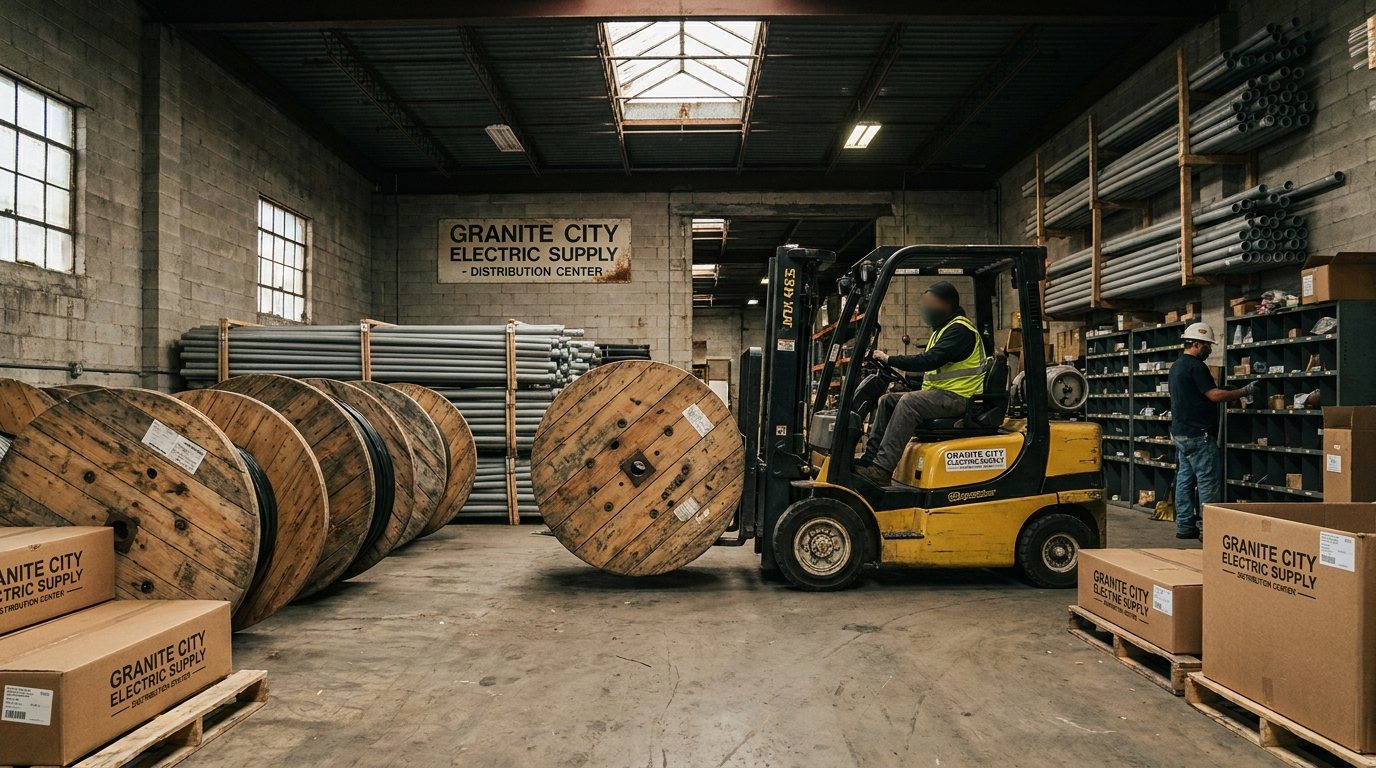
Part of Distributor Playbooks — strategy teardowns of every company on the MDM Top Distributors lists.
Granite City Electric Supply lands at #40 on Modern Distribution Management's 2026 Top Distributors list for the electrical vertical, a slip from #34 the year before but still a solid mid-pack rank in a category dominated by national and multinational platforms. What makes the company worth a closer look isn't the rank. It's that a business founded in 1923 by an Italian immigrant electrician still answers to his family, in a channel where almost everyone else has sold to someone bigger.
An electrician who couldn't find good supply
Nicholas V. Papani arrived in the United States at 16, served in World War I, earned his master electrician's license, and then did what a lot of frustrated tradespeople have done before and since: he decided the supply house he needed didn't exist, so he built one. In 1923 he opened Granite City Electric in Quincy, Massachusetts, betting that contractors in the area needed a local source for wire, fittings, and fixtures they could actually get their hands on. A century later that same instinct, put local inventory close to the people installing it, still describes the company's branch network.
The succession nobody expected in 1969
When Papani died in 1984, the company had already passed to his daughter, Phyllis Papani Godwin, who became principal owner and Chairman and CEO back in 1969. A woman running an electrical wholesale house was rare in that era; the trade was, and in many pockets still is, overwhelmingly male at the ownership level. Godwin didn't just hold the seat, she pushed the company's geographic expansion through the 1970s and 1980s, setting the template Granite City still follows: grow branch by branch into adjacent New England territory rather than chase a national footprint.
Growing by buying family businesses, not by becoming one's exit
This is the part of the story that doubles as the strategic insight. Electrical distribution has spent two decades consolidating into a handful of giant platforms, many of them private-equity-backed or owned by larger multinational groups. Granite City took the opposite path: it grew mostly by acquiring other small, family-run electrical distributors and keeping them intact rather than folding into a private-equity roll-up or selling itself to a Sonepar-scale acquirer. President Steve Helle, who joined in 1999, has overseen deals for JG Temple, C&I Electric, Electric Supply and Repair, The Whelan Co., Columbia Electric Supply, Major Electric, Baynes Electrical Supply, and, most recently, Barre Electric & Lighting Supply in August 2024, according to tED magazine's coverage of the deal.
The Barre deal is instructive. Barre had been family-owned since 2002, serving Vermont contractors and homeowners. Rather than dissolve the acquired brand into a faceless "corporate" identity, Granite City kept owner Greg Isabelle on as senior sales manager. Helle framed it as building "future opportunities for mutual growth," and Isabelle talked about combining teams, not cashing out and leaving. That pattern, buy the family business, keep the family running it, repeats across the acquisition list. It's a roll-up strategy that trades the speed and leverage of a PE-style consolidator for continuity that customers and employees can feel.
| Milestone | Year |
|---|---|
| Founded by Nicholas V. Papani in Quincy, MA | 1923 |
| Phyllis Papani Godwin becomes Chairman/CEO | 1969 |
| Steve Helle joins as President | 1999 |
| Official Boston Red Sox electrical supplier | 2004 |
| Barre Electric & Lighting Supply acquired | 2024 |
| MDM 2026 Top Distributors, Electrical #40 | 2026 |
The logistics bet that makes the branch model pay off
None of this works if a contractor can't get product overnight. Granite City's answer is Night Train, a proprietary overnight delivery system that, per tED magazine's reporting on the Barre acquisition, moves nearly 70 percent of the company's orders to customers by the next morning. Combined with roughly three dozen branches spread across Massachusetts, New Hampshire, Vermont, Connecticut, Rhode Island, and the Albany, New York market, the logistics network turns a regional footprint into something closer to same-day availability across six states. That's the unglamorous engine underneath the family story: branch density plus a dedicated overnight fleet, not scale for its own sake.
A hyper-local brand play in a commodity category
Since 2004, Granite City has been the official electrical supplier to the Boston Red Sox, a sponsorship most electrical distributors its size would never consider. Wire and conduit are about as commodity as products get, so brand differentiation in this category usually comes down to price and delivery speed. A regional sports partnership is a bet that showing up as "the Red Sox's electrician" builds trade recognition and community trust that a catalog full of Lutron and Square D parts numbers cannot.
The trade-off worth naming
Staying family-controlled and growing by absorbing like-minded local businesses has kept Granite City's culture intact across a century, but it also caps how fast the company can scale against national platforms with access to public or private-equity capital. MDM doesn't disclose Granite City's revenue, itself a marker of how firmly private the company has remained, and its rank of #40 in electrical sits well below the sector's billion-dollar consolidators. The bet Granite City has made, repeatedly, is that a loyal regional customer base and a continuous ownership line are worth more than the growth rate a sale would unlock. A century in, that bet has held.
Every distributor on this list runs on the same unglamorous plumbing: catalogs that have to be right, branches that have to be stocked, and data that has to move as fast as the trucks do. This series looks at how the largest ones built it.