
Green Mountain Electric Supply's Quiet Roll-Up of the Northeast
How a family-owned Vermont electrical distributor became one of the industry's most active acquirers without ever selling to private equity.
Part of Distributor Playbooks — strategy teardowns of every company on the MDM Top Distributors lists.
In MDM's 2026 Top Distributors list, Green Mountain Electric Supply lands at #33 among electrical/data/security distributors, having debuted on the list at #30 in 2025 after not ranking at all the year before. What changed wasn't organic sales growth so much as an acquisition pace that trade press had already flagged as unusual: a 1953 motor-repair shop from Newport, Vermont, out-acquiring almost everyone in its category except Sonepar and Graybar.
The company that wasn't on the list, then was
Electrical Trends' review of the 2024 MDM list called out Green Mountain Electric Supply, or GMES, as one of the sector's top three acquirers that year, alongside Sonepar and Graybar, even though it hadn't cracked the ranked list itself. Sonepar is a French multinational with tens of billions in global revenue. Graybar is a Fortune 500, employee-owned distributor. GMES is a privately held family company nobody outside the Northeast electrical trade had much reason to know. Being named in that company for deal volume, not size, is the tell that something structural was happening at GMES beyond a good sales year.
By the 2025 list, the acquisitions had compounded into rank. That sequence, consolidator before you're a top-30 name, is the opposite of how most distributors climb these lists, and it's the throughline of the GMES story.
From motor rewinding to a 34-location footprint
GMES traces to 1953, when Earl Laber, Raymond Place, and Norman Bean opened a motor repair and rewinding shop in Newport, Vermont, according to the company's own history page. The shop added electrical supply sales in the 1960s and formally became Green Mountain Electric Supply in 1970 when the founding trio retired. Earl Laber sold the business to his three sons, Gary, Scott, and Gregg, plus partner Steven Carpenter, in 1977, making it a second-generation operation. The motor-repair business itself was dropped in 1986 so the company could concentrate on distribution.
Growth from there was steady rather than dramatic for two decades: a branch in St. Johnsbury in 1998, acquisitions of Choinere Electric (2001) and Burgess Electrical Supply (2004), a branch in Glens Falls via acquisition in 2008, and Valley Electric Supply in 2010. A renewable energy division followed in 2011 and a corporate office in Colchester in 2014, the town GMES now calls headquarters.
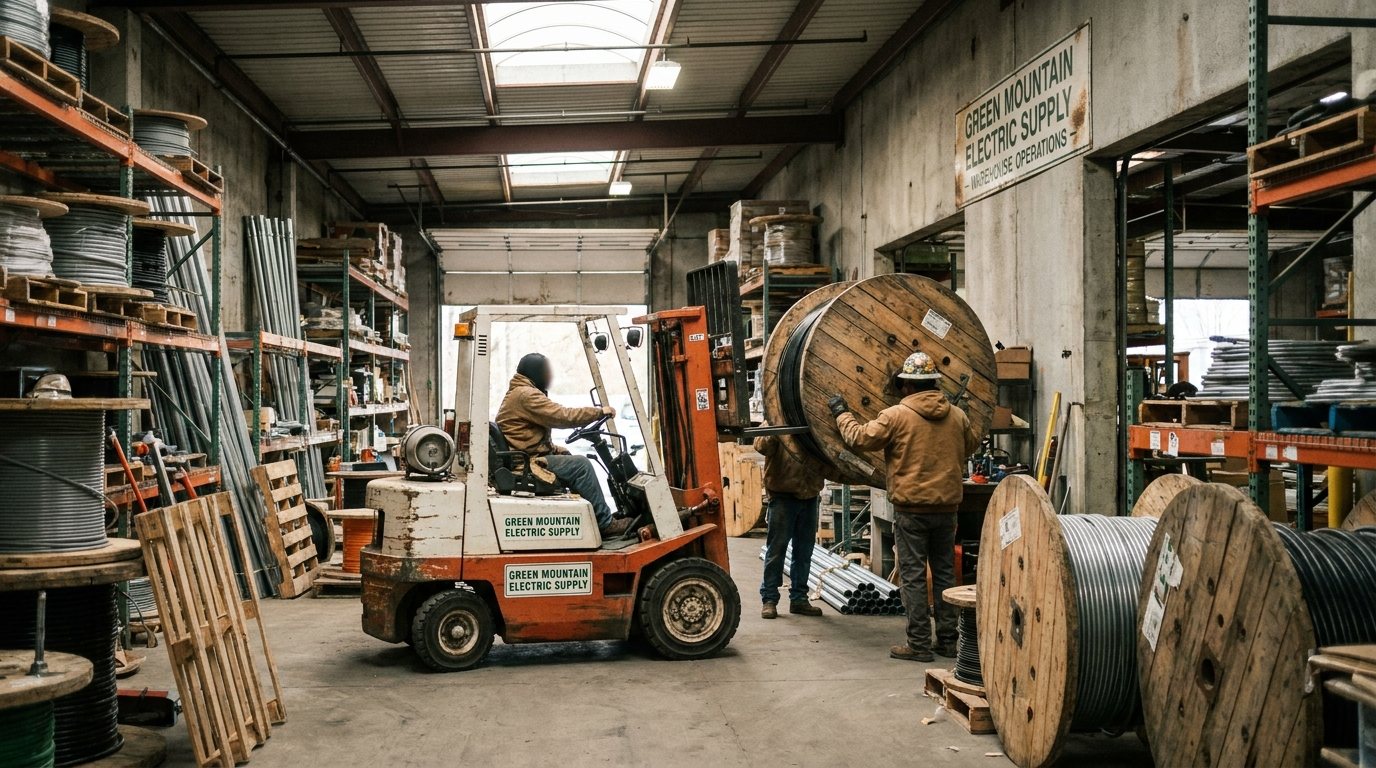
Then the pace changed. Falcone Electric of Batavia, New York, was acquired in October 2022, per Vermont Biz and a Generational Equity release. Dunn Electric Supply and Jamestown Electric Supply followed in early 2023. Scott Electric Supply, with locations in Fredonia and Depew, New York, brought GMES to 18 locations. Walsh Electric Supply, a Colchester competitor operating since 1959, joined in February 2024. Ion Lighting Distribution came a month later, adding a specialty lighting and energy-solutions line rather than another branch. New locations in Watertown and Franklin opened later in 2024, and Potsdam and Lake Placid, New York, followed in 2025, bringing the count to the 34 locations MDM's distributor profile now lists.
| Year | Move |
|---|---|
| 2022 | Falcone Electric (Batavia, NY) |
| 2023 | Dunn Electric, Jamestown Electric, Scott Electric (Fredonia/Depew, NY) |
| 2024 | Walsh Electric Supply, Ion Lighting Distribution, Watertown/Franklin branches |
| 2025 | Potsdam and Lake Placid, NY locations |
The insight: rolling up what the mega-consolidators skip
Every acquisition above is a small, independent, often family-run electrical house in a secondary or rural Northeast market: Batavia, Fredonia, Depew, Jamestown, Franklin. These are not the metro markets that Sonepar, Wesco, or PE-backed regional platforms are chasing when they build national density. They're exactly the towns too small to matter to a billion-dollar acquirer's growth model, which is precisely where a family-owned distributor with local knowledge and no external investors to satisfy can move fast and pay a fair, uncomplicated price to a retiring owner.
That's the strategic tension underneath the M&A engine: GMES is scaling by consolidating the sellers that consolidation, at national scale, would otherwise leave behind. It's a niche a purely organic-growth strategy could never fill, and one a PE-backed roll-up would likely find too small-ball to bother with deal by deal. The risk is the integration math. Nine acquisitions and multiple new-build branches since 2022, each arriving with its own product catalog, ERP habits, and counter-sales culture, is a lot of stitching for a company still run day-to-day by the family.
Nathan Laber, grandson of founder Earl Laber, now runs GMES as president and CEO, with his father Gregg Laber still serving as president, per MDM's profile and the company's own career pages, which describe GMES as a third-generation family business. MDM lists no revenue figure for the company at all, unusual for a company this high on the list in a sector where most peers disclose or are estimated with some confidence. For a company acquiring at this clip, staying that opaque about its own scale is itself a choice: no public debt, no PE sponsor with LP reporting requirements, no obligation to say more than the deal announcements already do.
Series note
Every branch GMES bolts on arrives with its own price files, vendor codes, and half-digitized catalog, the unglamorous back-office reality behind any roll-up story that reads clean in a press release.