
Bearing Headquarters Company: Family-Owned in a Rolled-Up Sector
Bearing Headquarters Company ranks #10 in power transmission on MDM's 2026 Top Distributors list, still family-owned after 90 years of buying machine shops.
Part of Distributor Playbooks — strategy teardowns of every company on the MDM Top Distributors lists.
Bearing Headquarters Company shows up at #10 on the power transmission/bearings list in MDM's 2026 Top Distributors report, the same rank it held the year before. MDM does not disclose the company's revenue publicly, which is itself consistent with the rest of this story: a distributor that has never needed to report a number to anyone outside the family. What the ranking does not show is the more interesting fact sitting next to it: nearly every other name on that PT top ten is public or private-equity owned, and this one still isn't.
MDM's list, now in its 17th year, ranks distributors on industry-specific revenue rather than total company revenue, drawing on more than 220 companies across 20 product verticals. That methodology is why a company the size of Bearing Headquarters can sit on the same page as national players many times its scale: the ranking measures depth in power transmission and bearings specifically, not overall size.
A $500 start in Chicago
Ray M. Ring started the business in 1934 with, by the company's own account, an initial investment of $500 and one assistant. He ran it as the Ray M. Ring Company, a single-location bearing distributor in Chicago, through the back half of the Depression. In 1939 the business renamed itself Bearing Headquarters, a name change meant to signal what it actually sold rather than who owned it. Frank Timble came in as Ring's successor and the company grew under Timble stewardship from there. Today the owner listed on the company's own team pages is Jim Timble, which puts the same family at the helm across multiple generations in an industry where that is no longer the norm.
That detail matters more than nostalgia. Look at who else sits on the Power Transmission Distributors Association's 2024 list of members named to MDM's rankings: Motion (a Genuine Parts Company subsidiary), Applied Industrial Technologies (NYSE-listed), Wajax (Toronto Stock Exchange), DXP Enterprises (NASDAQ-listed), Grainger (NYSE-listed), Purvis Industries (long backed by private equity), BDI, and IBT Industrial Solutions. Bearing Headquarters is the one entry on that list still privately held by the family that has run it since the mid-20th century. In a vertical that has spent three decades consolidating into public roll-ups and PE platforms, staying independent is itself a strategic choice, not an accident of size.
The machine shop years
The pivotal bet in the company's history did not happen at the counter. Between 1955 and 1979, Bearing Headquarters went on a buying spree of a different kind: machine shops, fabrication facilities, specialty manufacturing operations, and gear manufacturing businesses, according to the company's own history. Those acquisitions turned a bearing reseller into something closer to a captive repair-and-remanufacture network, later modernized with CNC equipment and laser measuring technology. A 1995 acquisition of Highland Hydraulics extended that same logic into hydraulic repair and development.
The strategic implication is straightforward once you see it: most bearing and power-transmission distributors compete on catalog breadth and delivery speed. Bearing Headquarters built a parallel business inside the distribution business, one where a failed gearbox or a worn bearing housing doesn't just get replaced from stock, it gets rebuilt, remachined, or fabricated on-site. That is a materially different cost structure and sales motion than running branches that only pick, pack, and ship. It also explains why the company still operates five metalworking shops today rather than zero.
What the model looks like now
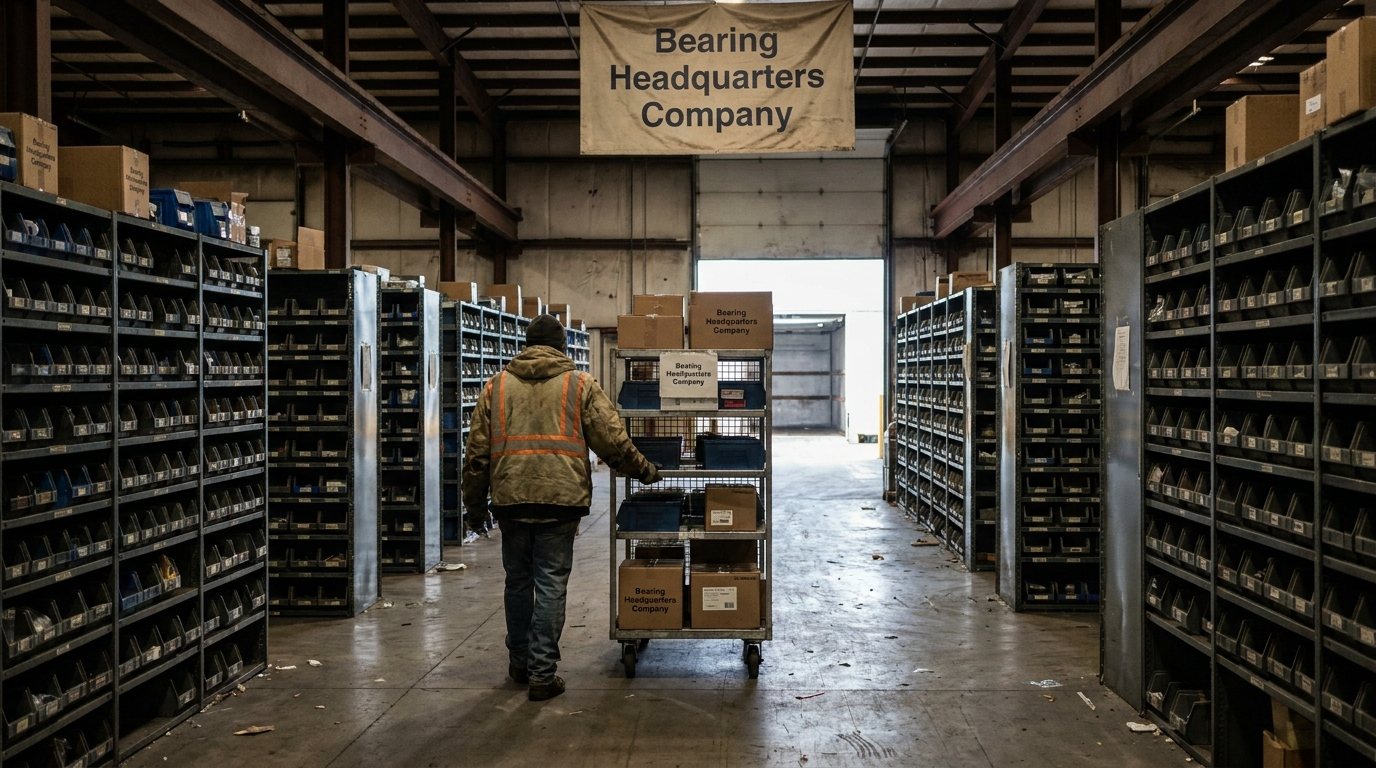
The current footprint, per the company's site, is a Midwest-concentrated network: headquarters in Broadview, Illinois, more than 25 branch locations, and those five machine shops layered on top. The product lines have broadened well past bearings alone: power transmission components, hose and fittings, linear products, material handling, seals and O-rings, air and hydraulic products, and adhesives, lubricants, and chemicals round out a nine-category catalog. The service side lists 24/7 emergency response, custom fabrication, and machining alongside straight repair and rebuild work.
That combination, a deep regional branch network plus in-house repair capacity, is the same playbook Applied Industrial Technologies and Motion run at a much larger scale, minus the acquisition-fueled national footprint and the public-market pressure to keep growing revenue every quarter. Bearing Headquarters has instead stayed dense in one region for nine decades, which is a defensible position as long as the region it serves, industrial Chicagoland and the broader Midwest manufacturing base, keeps running plants.
The honest tension
Staying private and regional cuts both ways. It has let successive generations of one family make long-horizon capital decisions, like buying gear-manufacturing shops in the 1960s, without answering to a board focused on next quarter. It also means the company has not chased the national branch counts or e-commerce scale that its publicly traded PT-list peers have built. Motion and Applied Industrial can roll up a competitor in another state on a Tuesday and report the synergies on Thursday's earnings call; Bearing Headquarters answers to a much smaller set of stakeholders and moves on a different clock entirely.
That is not a knock on the model, it is the trade-off that defines it. A 25-branch, five-machine-shop footprint concentrated in the Midwest means deep relationships with the plants it already serves and less exposure if a customer needs support two time zones away. Whether that MRO-and-machine-shop combination scales to the next horizon of automation and predictive maintenance, or whether it stays a strength precisely because it doesn't try to scale past its region, is the open question for any distributor of this size and shape.
Every distributor on this list runs on the same unglamorous inputs, correct catalogs, dense branch networks, and product data that actually matches what's on the shelf, whether the company behind it is a public roll-up or a family shop that has been rebuilding gearboxes in Broadview, Illinois since before the interstate highway system existed.