
How Home Depot Built a Distributor It Refuses to Brand
Home Depot Pro ranks on three 2026 MDM Top Distributors lists. Its real edge is a house-of-brands M&A engine it once tried to avoid building.
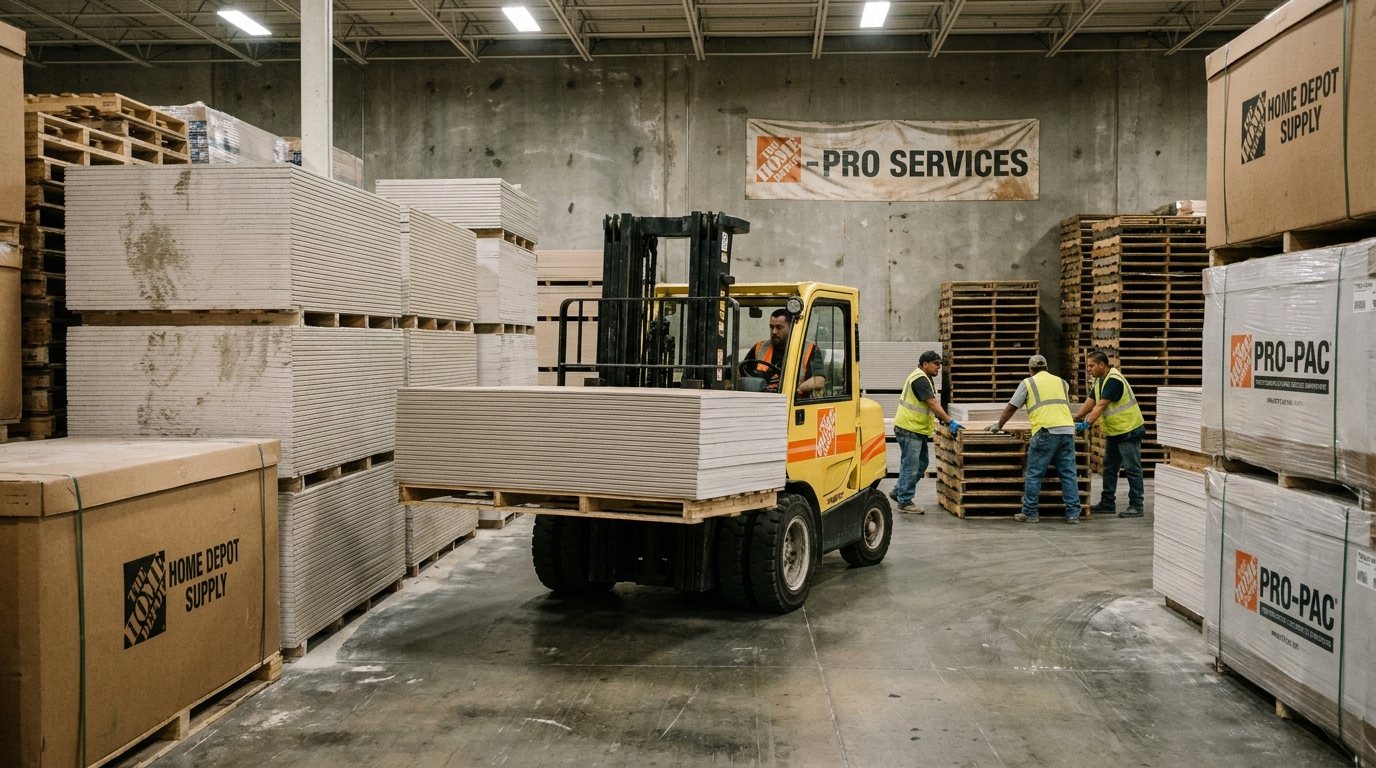
Part of Distributor Playbooks — strategy teardowns of every company on the MDM Top Distributors lists.
On MDM's 2026 Top Distributors lists, The Home Depot's Pro business lands at No. 6 in industrial supplies, No. 4 in MRO, and No. 8 in JanSan. Those rankings undersell what's actually happening: a company most people still picture as an orange-aproned DIY retailer now runs one of the largest wholesale distribution operations in North America, and it built the current version of that operation by deliberately not doing what it did the first two times it tried.
The Pro business is already half the company
Home Depot doesn't break out Pro revenue as a clean line item, but the shape of the business has shifted underneath the brand. Roughly 55 percent of company revenue now comes from the 5 percent of customers enrolled in its Pro programs, mostly contractors and tradespeople rather than weekend renovators, and Home Depot has said openly it's chasing a Pro and building-materials market it sizes at over a trillion dollars (Phenomenal World, PYMNTS). DIY has been soft. Pro has been the growth engine. That's the business context for everything below.
The boomerang that explains the current model
The clean way to understand Home Depot's Pro strategy is to look at what it tried before, because it tried the obvious version twice and walked away from it both times.
| Year | Move | Outcome |
|---|---|---|
| 1997 | Home Depot acquires HD Supply, builds it as an in-house wholesale arm | Centralized, Home Depot-run distribution unit |
| 2007 | Sells HD Supply to a PE consortium (Carlyle, Bain, CD&R) amid the housing downturn | Company exits wholesale distribution entirely |
| 2013 | HD Supply IPOs independently on NASDAQ | Runs as a standalone public distributor for years |
| 2020 | Home Depot buys HD Supply back for $8B | Re-enters distribution, still under its own name |
| 2024 | Acquires SRS Distribution for $18.25B, its largest deal ever | Enters Pro distribution through a multi-brand model instead |
| 2025 | SRS acquires GMS for $5.5B, adding drywall, ceilings, steel framing | SRS crosses 1,250 locations across the U.S. and Canada |
| 2026 | SRS acquires Mingledorff's, a 42-location HVAC distributor | Pro total addressable market expands to roughly $1.2 trillion |
That table is the real story. Home Depot built and owned a distribution arm under its own name (HD Supply), decided the economics or the fit didn't work, sold it, watched someone else run it profitably enough to take public, bought it back, and then, for its next and far larger bet on Pro, chose an entirely different structural answer: acquire a company that operates hundreds of locations under names that have nothing to do with Home Depot, and leave it that way (SRS Distribution history, Berkshire Partners).
The unique insight: a public retailer's biggest bet is on not being itself
Here's the thing worth naming directly. Most retailers who buy into distribution eventually put their own name on the trucks, because brand consolidation is supposed to be where the synergy lives. Home Depot did that with HD Supply for over a decade and it didn't stick as a permanent structure. SRS Distribution, the vehicle for Home Depot's current and much larger Pro push, was founded in 2008 by Dan Tinker out of a bankruptcy-era roll-up of family roofing suppliers, and its whole model was built on keeping the local brand each acquired company brought to the table. Roofers buy from the regional supplier they've bought from for twenty years, not from a national logo. Home Depot bought that philosophy intact for $18.25 billion and has kept extending it: GMS's building-products brands stayed GMS, and Mingledorff's, the HVAC distributor SRS picked up in 2026, kept its own name and its own five-state Georgia-rooted footprint too (Home Depot investor relations).
That's the pattern worth flagging to a competitor's strategy team: Home Depot's largest and most consequential distribution bet in company history is structured, on purpose, as a portfolio of brands that don't say Home Depot anywhere. The retail giant with maybe the strongest single brand in home improvement decided the winning move in wholesale distribution was to stay invisible.
The tension underneath the model
There's a real strategic bet buried in that choice, and it cuts both ways. Keeping SRS, GMS, and Mingledorff's under their own names preserves the contractor trust and local rep relationships that made each of them worth buying in the first place. But it also means Home Depot is running, in effect, a federated company of dozens of distinct sales cultures, credit terms, and delivery fleets stitched together mostly through back-office integration rather than a single storefront. The GMS deal alone pushed SRS past 1,250 locations in roughly a year and a half of Home Depot ownership (MDM). Every one of those brands still has to be onboarded onto shared systems, shared vendor terms, and eventually shared data, without contractors ever noticing the plumbing changed. That's a much harder integration problem than repainting a fleet, and it's the quiet work that determines whether this bet compounds or just adds up.
The MDM rankings capture where Home Depot Pro sits today across industrial supplies, MRO, and JanSan. What they don't capture is that the company arrived there by trying centralization, abandoning it, and betting its largest acquisition ever on the opposite instinct.
This series exists because the companies that move materials, parts, and supplies at scale win or lose on unglamorous things: what's in the catalog, what's on the truck, and whether the data behind both can keep up with how fast the branches multiply.