
How Incora Built a Fastener Giant, Then Nearly Lost It
Incora fused two century-old fastener distributors into a single giant, then a leveraged buyout nearly broke it. Here's how it survived Chapter 11.
Part of Distributor Playbooks — strategy teardowns of every company on the MDM Top Distributors lists.
In June 2023, a company carrying $3.16 billion in debt and supplying the bolts, clamps and chemicals that keep Boeing and Airbus production lines running filed for Chapter 11. Nineteen months later it walked out the other side, still shipping the same parts, under the same CEO. That company is Incora, and it lands twice on Modern Distribution Management's 2026 Top Distributors list: No. 29 in Industrial Supply and No. 8 in Fasteners, both climbing sharply from the year before. The rankings landed mid-restructuring, which tells you something about this business before you learn anything else about it: you can come close to going under and still be one of the largest distributors in your category, because the parts never stopped moving.
Two century-old distributors, one new name
Incora didn't start as Incora. It started as two separate companies built decades apart on opposite sides of the Atlantic, both specializing in the same unglamorous niche: C-class aerospace hardware, the bolts, screws, fasteners, clamps and consumables that individually cost pennies but that no aircraft gets built or maintained without.
Wesco Aircraft was founded in 1953 and grew into one of the largest suppliers of that hardware to commercial and defense aerospace, eventually going public and running distribution and kitting operations across more than 20 countries. Pattonair took the same idea and built it in Derby, England, founded in 1972 by John Patton and grown from a local engineering supplier into a global aerospace supply chain integrator handling the same class of parts for European and defense customers.
Platinum Equity, the private equity firm founded by Tom Gores, ended up owning both. In January 2020 it took Wesco Aircraft private in a deal valued around $1.9 billion and combined it with Pattonair, already in its portfolio, per Incora's own account of the merger. Rather than keep either century-old name, the combined company rebranded entirely as Incora in 2021 — an unusual move in a channel where distributors typically trade on decades of name recognition with the engineers who qualify their parts. The bet was that scale and a single global brand would matter more than either legacy identity.
What the combined company actually does
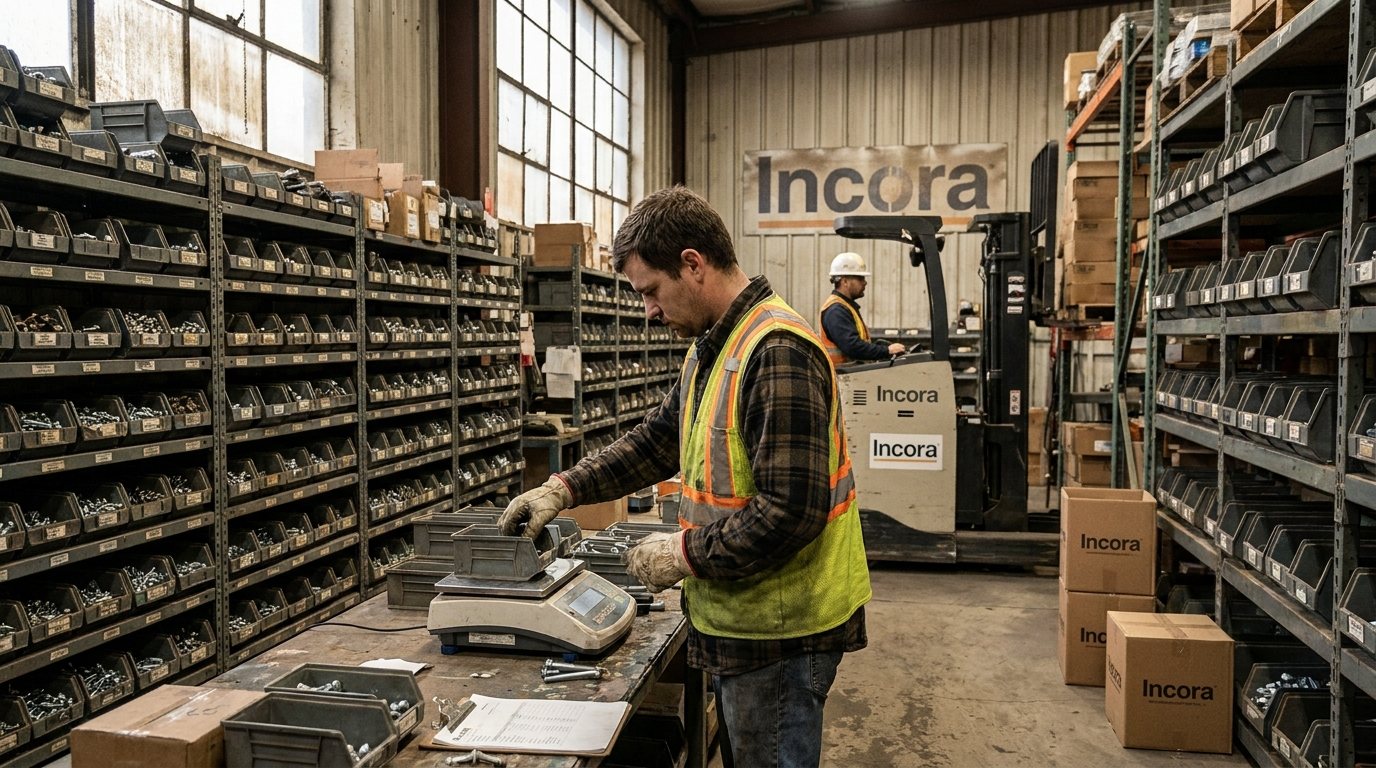
Strip away the corporate history and Incora is, today, a very large parts and chemicals distributor built for one purpose: making sure aerospace manufacturers and MRO shops never run out of the small stuff. By its own figures, Incora now operates more than 60 locations worldwide, manages over 644,000 active SKUs, and serves more than 8,400 customers sourced from over 7,000 suppliers, with 42 facilities carrying AS9120 distribution accreditation. Its services stretch beyond shipping boxes of fasteners into vending, kitting, chemical management and inventory programs designed to sit inside a customer's own production line.
None of that is glamorous. All of it is the reason the business survived what came next.
The near-death chapter
| Milestone | Date |
|---|---|
| Wesco Aircraft founded | 1953 |
| Pattonair founded | 1972 |
| Platinum Equity buyout and merger creates Incora | January 2020 |
| Chapter 11 filed, $3.16B in funded debt | June 1, 2023 |
| Reorganization plan confirmed | December 27, 2024 |
| Emerges from Chapter 11 | January 31, 2025 |
The merger closed just before the pandemic hit commercial aerospace, and then Boeing's 787 delivery halts compounded the damage. According to Supply Chain Dive's reporting, Incora's revenue fell 18.3% between 2019 and 2021 as build rates collapsed. Supplier shipments arriving late jumped ninefold year over year, on-time delivery fell to roughly 50%, and average lead times doubled from nine months to eighteen. Then-CFO Ray Carney called the inventory disruption one of the most significant drags on the company's financial performance, because aerospace contracts require the distributor to hold and guarantee availability regardless of how erratic its own supply gets.
That kind of shock is survivable for a distributor with a conservative balance sheet. Incora didn't have one. The 2020 buyout had loaded a working-capital-intensive business, one that lives on holding inventory and financing customer terms, with leverage sized for steadier times. By the time Incora filed Chapter 11 on June 1, 2023, in the Southern District of Texas, funded debt had reached $3.16 billion, a figure that dwarfed the $1.9 billion price Platinum Equity had paid for Wesco alone three years earlier.
The insight: the parts held up, the math didn't
This is the detail worth sitting with. Incora's crisis wasn't a product failure, a quality lapse, or a customer walking away. Aerospace manufacturers still needed the bolts. What broke was financial architecture layered onto an operating model that runs on thin margins and heavy working capital, then asked to absorb a pandemic and a grounded jet program at the same time. It's a pointed case study in what happens when a roll-up's leverage assumes the world stays calm.
The recovery followed the same pattern in reverse. According to Incora's press release announcing emergence, the plan confirmed December 27, 2024 eliminated roughly $2 billion in net debt and handed ownership to a new group of institutional investors, while CEO David Coleal stayed in place throughout, calling the company "a stronger company, both financially and operationally" on exit. The operating business underneath, the branches, the SKUs, the customer relationships, never stopped functioning even while its capital structure went through bankruptcy court.
Since emerging, Incora has moved back into expansion mode: a new Malaysia office and expanded India operations to build out Asia-Pacific coverage, plus continued presence at industry events like the Paris Air Show. The company that nearly buckled under its own balance sheet is now the same one still holding a top-20 fastener ranking, a reminder that in this channel, staying solvent and staying essential are two very different tests, and Incora is one of the few large distributors to have failed one while passing the other.
Distribution rarely makes headlines for what actually keeps it running: the catalogs that never go out of stock, the branches that open before the sun, the systems tracking a bolt from a warehouse in Derby to a wing in Everett. Incora's last five years are a reminder that the infrastructure holds even when the financing behind it doesn't.