
How Inline Electric Supply Chose Employees Over a Buyer
Ranked #34 in electrical on MDM's 2026 Top Distributors list, Inline Electric Supply grew from one Alabama branch to 41 by staying employee-owned.
Part of Distributor Playbooks — strategy teardowns of every company on the MDM Top Distributors lists.
Inline Electric Supply lands at #34 on the electrical vertical of MDM's 2026 Top Distributors list, Modern Distribution Management's annual accounting of North America's largest wholesale distributors. MDM lists the company's fiscal 2025 revenue at $456 million. Inline has spent almost four decades building density across the Southeast without ever needing to court a public audience. The more interesting number in its file is 2012, the year it converted to full employee ownership.
One branch, then thirty-nine more
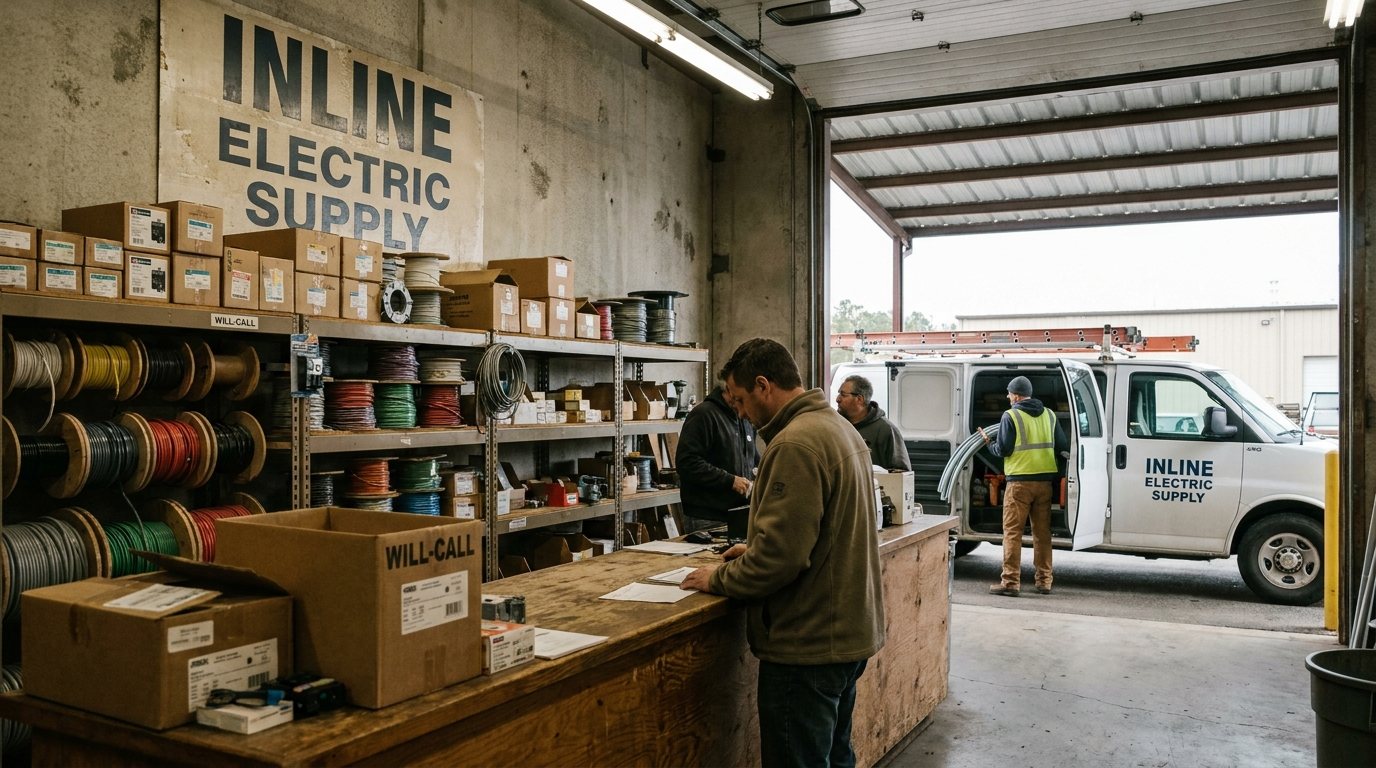
Inline opened its first counter in Huntsville, Alabama, in 1988, selling wire, conduit, and panels to the contractors building out a region that was then mostly aerospace and defense work. The company's own account of that period is plain: keep local inventory deep, keep pricing sharp, keep service fast enough that a contractor with a stalled jobsite doesn't have to think twice about calling. That is the entire playbook of a regional electrical house, and Inline ran it branch by branch for a quarter century before it became anything larger than a well-run Alabama company.
The expansion since has been steady rather than dramatic. Inline now operates 41 locations across Alabama, Tennessee, Georgia, and Florida, with more than 600 employees. Seventeen of those branches are in Alabama alone, a home-state density that mirrors how the best regional distributors actually grow: saturate the territory you understand before you go looking for a new one. Seven locations are dedicated lighting showrooms rather than standard supply counters, a signal that Inline treats lighting design and specification as its own discipline, not a shelf category bolted onto wire and conduit.
The pivot that matters more than the branch count
The branch map explains Inline's reach. It does not explain why the company still exists as an independent, privately held distributor in 2026, in a vertical where Sonepar, Rexel, and WESCO have spent two decades buying up exactly the kind of regional operator Inline was in the 1990s. The answer is the 2012 decision to convert to an employee stock ownership plan, making every employee a shareholder in the business they show up to run.
That is the unique fact worth naming plainly: Inline chose to sell itself to its own workforce rather than wait for a strategic buyer or a private equity platform to make an offer. It joins a short list of electrical distributors, alongside names like Border States, that treat employee ownership as a long-term structural choice rather than a one-time liquidity event for a founder. For a company that had already spent 24 years building a reputation on being the branch that answers the phone and has the part, an ESOP is a bet that the people who built that reputation are also the ones best positioned to protect it, because they now personally own the outcome.
What the ownership structure buys operationally
The strategic logic shows up in how Inline is built, not just in who owns it. A branch manager whose retirement account is denominated in company stock has a very different relationship to inventory accuracy, customer retention, and counter service than a branch manager reporting quarterly numbers to a private equity sponsor three ownership layers away. Inline's panel program partnerships with Eaton and Siemens and its lighting-consultation and energy-audit services are the kind of higher-touch, relationship-dependent offerings that tend to survive best in organizations where frontline staff aren't rotating through a portfolio-company playbook every few years.
There is a real trade-off, and it is worth naming rather than smoothing over. PE-backed and strategically owned rivals in electrical distribution can raise acquisition capital fast and roll up smaller houses in a single deal cycle. An ESOP structure finances growth more slowly, out of earnings and modest debt rather than sponsor equity, which is one reason Inline's expansion from one branch to 41 took nearly four decades instead of four leveraged years. The company has effectively chosen compounding branch density in four contiguous states over the kind of multi-region sprint that a buyout-funded competitor could execute. It is a slower flywheel, but it is one where the people spinning it keep the value it creates.
The quiet advantage of staying put
That patience is also why Inline's MDM placement is worth reading past the rank number. A #34 finish in electrical is not a company optimizing for the league table. It is a company that has spent since 1988 optimizing for the branch manager in Cullman or the counter clerk in Chattanooga having a direct stake in whether the truck gets loaded on time. In a vertical where scale increasingly comes from a buyer's balance sheet, Inline's scale still comes from tenure, density, and an ownership structure that keeps decisions close to the loading dock.
Every distributor on the MDM list wins or loses on some version of the same unglamorous inputs: what's in stock, who picks up the phone, and how clean the underlying product data is behind both. This series looks at how the companies on that list actually built those advantages.