
Kimball Midwest: The MRO Distributor With No Storefronts
Kimball Midwest ranks across four 2026 MDM lists without a single retail branch. Here is how a third-generation family business wins on trucks, not stores.
Part of Distributor Playbooks — strategy teardowns of every company on the MDM Top Distributors lists.
Kimball Midwest shows up four times on Modern Distribution Management's 2026 Top Distributors rankings — Industrial Supply #37, MRO #15, Fasteners #20, and Hose #8. That spread across four categories from one Columbus, Ohio company is unusual. So is the fact that you cannot walk into a Kimball Midwest store, because there isn't one.
The model: no branches, only trucks
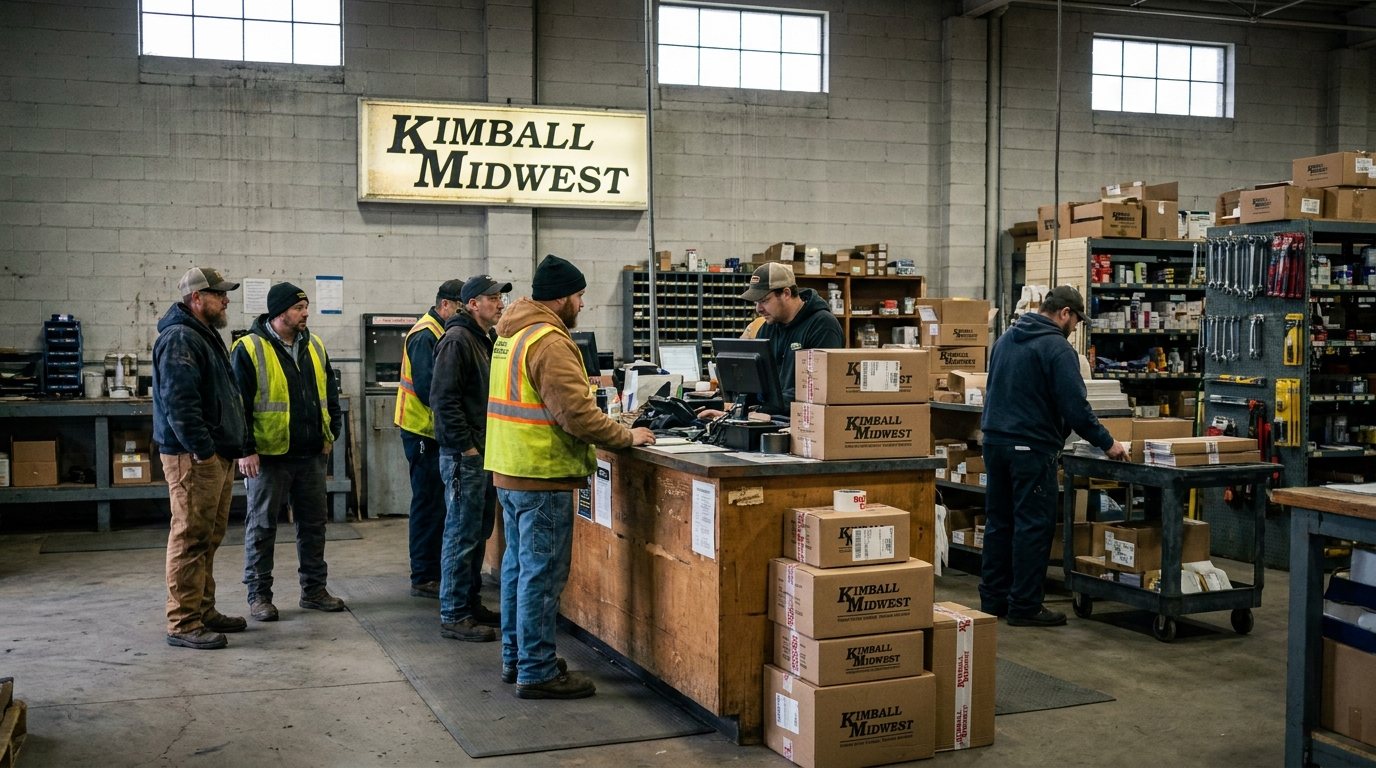
Grainger has stores you can drive to. Fastenal built its growth around a dense grid of small branches near customer sites. Kimball Midwest picked neither. Its distribution network runs through five distribution centers and more than 1,200 direct sales representatives, each one carrying rolling inventory in a van and calling on maintenance shops, fleets, and plant floors in person, according to Global Fastener News. There is no retail counter. There is no walk-in. The rep is the branch.
That is a genuinely different bet than most of its peers on the MRO and fastener lists made. A branch network scales by real estate: find a market, lease a building, staff a counter. Kimball Midwest scales by headcount and relationships: hire a rep, give them a truck stocked from one of the regional distribution centers, and let them build a route of maintenance accounts who reorder because the rep shows up, not because there's a location nearby. It is closer to a route-sales model than a classic industrial distributor, and it means Kimball Midwest's growth ceiling is tied to how many good reps it can hire and retain rather than how many square feet it can lease.
The tradeoff is real. A branch-based competitor can put inventory in front of a walk-in customer the same hour they need it. Kimball Midwest instead leans on fill rate from the back end: it says it can get product to more than 90 percent of customers next-day and hit same-day dispatch on the vast majority of orders, per Chief Executive. The bet only works if the logistics behind the reps are tight enough that "no branch nearby" never becomes a customer's problem.
Third generation, no private equity
The other detail worth naming plainly: Kimball Midwest is still a family business, three generations in, in a sector that has spent two decades consolidating under private equity and strategic roll-ups. Pat McCurdy Sr. bought into Midwest Motor Supply in 1950 and became sole owner by 1978. His son, Pat McCurdy Jr., carried the company through the 1984 merger that created the Kimball Midwest name. Patrick McCurdy III now serves as president, per Chief Executive's reporting on the company's centennial.
Compare that to the rest of the MRO and industrial-supply landscape, where names like Applied Industrial Technologies grew by acquisition and firms like WESCO trace back to a leveraged buyout. Kimball Midwest's growth from roughly $1 million in revenue in 1983 to more than $400 million today happened almost entirely organically, one rep and one new distribution center at a time, without a string of acquired competitors bolted onto the balance sheet. Staying private and staying in the family is a choice that trades the speed of a roll-up for control over culture and pace — the company has landed on multiple best-places-to-work and best-companies-to-sell-for lists nine years running, according to its newsroom.
From auto parts counter to industrial MRO
The founding story explains some of that patience. Midwest Motor Supply started in Columbus in 1933 as an automotive parts business. The Kimball Company was a separate Cleveland outfit founded in 1923. The 1984 merger of the two didn't just combine balance sheets, it repositioned an automotive-parts distributor into an industrial and MRO supplier serving fleets, manufacturers, and maintenance shops, a pivot that took decades to fully play out. That auto-parts DNA is still visible in the catalog. Fleet and vehicle maintenance products sit alongside fasteners, abrasives, and hydraulics in a line-up now numbering more than 55,000 SKUs.
The company has also built its own manufacturing angle rather than relying purely on resale, with proprietary lines like Kim-Krimp and Ultra Pro-Max, and it markets hard on domestic sourcing, stating that roughly 80 percent of its inventory dollars go to American-made goods built in American factories. For a distributor whose whole model depends on reps making the case for a product face-to-face, "made in America" functions as sales ammunition as much as it does supply-chain policy.
Recent momentum
The centennial year in 2023 doubled as a capacity expansion, with the opening of a 142,000-square-foot distribution center in Newtown, Connecticut, adding a sixth region of coverage on the East Coast and a $1 million community giving campaign tied to the milestone. Since then the company has kept stacking recognition rather than headlines: a 16th straight year on an industrial-suppliers ranking, a spot among finalists in the 2025 Americas B2B eCommerce Awards, and, in early 2026, president Patrick McCurdy III taking a speaking slot at the National Association of Wholesaler-Distributors' executive summit in Washington. None of it is a pivot. It reads like a company compounding the same model it picked forty years ago.
The strategic tension worth watching is scale. A rep-driven, van-based model works because reps can build trust route by route, but every new market means finding, training, and retaining another cohort of salespeople in a labor market that is not getting easier for field sales roles. Kimball Midwest has bet its next hundred years on that being solvable the same way it solved the first hundred: hire well, keep them, and let the relationship do the selling that a storefront can't.
Distribution wins like this rarely show up in a press release. They show up in a catalog that ships the right part, a rep who knows the account, and a warehouse system quiet enough that nobody notices it working.