
Kirby Risk: A Century-Old Family Distributor Still Winning
Kirby Risk ranks #26 on MDM's 2026 electrical distributor list. A century in, the company is still Risk-family led, and that tension is the whole story here.
Part of Distributor Playbooks — strategy teardowns of every company on the MDM Top Distributors lists.
Kirby Risk lands at number 26 on Modern Distribution Management's 2026 Top Distributors list for the electrical vertical, a solid mid-market position in a category dominated by Sonepar, Rexel, WESCO, and Graybar. What the ranking does not show is the more unusual fact underneath it: a company founded in 1926 in a blacksmith shop is still run, in 2026, by a descendant of the man who started it.
A $500 loan and a dead battery business
The company began as the Keiffer-Risk Battery Company, opened by J. Kirby Risk and Otto Keiffer in an abandoned blacksmith shop on North Second Street in Lafayette, Indiana, with $500 Risk borrowed from his father. Keiffer's tenure was brief. He withdrew that same fall due to illness, and George M. Tweedie stepped in as the new partner. By 1934 the venture had rebranded as the Kirby Risk Electric Co., a name that better matched where the business was actually headed: not batteries, but the electrical supply chain of a fast-industrializing Midwest.
That rebrand mattered more than it looks. Selling batteries in 1926 is a commodity trade. Selling electrical supply into factories, farms, and eventually data centers is a relationship business, and it is the one Kirby Risk chose to build around. Ninety-five years later, in 2021, the company marked that anniversary still headquartered in Lafayette and still bearing the founder's name.
Six businesses wearing one badge
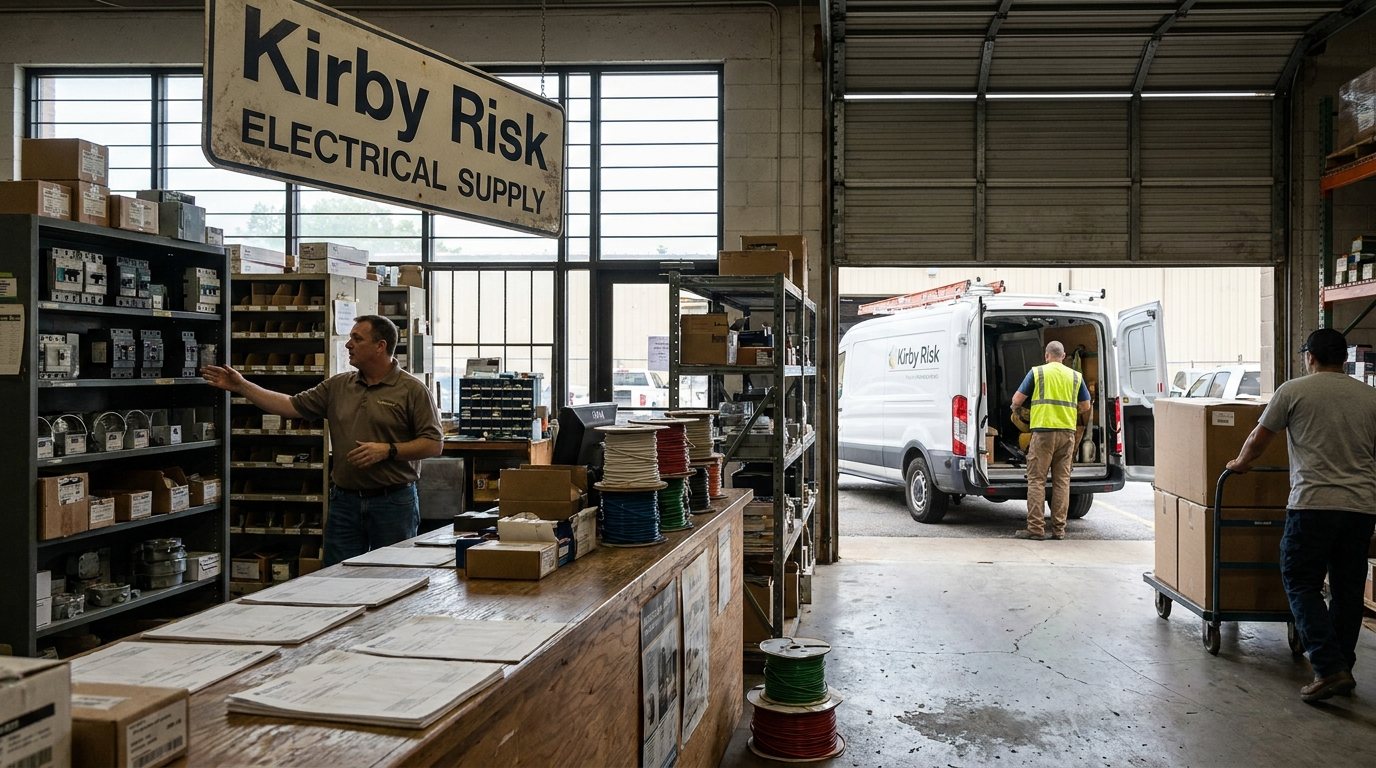
Most electrical distributors pick a lane: resale, or apparatus repair, or contract manufacturing. Kirby Risk runs six distinct business operations under one roof, spanning electrical distribution, electrical apparatus sales and repair, wiring harness and cable manufacturing, industrial component manufacturing, and logistics management, according to the Tecsys press release announcing its warehouse-system upgrade. That spread is the company's real moat. A distributor that only resells competes on price and fill rate. A distributor that also repairs motors, builds wiring harnesses, and manufactures industrial components has a second and third way to keep the same industrial customer's business when the resale margin gets squeezed.
The scale that supports those six businesses is not huge by national standards. More than 40 locations across Indiana, Illinois, Ohio, and Georgia, representing over 2,000 manufacturers and stocking roughly 90,000 products, per the same release. That is a fraction of what Sonepar or WESCO run. But it is enough density in the Midwest and Southeast corridor to make Kirby Risk a default call for industrial and contractor accounts in its footprint, and the manufacturing side means it is not purely at the mercy of distributor economics.
In February 2025, Kirby Risk selected Tecsys' Elite warehouse management system, integrated with its existing Eclipse ERP, specifically to handle the operational complexity that six business lines create: wire-cutting management and volumetric optimization are not problems a pure resale distributor needs to solve. Joe Hart, the company's EVP and SVP of Operations, framed it as reinforcing "our position as a leader in electrical distribution" rather than as a defensive catch-up move, which tracks with a company investing from a position of stability rather than crisis.
The family stayed, the bench professionalized
Here is the tension worth naming plainly: Kirby Risk is one of the few companies at this scale in electrical distribution still controlled by its founding family, in a vertical where the biggest names are a French conglomerate (Sonepar), a public company (WESCO), another French conglomerate (Rexel), and an ESOP (Graybar). James Kirby Risk III holds the title of President and CEO today, a hundred years after his forebear borrowed $500 to open a blacksmith-shop battery shop, per the company's MDM profile.
That kind of longevity usually comes with a tradeoff: family control can mean the operating bench stays thin, insulated from the talent that flows through the big national players. Kirby Risk's answer was to import it. John Eggleton, president of the company, came up through Affiliated Distributors, supplyFORCE, Grainger, and Deluxe Corporation before joining Kirby Risk, according to his NAED leadership profile reported by tED magazine. In June 2026 he began a two-year term as Board Chair of the National Association of Electrical Distributors, succeeding Paul Kennedy of DSG. A mid-market, family-controlled distributor now has its president chairing the industry's own trade association, which is a level of influence that revenue rank alone would not predict.
That combination, family ownership at the top, professional operators recruited from the industry's largest players filling out leadership underneath, is not the model most of Kirby Risk's larger competitors use. It lets the company keep the patient capital and long time horizon that family ownership tends to produce, while still plugging into the same talent networks that Grainger and its peers rely on.
Betting on electrification, not just holding share
Kirby Risk's own public commentary is not modest about where growth comes from next. In an August 2024 tED magazine feature, Eggleton described expecting "exponential growth over the next decade" tied to electrification, reshoring, SMART manufacturing, and AI infrastructure buildout, the same demand wave pulling copper, switchgear, and controls through every electrical distributor's warehouse right now. For a company whose manufacturing arm already builds wiring harnesses and industrial components, that demand wave is not just more resale volume. It is more reason to lean on the parts of the business that look nothing like a typical distributor.
Distribution rankings measure revenue and rank, but they do not capture how a company got built or why it holds together. This series exists to look past the number and into the branch networks, catalogs, and century-long bets that make the electrical, industrial, and every other channel actually run.