
Kodiak Building Partners: The Roll-Up That Got Rolled Up
Kodiak Building Partners ranked #13 among MDM's 2025 top building-materials distributors, then became proof that the roll-up model rolls up its own.
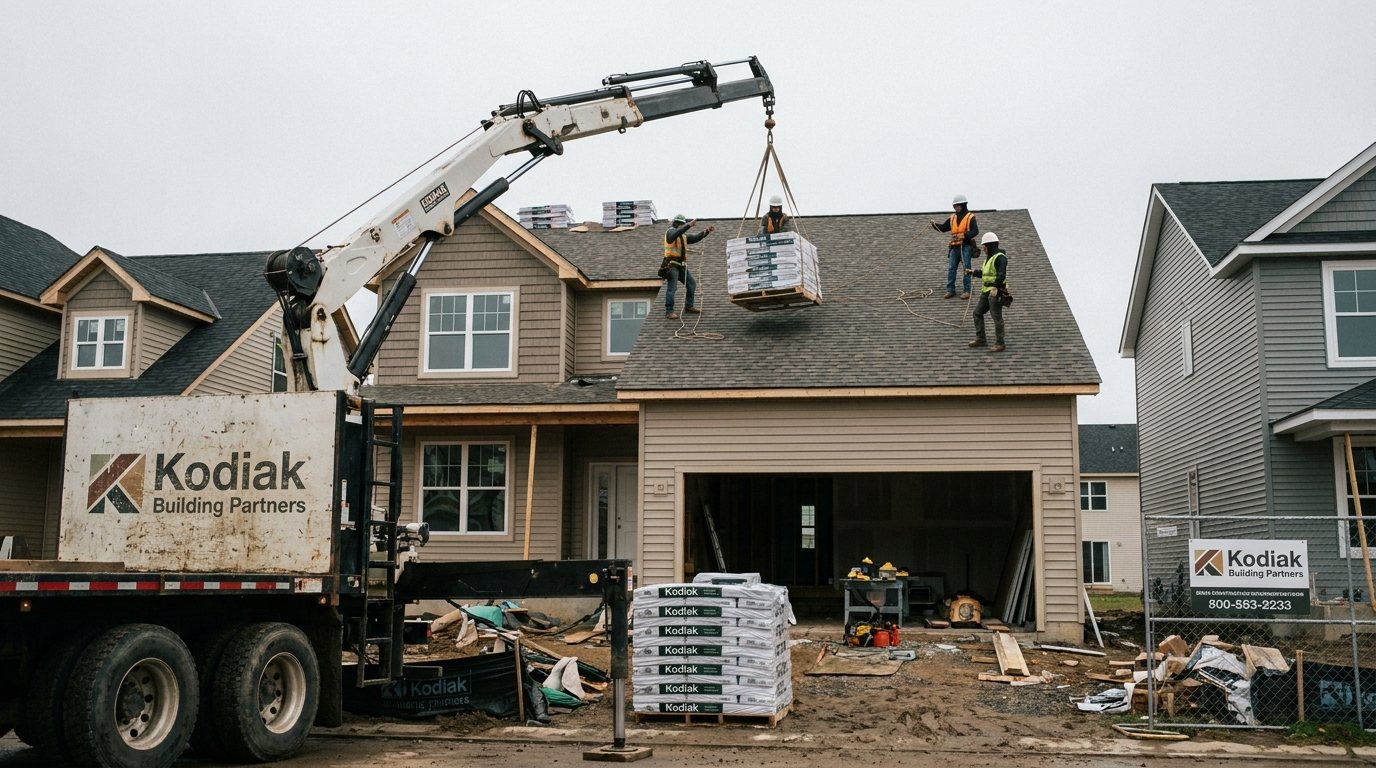
Part of Distributor Playbooks — strategy teardowns of every company on the MDM Top Distributors lists.
Kodiak Building Partners spent fifteen years perfecting a strategy: buy local building-materials dealers, leave their names on the sign, and let each one keep running like nothing changed. It worked well enough to land Kodiak at #13 on Modern Distribution Management's 2025 Top Distributors list for building materials, on $3.0 billion in 2024 revenue. It does not appear on MDM's 2026 Top Distributors lists. In early 2026, the exact playbook Kodiak had run for a decade and a half got run on Kodiak itself.
A roll-up that refused to look like one
Steve Swinney co-founded Kodiak in 2011 in Englewood, Colorado, with a bet that cut against the usual consolidation script. Most roll-ups buy small dealers and fold them into one national name, chasing brand recognition and a single ERP. Kodiak did the opposite: it bought family-run lumberyards, door shops, millwork houses and drywall suppliers, and left the local identity alone. The pitch to a seller was simple. You get liquidity and back-office scale, your customers never notice a change of ownership, and your name stays on the truck.
Over time that added up to a genuinely large distributor hiding behind dozens of small ones. By 2026, QXO's own transition page for the business listed more than three dozen former Kodiak brands still operating under their own names, among them Albeni, American Builders Supply, AO Doors, Barnsco, Barton, Builders Alliance, Christensen, Direct Lumber, Gross Yowell, Jenkins, Ponderosa, San Antonio, Simonson, Sunrise, Western and Zarsky. Most contractors buying lumber from Barton or windows from AO Doors likely never knew they were customers of the same $3 billion company.
Concentration where the growth was
Kodiak's footprint wasn't spread evenly. According to Benzinga's coverage of the sale, roughly 40 percent of the company's 2025 revenue came out of Florida and Texas alone, the two fastest-growing homebuilding markets in the country. That's not an accident of geography. It's the acquisition strategy showing its hand: Kodiak and its private equity backer, Court Square Capital Partners, weren't buying dealers at random. They were buying density in Sun Belt and Mountain West markets where housing starts, and the lumber, doors, windows and concrete supply that go with them, were growing fastest. A roll-up built on preserving local brands still needs a portfolio thesis behind which brands it buys, and Kodiak's was population growth.
The insight: the roll-up got rolled up
Here's the part of the story that makes Kodiak worth studying rather than just noting. On February 11, 2026, QXO agreed to acquire Kodiak for roughly $2.25 billion, structured as $2.0 billion in cash plus 13.2 million shares of QXO stock (subject to a repurchase option) and rollover equity for Kodiak employees, according to Insider Monkey's reporting on the deal. Swinney himself stayed on, tapped to lead the new lumber and building materials division inside QXO. The deal closed that April.
QXO is Brad Jacobs' latest consolidation vehicle, already the largest publicly traded distributor of roofing and waterproofing products in North America after absorbing Beacon Roofing Supply in 2025, and it moved to acquire TopBuild for roughly $17 billion just weeks after closing Kodiak. The Kodiak deal was explicitly framed as market expansion: it pushed QXO's addressable market past $200 billion and gave the roofing-focused company its first real foothold in lumber and general building materials, with an eye on selling more categories to the large homebuilders both companies already served.
Strip away the tickers and the math, and the pattern underneath is the interesting part. Kodiak built a $3 billion distributor by buying dozens of smaller distributors and running them as a quiet federation under one balance sheet. QXO just did the same thing to Kodiak, one level up, at ten times the scale, with the same logic: shared procurement, shared technology, shared capital, and local operators left mostly alone to run what they know. The roll-up that built its whole identity on absorbing others without erasing them became, in turn, a single line item absorbed by a bigger one. Kodiak's playbook didn't fail. It got out-scaled by an identical playbook with a larger checkbook behind it.
What it says about the moment
There's a real tension sitting inside that story, and it's worth naming rather than glossing over. The federation model that let Kodiak grow fast and keep local trust intact is the same model that made Kodiak itself an easy, clean acquisition: no messy rebrand to unwind, no customer relationships tied to a national name that a buyer would have to protect. Scale built through preserved local identity is portable. That's a feature for a buyer and, it turns out, a vulnerability for the seller once someone bigger decides the category is worth consolidating further.
For a private equity owner like Court Square, that portability is exactly the exit thesis: build something a strategic acquirer with a bigger platform can bolt on cleanly, then sell at the moment consolidation appetite peaks. Building materials distribution is in one of those moments right now, with a single public acquirer moving through roofing, lumber and building products in back-to-back multibillion-dollar deals inside of three months. Kodiak's own history explains, better than any press release could, exactly why it was buyable.
This series exists because distribution's real advantage rarely shows up on a homepage. It's in the branch network nobody notices, the catalog that stayed accurate through a change of ownership, and the local team that kept answering the phone the same way the week the sign changed.