
Lighting has a product-data problem — and 2026 is when it starts costing deals
Lighting's product data is stuck in PDFs and half-filled spec sheets. Here's what that costs in returns and lost search, and why 2026 raises the stakes.
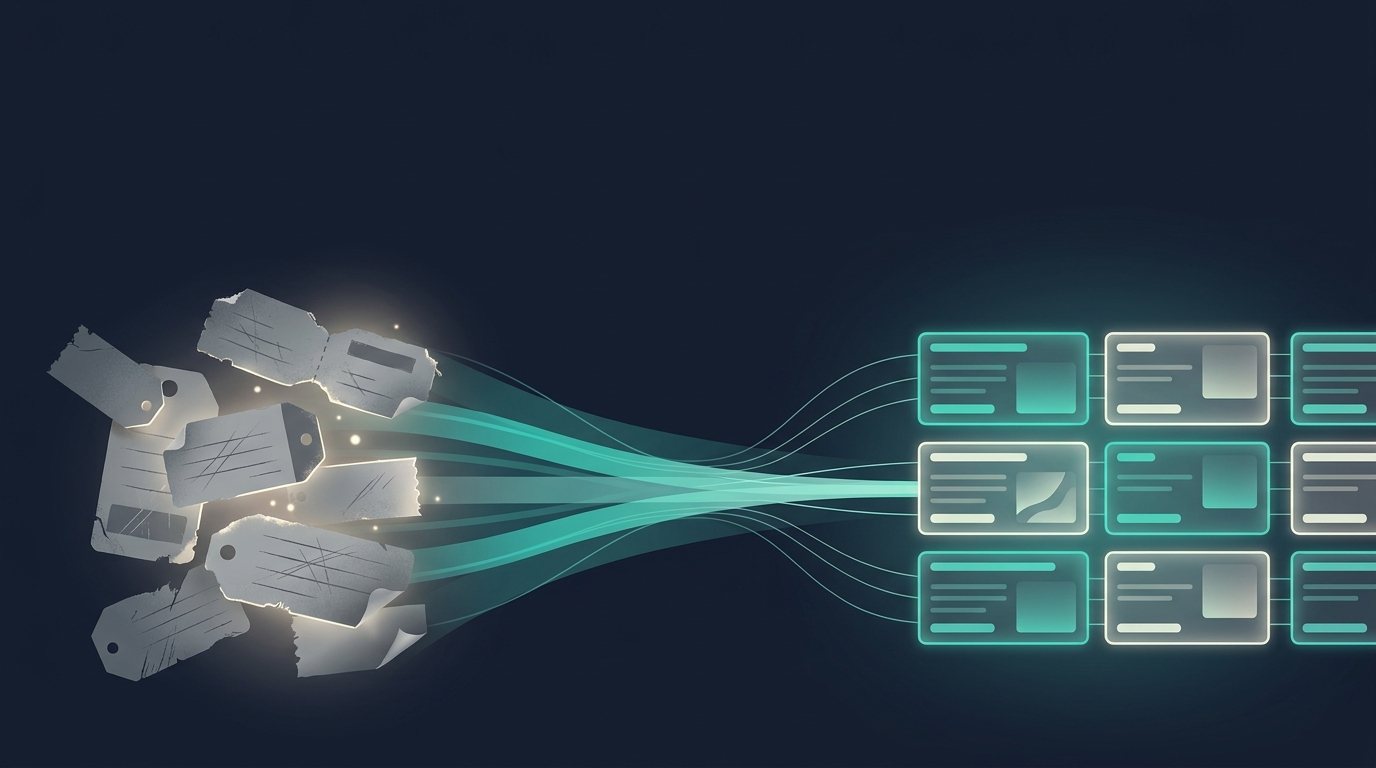
Walk any lighting distributor's website and you'll find the same pattern: a 2x4 troffer with a title, a wattage, and a stock photo, sitting next to a competitor's SKU with a full photometric file, CRI, DLC listing status, and 0-10V dimming range spelled out. Both are "live" in the catalog. Only one of them is actually sellable to a spec-driven buyer or readable by an AI shopping assistant. That gap is now a revenue problem, not a data hygiene footnote.
The catalog is inconsistent by design, not by accident
Lighting product data is unusually hard to keep clean because it comes from too many places at once: manufacturer PDFs, IES photometric files, DLC and Energy Star listing databases, NEMA/IEC enclosure ratings, and whatever a rep typed into a distributor ERP a decade ago. NEMA itself maintains a comparison guide between NEMA enclosure types and IEC IP ratings specifically because the two get conflated constantly in marketing copy and spec sheets — an IP65 claim means nothing to a buyer or a bot unless it's clear whether that rating applies to the fixture body, the optical chamber, or just the driver compartment.
The industry's answer to fragmented sourcing has been content syndication. IDEA Connector, the electrical industry's product-content platform (jointly owned by NEMA and NAED), now moves data for more than 1,000 manufacturer brands into roughly 8,000 distributor locations, syncing new items within 24 hours. That's real infrastructure — but syndication moves whatever attributes a manufacturer bothered to key in. If the source record is missing CRI, controls compatibility, or a current DLC QPL status, syndication just distributes the gap faster.
Meanwhile the spec surface keeps growing. DesignLights Consortium's SSL V6.0 and LUNA V2.0 requirements, effective January 2026, raised minimum efficacy thresholds roughly 14 percent and added new qualifying categories (low-CCT and amber LEDs, solar luminaires, horticultural fixtures) along with clearer controls-integration fields tied to the NLC-HVAC toolkit. Add to that nearly 950 North American municipalities with their own outdoor lighting ordinances, and every SKU now needs more correct attributes than it did two years ago, not fewer.
What incomplete data actually costs
None of this is abstract. Three costs show up on the P&L:
| Cost | How it shows up |
|---|---|
| Returns and RMAs | Wrong CCT, missing dimming compatibility, or an unclear voltage spec means the wrong fixture ships — and the buyer, not the catalog, absorbs the callback |
| Lost search and PDP conversion | A thin listing with no lumens, no CRI, no DLC status can't win a spec-filtered comparison against a competitor's complete one, online or in a distributor's own site search |
| Slower quoting and spec cycles | Reps re-key or call manufacturers to confirm attributes that should already be in the feed, adding hours to jobs that are increasingly won or lost on turnaround time |
That last one matters more right now: NEMA's own Electroindustry Business Confidence Index fell to 47.7 in May 2026, below the expansionary threshold, with manufacturers citing "rising costs and slower customer decision-making." When budgets are cautious and decisions take longer, a distributor whose PDPs answer a spec question in one look has a real edge over one whose PDP prompts a phone call.
Why 2025-2026 raises the stakes
Three forces are converging on lighting catalogs at once:
AI search is now a shopping channel. Buyers and AI shopping assistants alike need complete, structured attributes to compare fixtures — lumens, CCT range, CRI, dimming protocol, DLC/Energy Star status, IP or NEMA rating. A record that's missing half those fields doesn't get compared; it gets skipped. Ask an answer engine "best 2x4 LED troffer for a school hallway retrofit with 0-10V dimming and DLC Premium listing" and it can only surface fixtures whose data explicitly says so — not fixtures where that information exists only in a PDF nobody indexed.
The buyer is getting younger and more self-service. NAED has made workforce and digital self-service a stated strategic priority for the channel, launching a Digital Center of Excellence and partnering with e-commerce platforms specifically because buying behavior is shifting away from phone-and-counter transactions toward researched, online purchase paths.
Channel and regulatory pressure isn't slowing down. New DLC tiers, expanded municipal ordinances, and tariff-driven cost uncertainty all mean more attributes to track correctly, more often, with less room for a stale spec sheet to slide through unnoticed.
What a fixable record looks like
Here's the same 2x4 troffer, before and after:
Raw feed description: "LED Troffer 2x4 40W 4000K White Dimmable"
Enriched attribute table:
| Attribute | Value |
|---|---|
| Form factor | 2x4 ft recessed troffer |
| Delivered lumens | 4,800 lm (120 lm/W) |
| CCT | Selectable 3500K / 4000K / 5000K |
| CRI | 90+ CRI Ra |
| Dimming | 0-10V, 10%-100% |
| Input voltage | 120-277V |
| DLC status | DLC Premium qualified |
| Certifications | UL/cUL Listed, dry-location rated |
| Warranty | 5-year limited |
The raw version can't win a filtered search, can't answer a spec question, and can't be trusted by an AI assistant summarizing options for a buyer. The enriched version can do all three — and it's built from values pulled and quality-scored from the manufacturer's own documentation, not guessed.
Where this connects to the work
None of this requires ripping out a PIM, an ERP, or a syndication feed lighting distributors already depend on — the infrastructure that gets fixtures from manufacturer to catalog is doing its job. What's missing is the layer that keeps the attributes flowing through it complete, current, and consistent as the spec surface keeps expanding. That's the gap Anglera is built to close: your PIM or flat file stores the lighting catalog, and Anglera does the ongoing work of scoring, gap-filling, and enriching it — so the fixture that's technically "in the catalog" is also the one a buyer, a rep, or an answer engine can actually find and trust.