
How Lonestar Electric Supply Built a Top-15 Player in a Decade
Lonestar Electric Supply cracked MDM's 2026 top 15 electrical distributors just 11 years after founding. Here is the operating model behind the speed.
Part of Distributor Playbooks — strategy teardowns of every company on the MDM Top Distributors lists.
Lonestar Electric Supply landed at number 12 on Modern Distribution Management's 2026 Top Distributors list for the electrical vertical, with $1.7 billion in fiscal 2025 revenue, up three spots from No. 15 the year before. That placement sits next to distributors that have been operating since before World War II. Lonestar was founded in 2015.
The number that matters more than the revenue
Eleven years is nothing in electrical distribution. WESCO traces back to Westinghouse's supply arm in 1922. Border States has been employee-owned since 1968. Rexel and Sonepar are French holding companies with roots older than the interstate highway system. The electrical channel does not usually produce new entrants at scale, because the capital intensity of inventory and the trust required to get on a contractor's bid list both compound slowly.
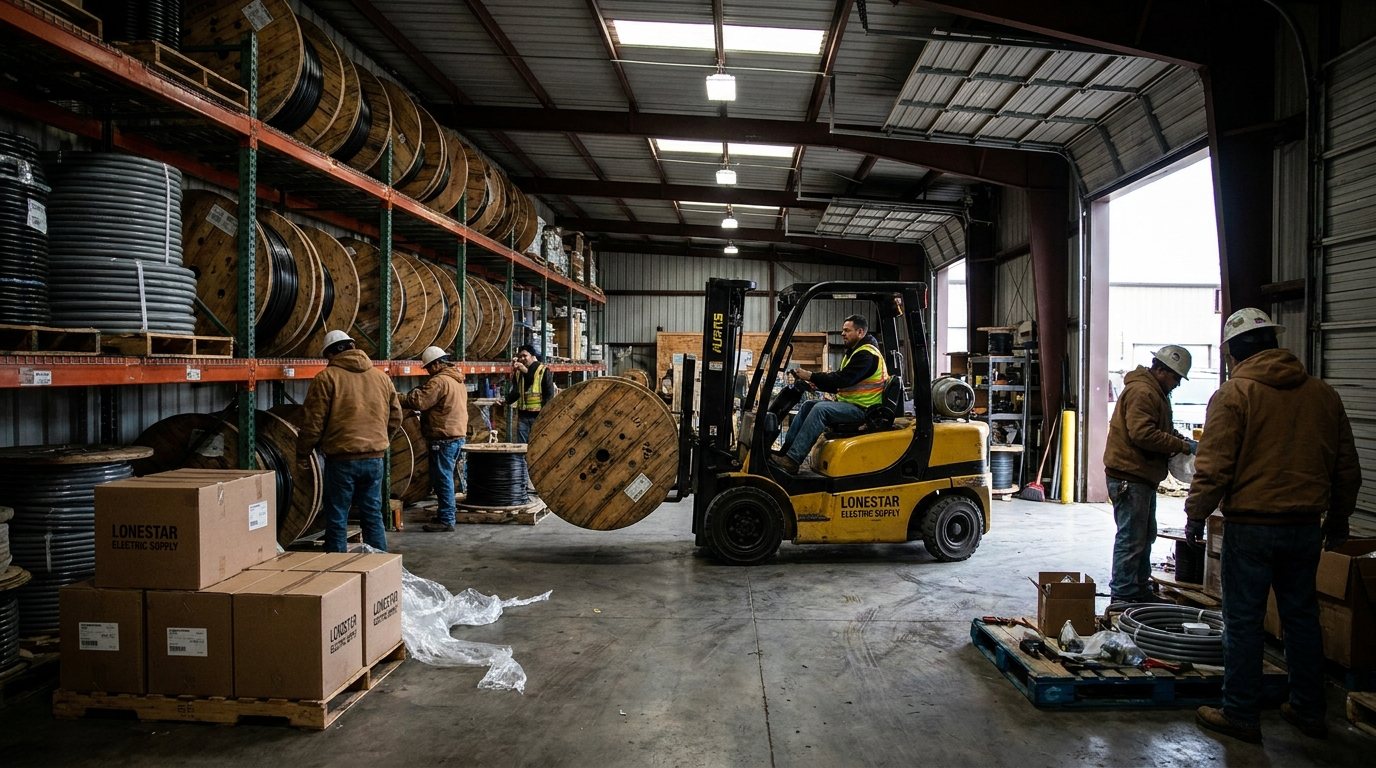
Lonestar compounded fast instead. Founded in Houston and describing itself as "the fastest growing wholesale electric distributor," the company has pushed from a single regional operation to 25-plus locations across Texas, Oklahoma, Louisiana and Tennessee, $275 million-plus in local inventory, 225-plus outside sales associates, and more than 6,000 customer accounts. Getting from zero to a $1.7 billion, top-15 national footprint inside one decade is the actual story here, and it did not happen by accident. It happened by design.
Win the market, then hand it to someone who already has
The mechanism is a market president structure layered under a holding-company architecture. Lonestar is not one brand doing one thing everywhere. It is a parent company running distinct operating units, Lonestar Equipment Solutions, Lonestar Integrated Solutions, and Lonestar Electric Industrial Supply among them, each with its own specialization and, increasingly, its own named leader accountable for a specific geography.
When Lonestar opened in Waco this year, the announcement did not center on square footage. It centered on Ricky Palmer, a 25-year veteran of the Waco electrical market, installed to run the branch, with Market President Derek Jones framing the move as leveraging eleven years of Dallas-Fort Worth infrastructure rather than starting cold. Northeast Oklahoma got the same treatment: a Broken Arrow facility timed to open summer 2026 to double the company's Oklahoma presence, justified by Market President Jason Rhines citing data center, manufacturing, and industrial demand in the Tulsa corridor. The pattern repeats across every expansion: identify a market already showing demand signals, then buy or build local credibility rather than parachute in a generic branch.
Bolt-on M&A as a shortcut around the trust problem
Greenfield branches cover new geography. Acquisitions cover geography plus an existing customer book, which is the harder asset to build from scratch in a relationship-driven channel. In July 2026, Lonestar acquired Industrial Cable Solutions, a roughly 25-employee distributor in West Monroe and Ruston, Louisiana specializing in industrial automation and structured cabling. CEO Jeff Metzler's framing was explicit about intent: ICS gave Lonestar an instant, credible position along the I-20 corridor rather than years of cold-calling contractors who already had a supplier. ICS keeps its existing facilities and staff. Lonestar keeps the relationships that took someone else a decade to build.
That is the pattern behind New Orleans, Baton Rouge, and Lafayette too: a Gulf South build-out that mixes new branches with targeted purchases, each one picked for a specific corridor or vertical rather than a blanket geographic sweep.
Reading the capex supercycle correctly
The newest piece of the model, a division called Lonestar CORE, launched in June 2026 under Lonestar Electric Industrial Supply president Kevin Hogan. CORE stands for CapEx, Optimization, Reliability, and Execution, and it exists to be a single point of accountability for materials on capital-intensive projects: data centers, utility interconnection work, combined-cycle generation, renewables, oil and gas pipelines. Hogan's own words were direct: customers are taking on bigger, more complex capital projects than distributors have historically had to coordinate for.
That is the honest tension in Lonestar's whole trajectory. The company's growth curve lines up almost exactly with the Gulf South and Southern Plains buildout of data centers, LNG infrastructure, and industrial manufacturing capacity over the past decade. A distributor built to move fast on emerging demand is extremely well positioned while that capex supercycle runs. The same speed and geographic concentration that built the top-15 ranking would be tested hard if hyperscaler and industrial capital spending in exactly those markets ever cooled at once. Lonestar has not diversified away from that exposure. It has doubled down on it, which is a legible bet, not a hidden one.
The insight, stated plainly
Lonestar's moat is not inventory or scale in the way a century-old distributor's is. It is organizational: a holding-company structure that lets each region operate like a locally led business while still rolling up into $1.7 billion of collective purchasing power and a national ranking. Most of the companies above Lonestar on the MDM electrical list built that structure over eighty or a hundred years. Lonestar built a version of it in eleven, by hiring market presidents with existing local reputations and buying companies that already had the customer trust a new branch would take years to earn.
Distribution rankings like MDM's tend to reward accumulated history. Lonestar's placement on the 2026 list is a reminder that the underlying advantages, local trust, inventory depth, catalog accuracy, technical sales relationships, can still be assembled quickly by a company willing to buy and hire its way to credibility rather than waiting to age into it.
This is the fourth installment of Distributor Playbooks, a series on the operating models behind the companies that move North America's physical goods, one branch, one catalog, and one truckload at a time.