
Main Electric Supply: One House, Three Independent Brands
Main Electric Supply hit #24 on the 2026 MDM electrical list by staying private and running three branch brands under one roof. Here is the model.
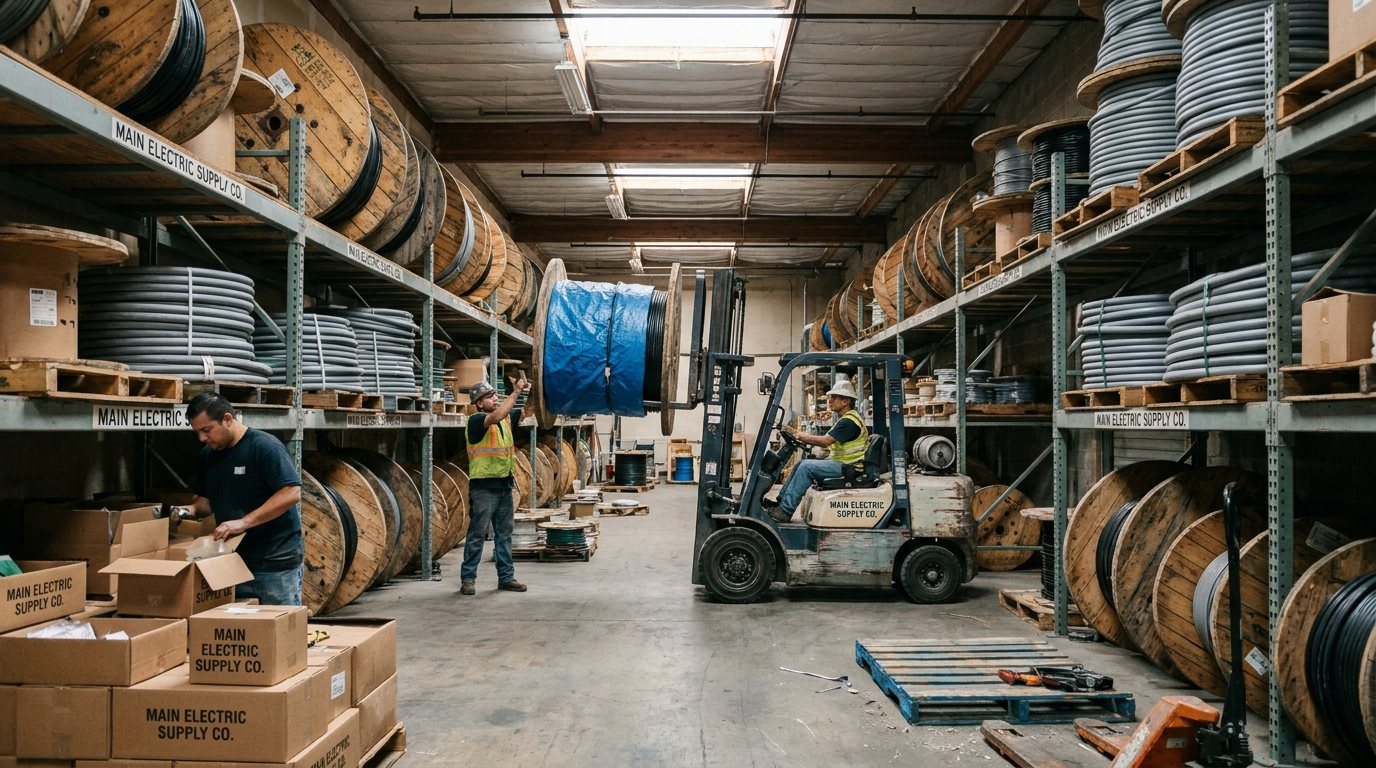
Part of Distributor Playbooks — strategy teardowns of every company on the MDM Top Distributors lists.
Main Electric Supply Company ranks #24 on Modern Distribution Management's 2026 Top Distributors list for the electrical vertical, the annual scorecard of North America's largest wholesale distributors. It got there from a standing start most of its national competitors no longer have: a single Los Angeles storefront opened in 1946 by two men, Charles Vowels and Burt McCombs, that never sold to a strategic acquirer or a private equity roll-up. Eighty years later it is still doing business the way it started, just with sixteen more branches and two more names on the door.
The house with three names on it
Pull up Main's own branch locator and something unusual shows up: alongside sixteen Main Electric Supply branches spanning California, Nevada, and Utah, the same list carries United Electric Supply, with locations in Chino and San Diego, and SAF-COM, in San Dimas. All three appear on Main's official locations page as part of the same network, run from the same corporate house.
That is a deliberate structural choice, not an accident of naming. National consolidators tend to fold every acquired counter under one master brand the moment the ink dries, chasing marketing efficiency and a single P&L story. Main has left United Electric Supply and SAF-COM standing as their own storefronts, in overlapping Southern California territory the flagship brand already covers. The likely logic: a contractor who has ordered from United Electric Supply for twenty years keeps ordering from United Electric Supply, under a name and a counter crew they already trust, while the parent company captures the volume, the purchasing scale, and the balance sheet underneath. It is a quieter way to grow share without asking anyone to change their habits.
Three desks, not one price list
Main organizes its quoting operation around three specialized departments rather than a single generalist sales desk. Per Main's own services pages, a Lighting department builds product-list analysis and competitive packaging for fixture jobs; a Switchgear department runs job-variable analysis and multiple pricing scenarios to help contractors win distribution-equipment bids, with dedicated project-management and receivables staff; and a Commodities desk actively tracks wire, conduit, and raw-material markets to time purchasing.
That structure matters more than it sounds. Lighting and switchgear are quoted and specified differently from a spool of THHN wire, on different timelines, against different competitors, with different margin math. A distributor that routes all three through one generalist counter either underprices the complex jobs or overstaffs the simple ones. Splitting the desks is a small operational bet that shows up as win rate on the bids that carry the best margin.
The part that never shows up on an invoice
Main also runs a service layer that looks more like a job-site subcontractor's toolkit than a wholesale counter's price sheet: pre-fabrication and kitting, on-site inventory management, night deliveries timed to avoid daytime site congestion, custom labeling, material take-offs, and in-house metal fabrication and powder-coating, according to Main's services overview. None of that is core to moving electrical product from a warehouse to a truck. All of it is labor-intensive, hard to staff, and genuinely difficult for a thinner competitor to copy quickly, which is exactly why a distributor with real branch density chooses to offer it. It converts a commodity purchase into a relationship a general contractor has to actively decide to leave.
Three customer motions, one supply chain
Main also splits its go-to-market by segment rather than treating "electrical contractor" as one buyer. It runs separate playbooks for commercial contractors, residential builders working custom, tract, and multi-family product, and industrial OEM and MRO accounts, per its industries page. Each of those buyers cares about a different thing first: the commercial contractor wants total acquisition cost and specification compliance, the residential builder wants a program that scales with a subdivision schedule, the industrial MRO buyer wants uptime. Running three go-to-market motions off one inventory pool is harder than running one, but it is how a mid-size regional distributor competes with national accounts teams without matching their headcount.
The insight: still independent, eighty years in
The plain observation worth naming: Main Electric Supply has stayed privately held for eight decades in a channel where the recognizable national names have mostly changed hands, merged, or been assembled by outside capital over the last two decades. Main did the opposite. It built scale by adding branch brands under its own roof rather than being added to someone else's, and it shows up as a 2024 Inc. 5000 honoree and a named Top Workplace, both signals of an organization still growing on its own terms rather than being optimized for a sale.
That is a real trade-off, not just a nicer story. An independent regional player can move faster on service decisions like the metal-fab shop or the night-delivery schedule than a division inside a larger portfolio company waiting on a corporate playbook. What it gives up is the purchasing scale and the balance sheet of a Sonepar or a WESCO. Landing at #24 nationally while staying private is the evidence that, in electrical distribution, the trade-off still works.
Every distributor on this list runs on the same unglamorous machinery: a catalog that has to be right, a branch network that has to be in the right place, and data that has to move as fast as the trucks do.