
McKesson: How the Biggest Pharma Distributor Keeps Winning
McKesson tops MDM's 2026 Pharma & Healthcare list at $359.1B by owning oncology demand while quietly offloading its lowest-margin commodity business.
Part of Distributor Playbooks — strategy teardowns of every company on the MDM Top Distributors lists.
McKesson Corporation ranks #1 on Modern Distribution Management's 2026 Top Distributors list for Pharma & Healthcare, with $359.1 billion in FY2025 revenue. That number alone tells you McKesson moves more prescription drugs than any company in North America. It does not tell you the more interesting thing: a distributor this size has spent the last fifteen years quietly walking away from pure distribution, buying its way into the demand side of healthcare while handing off the parts of its business that look most like a commodity.
The moat is not the trucks
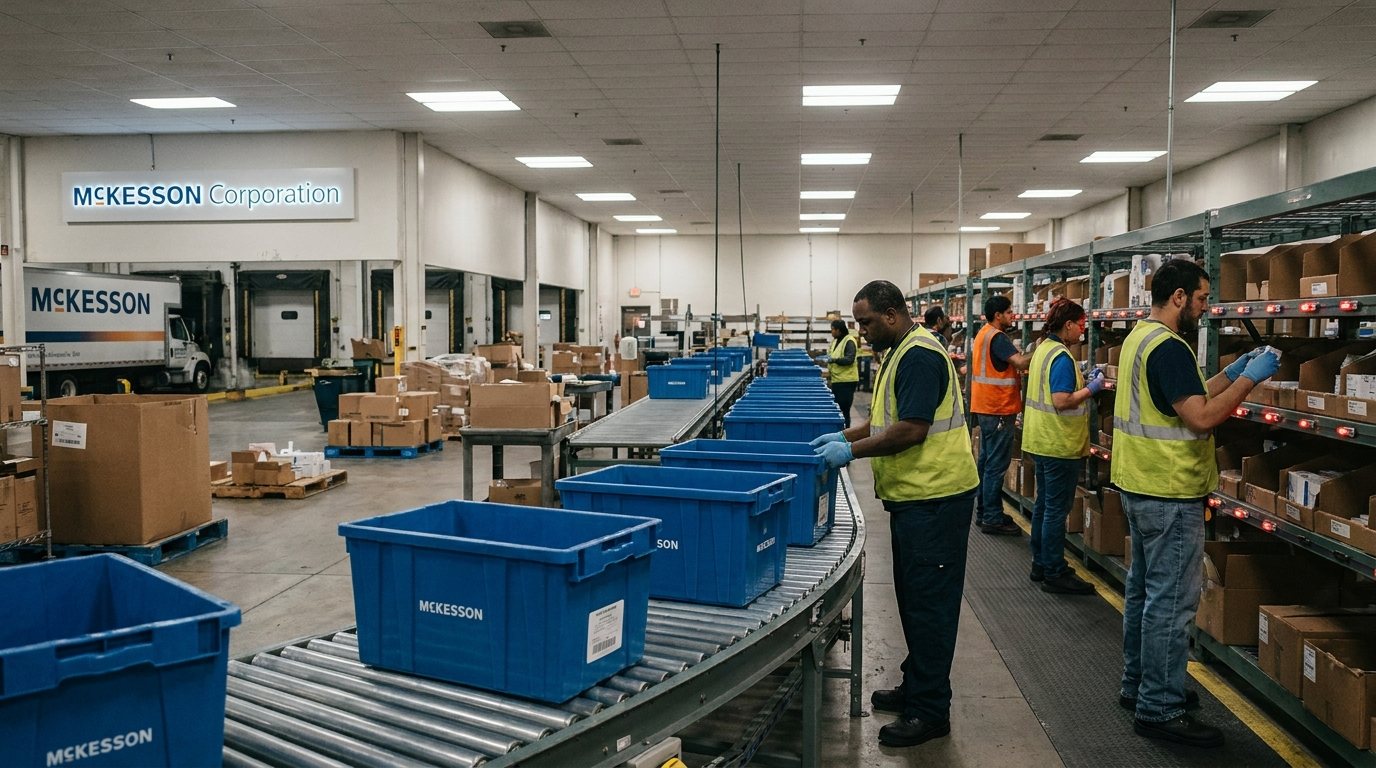
Pharmaceutical distribution is a brutal, thin-margin business by design. Wholesalers like McKesson, Cencora, and Cardinal Health operate on fee-for-service margins that round to low single digits, and the entire model depends on volume, working-capital efficiency, and not losing a manufacturer contract. McKesson runs more than 344 distribution facilities and completes roughly 40,000 deliveries a day to nearly every site of care in the country, per its own company overview. That density is real and it is hard to replicate. But density alone doesn't explain why McKesson trades at a premium to a pure logistics business, and it doesn't explain the last decade of deal-making.
Buying the demand side of the supply chain
The pivotal bet was oncology. McKesson bought US Oncology for $2.16 billion in 2010, a network of independent, community-based cancer practices, and has spent every year since deepening it rather than treating it as a bolt-on. Today The US Oncology Network supports about 3,300 independent oncology providers, and McKesson's Sarah Cannon Research Institute runs more than 700 active clinical trials, according to the company's oncology overview. This matters strategically in a way a warehouse count doesn't: oncology drugs are the highest-margin, fastest-growing category in specialty pharmacy, and a distributor that also owns relationships with the doctors prescribing those drugs shapes where the product goes, not just how fast it arrives. Community oncology, kept independent instead of consolidated into hospital systems, is McKesson's hedge against disintermediation by manufacturers or payers who would love to cut the wholesaler out.
The 2014 acquisition of German drug distributor Celesio for roughly $8.3 billion extended the same logic internationally, turning a North American wholesaler into a genuine global healthcare company. The pattern holds through the smaller, more recent moves too: a 2025 agreement to acquire 80% of PRISM Vision Holdings pushes McKesson into ophthalmology practice management, the same community-specialty playbook it ran in oncology, applied to a new therapeutic area.
The tell: giving away the commodity business
Here is the part that a company's own newsroom will not frame as a tension, but should be read as one. In May 2025, McKesson announced plans to spin off its Medical-Surgical Solutions unit, and in June 2026 it closed a deal bringing in Apollo Funds as a minority strategic investor in that same business. Medical-Surgical is the McKesson division that looks most like classic distribution: gloves, gauze, exam tables, commodity products sold on price to hospitals and physician offices. It is also the one segment where McKesson's competitive advantage is closest to zero, since the products are largely undifferentiated and price is the only lever.
That is the unique insight worth naming plainly: McKesson is not simply "the biggest pharma distributor." It is a company actively sorting its own portfolio into a high-margin, relationship-locked core (oncology, specialty pharmacy, biologics) that it is buying deeper into, and a low-margin, price-competed shell (medical-surgical supply) that it is structurally distancing itself from, even while both wear the McKesson name today. Most Top Distributors profiles show a company doing one thing well. McKesson is doing two contradictory things at once, and doing them on purpose.
Built on two scandals, not zero
McKesson's scale gives it the appearance of institutional inevitability, but the company's nearly two-century history includes two genuine near-death moments, not the survivor-story gloss usually applied to legacy companies. In 1938, McKesson & Robbins (as it was then known) was rocked by a fraud in which CEO Phillip Musica, operating under a false identity, had embezzled funds and inflated reported assets by roughly a quarter, one of the defining accounting scandals of the 20th century. Six decades later, the 1999 acquisition of HBO & Company was followed by accounting irregularities at HBOC that cut McKesson's share price roughly in half and led to executive prosecutions. Both episodes are more than a century and a half after founding, and both predate the modern management team by decades, but they are part of why McKesson runs an unusually conservative compliance and controls apparatus relative to its peers today. A company that has twice been burned by accounting failure tends to over-engineer the parts of the business regulators can see.
What the timeline shows
| Year | Move | Why it mattered |
|---|---|---|
| 1828 | Founded in New York as a botanical drug importer | Origin of the modern pharma wholesale model |
| 1938 | McKesson & Robbins fraud scandal | Near-death governance crisis |
| 1999 | HBOC acquisition and accounting fallout | Second governance shock |
| 2010 | US Oncology acquired, $2.16B | Pivot from pure distribution to owning specialty demand |
| 2014 | Celesio acquired, ~$8.3B | Became a global healthcare distributor |
| 2020 | Named CDC/HHS distributor for COVID-19 vaccines | Proof of logistics capacity at national scale |
| 2025 | Medical-Surgical spinoff announced; PRISM Vision deal signed | Selective de-integration alongside specialty expansion |
| 2026 | Apollo Funds takes minority stake in Medical-Surgical | Commodity segment financially separated from core |
Sources: MDM Top Distributors, McKesson About, McKesson Newsroom, Wikipedia: McKesson Corporation.
This is what distribution at scale actually looks like from the inside: not one business, but a portfolio of margins, sorted case by case, all riding on the same trucks, catalogs, and data that never make the headlines.