
Owens & Minor: The Distributor That Sold Its Own Name
Owens & Minor ranked #7 in Pharma & Healthcare on MDM's 2026 Top Distributors list, then sold its own founding business and brand name to private equity.
Part of Distributor Playbooks — strategy teardowns of every company on the MDM Top Distributors lists.
Owens & Minor placed #7 in the Pharma & Healthcare vertical on Modern Distribution Management's 2026 Top Distributors list, the annual ranking of North America's largest distributors, on $8.0 billion in FY2024 revenue. By the time that number was published, the company that earned it was already being sold off in pieces. This is the story of a 144-year-old medical-surgical distributor that grew by acquisition for two decades, then handed its own name to a private equity firm to bet everything on a smaller, different business.
A pharmacy that became a supply chain
The company traces to 1882, when G. Gilmer Minor and Otho O. Owens opened a pharmacy in Richmond, Virginia. It stayed a drugstore operation for most of a century, incorporating in 1926 and growing through the usual regional consolidation. The pivot into distribution as a discipline came in 1966, with the acquisition of Virginia A&J Hospital Supply, which moved the company from selling drugs at retail to moving medical and surgical products into hospitals. By 1970 it was running Cardinal Drug Centers stocking more than 25,000 items, and in 1988 it listed on the New York Stock Exchange as OMI, according to the company's own history as documented on Wikipedia.
The following two decades were an acquisition ladder typical of med-surg distribution, where scale is the only durable advantage against thin margins. McKesson Medical-Surgical came aboard for $152.1 million in 2006. Movianto brought a European logistics footprint in 2012. ArcRoyal added medical kitting in 2014. The largest deal in the company's history closed in 2018: Halyard Health's Surgical & Infection Prevention business for $710 million, adding sterilization wrap, exam gloves, and surgical drapes to the portfolio. Each acquisition was the same bet: more volume through the same distribution network lowers the cost of serving every customer on it.
The pivot nobody in med-surg distribution usually makes
Under CEO Edward Pesicka, who took over in March 2019, the company built out a second business alongside its core distribution operation: Patient Direct, selling supplies like diabetes management products, wound care, and respiratory equipment straight to patients through brands including Byram Healthcare and Apria, according to Accendra Health's own site. Distribution to hospitals is a volume game with compressed margins. Selling directly to patients with reimbursement behind it is a different, generally better-margin business. Owens & Minor spent years building both under one roof, which is unusual. Most large med-surg distributors stay in their lane.
The bet on patient-direct home care got bigger in July 2024, when the company agreed to acquire Rotech Healthcare, a home respiratory and durable medical equipment provider, for $1.36 billion. That deal collapsed in June 2025. Owens & Minor terminated the agreement citing regulatory hurdles and paid an $80 million termination fee, per the company's own disclosed history on Wikipedia. It was a costly signal that the regulatory environment around consolidating home respiratory care had gotten harder, not easier.
Selling the name to keep the strategy
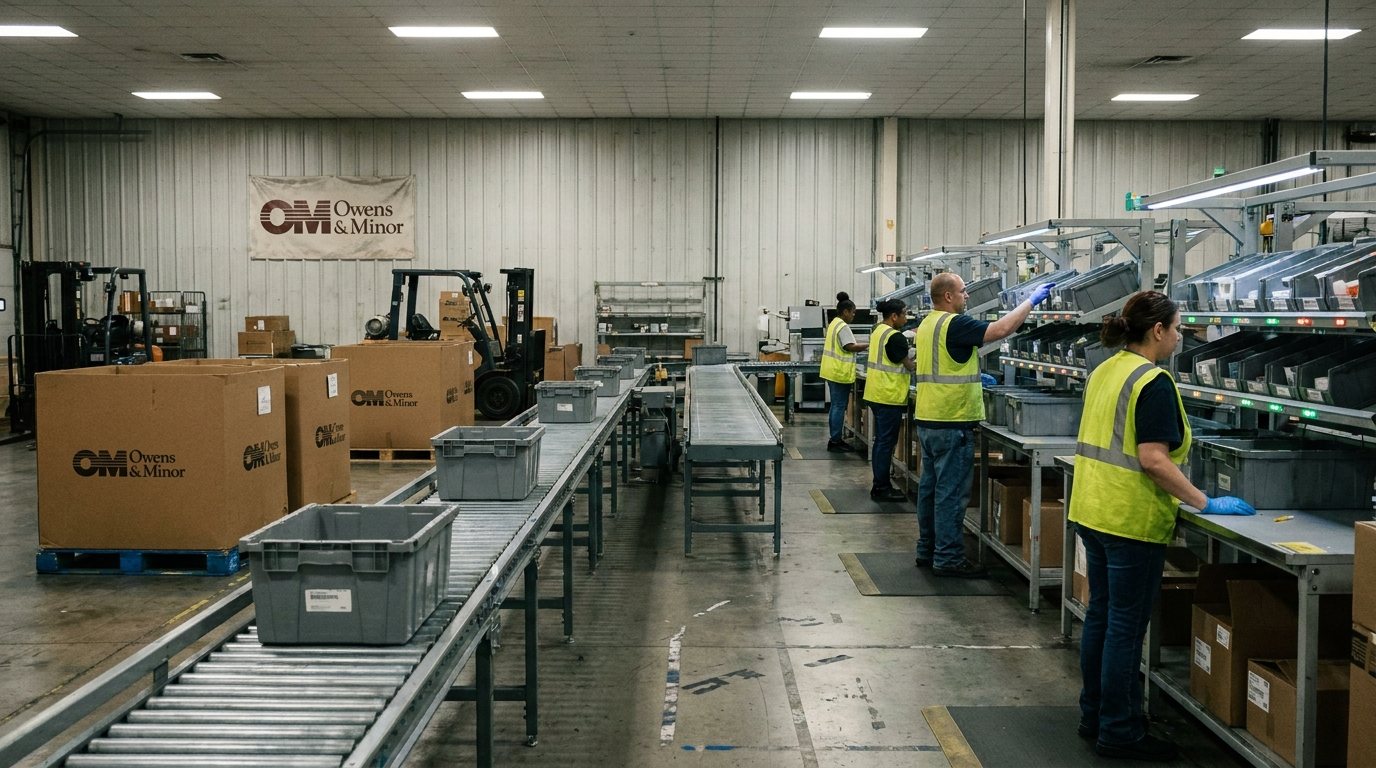
What happened next is the part of this story that makes it worth telling. In October 2025, Owens & Minor announced a definitive agreement to sell its entire Products & Healthcare Services segment, the original 1966-vintage medical-surgical distribution business that had just earned the company its #7 spot on MDM's list, to Platinum Equity for $375 million in cash plus a retained 5 percent equity stake and more than $150 million in preserved tax attributes. The deal closed December 31, 2025. On December 18, ahead of that closing, the company announced it was renaming itself Accendra Health, Inc., according to reporting on the transaction. Platinum Equity took the Products & Healthcare Services business and the Owens & Minor brand itself. The publicly traded parent kept Apria and Byram Healthcare, and nothing else.
Here is the insight worth naming plainly: distributors almost never divest the business that made them a distributor. The distribution arm is usually the ballast, the stable core a company keeps while it experiments elsewhere. Owens & Minor inverted that. The unit that generated the $8.0 billion and the MDM ranking was the one it let go, brand included, while it kept a newer, smaller, home-care-only operation running fewer than 300 service locations with roughly 6,000 employees under a name nobody outside the industry has heard yet. A company can outgrow its own founding business, decide the founding business is worth more to somebody else, and keep the parts built in the last five years instead of the parts built in the last hundred and forty.
That is a real strategic bet with a real trade-off, not an obvious win. Patient-direct home care runs on better unit economics than hospital distribution, but it is also a more fragmented, reimbursement-exposed market where the failed Rotech deal shows how hard it is to add scale through acquisition. Owens & Minor, the entity, now belongs to a private equity firm and reports to nobody outside its own board. Accendra Health, the entity that used to be Owens & Minor, is smaller, more concentrated, and betting its whole existence on one segment succeeding where the other one, after 144 years, apparently could not carry the corporate name forward on its own.
Every ranking on a list like MDM's Top Distributors is a snapshot of a moment, and moments in distribution change faster than the branch signage does. The catalogs, the fill rates, and the freight lanes behind a number like $8.0 billion outlast the corporate identity that reported it, which is the quiet lesson this one leaves for the rest of the channel.