
Medline: How a Family Distributor Ended Up Public Anyway
Medline spent 55 years avoiding public markets, sold for $34B in 2021, then IPO'd anyway in 2025 for even more. Here's the strategy behind that detour.
Part of Distributor Playbooks — strategy teardowns of every company on the MDM Top Distributors lists.
Medline Industries lands at #5 on Modern Distribution Management's 2026 Top Distributors list for Pharma & Healthcare, with $28.4 billion in FY2025 revenue. That figure is almost quaint next to what happened to the company in the eighteen months after: a $34 billion leveraged buyout followed by the largest IPO of 2025. Medline's real story isn't the rank. It's the decades it spent trying not to need one.
A garment factory, not a hospital supplier
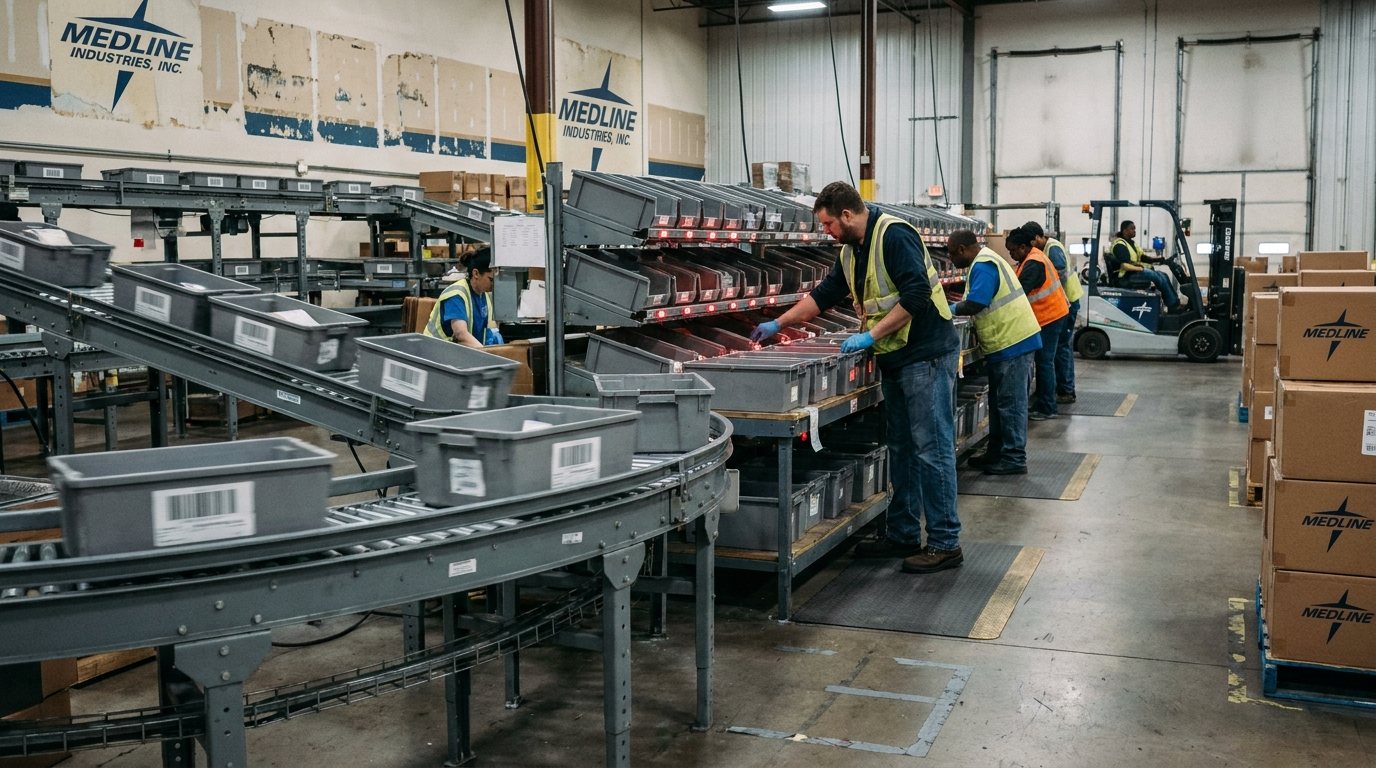
Medline's roots go back to 1910, when A.L. Mills started the Northwestern Garment Factory in Chicago. His son Irving pushed the business into hospital supplies in the 1920s, then sold it to the conglomerate Cenco in 1961. Irving's sons, Jim and Jon Mills, didn't stay bought. In 1966 they started over, founding the modern Medline out of a roughly 12,000-square-foot warehouse in Evanston, Illinois, with one loading dock, according to the company's history. Sixty years later that warehouse is a $28 billion-plus distribution business with more than 550,000 SKUs moving through 50-plus North American distribution centers into 125 countries.
The moat was the factory, not the catalog
Most hospital-supply distributors buy from manufacturers and sell into hospitals. Medline built factories first. It opened its first textile plant in Covington, Indiana in 1968, then bought its way into injection-molded plastics in 1972, well before it formally organized a standalone "distribution" arm in 1996. That sequencing matters. Medline treated manufacturing as the core capability and distribution as the delivery mechanism, not the other way around. Owning production gave it margin control that pure-play distributors don't have and let it build a private-label business years before "private label" became standard distributor strategy. It acquired the Curad first-aid brand from Beiersdorf in 2007, layering a retail-facing consumer brand onto a hospital-facing manufacturing base.
Fifty-five years of staying out of the market
Here's the part of Medline's story that reads strangely against the rest of its sector: for over half a century it stayed privately held and family-run while nearly every one of its healthcare-distribution peers went public, got rolled up, or both. Cardinal Health, McKesson, and Owens & Minor all trade on public markets and have for decades. Medline didn't need the capital. Manufacturing margin funded its own growth, and the Mills family kept control tight enough that no board of outside directors ever forced a listing. That's the unique insight worth naming plainly: Medline is a case of a distributor treating public markets not as a milestone to reach but as a risk to avoid, for as long as the balance sheet would allow it.
The balance sheet allowed it until June 2021. That month, a consortium of Blackstone, Carlyle, and Hellman & Friedman bought Medline in a deal valuing the company at roughly $34 billion, one of the largest leveraged buyouts in history. Even then, the family didn't sell to the public. It sold to private equity, and Charlie Mills stayed on as board chair. The company chose the most private possible exit from private ownership.
The detour that ended where it started
Then, in December 2025, Medline went public anyway. The IPO priced at $29 a share, raised more than $6.3 billion, and the stock jumped roughly 40% on its debut to close near $40, making it the largest US IPO of 2025, trading under the ticker MDLN. Jim Boyle, who became CEO in October 2023, now runs a company valued north of $37 billion, more than four times the enterprise value MDM credited it with just two years earlier.
Sit with the sequence: fifty-five years avoiding the public markets, followed by a private-equity buyout that was itself supposed to be the alternative to going public, followed four years later by going public anyway, at a higher price. Medline didn't resist the stock market. It just insisted on arriving there on terms it controlled, after building the industrial base and the buyer group that would let it dictate the valuation rather than accept whatever the market offered a family business walking in cold. Most companies avoid an IPO because they aren't ready. Medline avoided one because, for five decades, it didn't need what an IPO buys.
What the rank actually measures
MDM's #5 placement in Pharma & Healthcare captures Medline mid-transition: a distributor still built like a manufacturer, still selling clinical consumables and surgical packs into hospitals through the same kind of direct sales force it's used for decades, but now carrying public-market scrutiny for the first time in its history. The 45,000 employees moving product through those 50-plus distribution centers didn't change with the ticker symbol. What changed is who Medline now answers to on a quarterly cadence, after answering only to itself and a handful of investors for as long as it possibly could.
| Era | Event |
|---|---|
| 1910 | A.L. Mills founds Northwestern Garment Factory |
| 1961 | Irving Mills sells hospital supply business to Cenco |
| 1966 | Jim and Jon Mills found modern Medline in Evanston, IL |
| 1968-1972 | Medline builds textile and injection-molding manufacturing |
| 2021 | Blackstone/Carlyle/Hellman & Friedman buy Medline, ~$34B |
| 2025 | Medline IPOs on Nasdaq (MDLN), raises $6.3B |
Distribution rankings measure a single year of revenue. They rarely capture the decades of ownership decisions, manufacturing bets, and capital-structure choices that got a company to that line on the list. Medline's climb is a reminder that the moat is built long before the catalog ever ships.