
McLane: The Distributor Walmart Sold and Still Depends On
McLane Company made the 2026 MDM Top Distributors Food & Beverage list. Here is how a company Walmart sold in 2003 still supplies Walmart's shelves today.
Part of Distributor Playbooks — strategy teardowns of every company on the MDM Top Distributors lists.
McLane Company shows up on Modern Distribution Management's 2026 Top Distributors list in the Food & Beverage category, one of twenty verticals MDM tracks across North America's largest wholesalers. McLane does not disclose revenue on its own, because it has not been an independent company since 2003 — but parent Berkshire Hathaway's FY2025 10-K puts the segment at $51.0 billion for the year ended December 31, 2025. It is a Berkshire Hathaway subsidiary, and it is the supply line behind a huge share of the snacks, drinks, and fresh food sold at convenience stores and restaurants across the country.
A grocery store that became a warehouse
The company started in 1894, when Robert McLane opened a retail grocery in Cameron, Texas. By 1903 the family had flipped the model: instead of selling groceries to shoppers, they sold groceries to other grocers, shipping by rail and horse-drawn wagon around Central Texas. That inversion, retailer to wholesaler, is the same move the company has been running for 130 years, just at a scale Robert McLane could not have imagined.
The company moved to Temple, Texas in 1966 and, under Drayton McLane Jr. starting in 1976, expanded outward from grocery into the convenience store channel that was then exploding across the country. By 1990 McLane had a genuinely national footprint. That was also the year Drayton McLane sold the company to Walmart, for 10.4 million shares of Walmart stock plus cash, according to Wikipedia's account of the company's history.
The sale that didn't end the relationship
Here is the detail that makes McLane worth studying rather than just noting: Walmart owned McLane for barely a decade, selling it to Berkshire Hathaway in May 2003 for $1.45 billion. But Walmart didn't stop being McLane's customer when it stopped being McLane's owner. Walmart and Sam's Club remained McLane's largest client relationship afterward, accounting for roughly a quarter of McLane's revenue as of the mid-2010s.
That is the unusual part of McLane's model: it is a captive supply chain that outlived its captivity. Most distributors either serve one dominant retail parent or serve nobody in particular. McLane did both, in sequence, and the divestiture didn't sever the dependency in either direction. Walmart still needed a distributor that knew its stores cold; McLane still needed the volume. Berkshire got a business with a built-in anchor customer it never had to negotiate into existence.
Building out from grocery into three businesses
Once independent of Walmart's balance sheet, McLane spent the 2000s and 2010s stacking categories onto its core grocery wholesale business rather than chasing new geography. The acquisitions tell the story of a company deliberately becoming three companies in one:
| Year | Acquisition | What it added |
|---|---|---|
| 2000 | AmeriServe Food Distribution assets | Foundation for McLane Foodservice, entry into restaurant chain supply |
| 2004 | C.D. Hartnett | Texas grocery wholesale density |
| 2006 | McCarty-Hull | Amarillo-market grocery reach |
| 2010 | Empire Distributors | Southeast beverage distribution |
| 2012 | Meadowbrook Meat Company | National foodservice protein distribution |
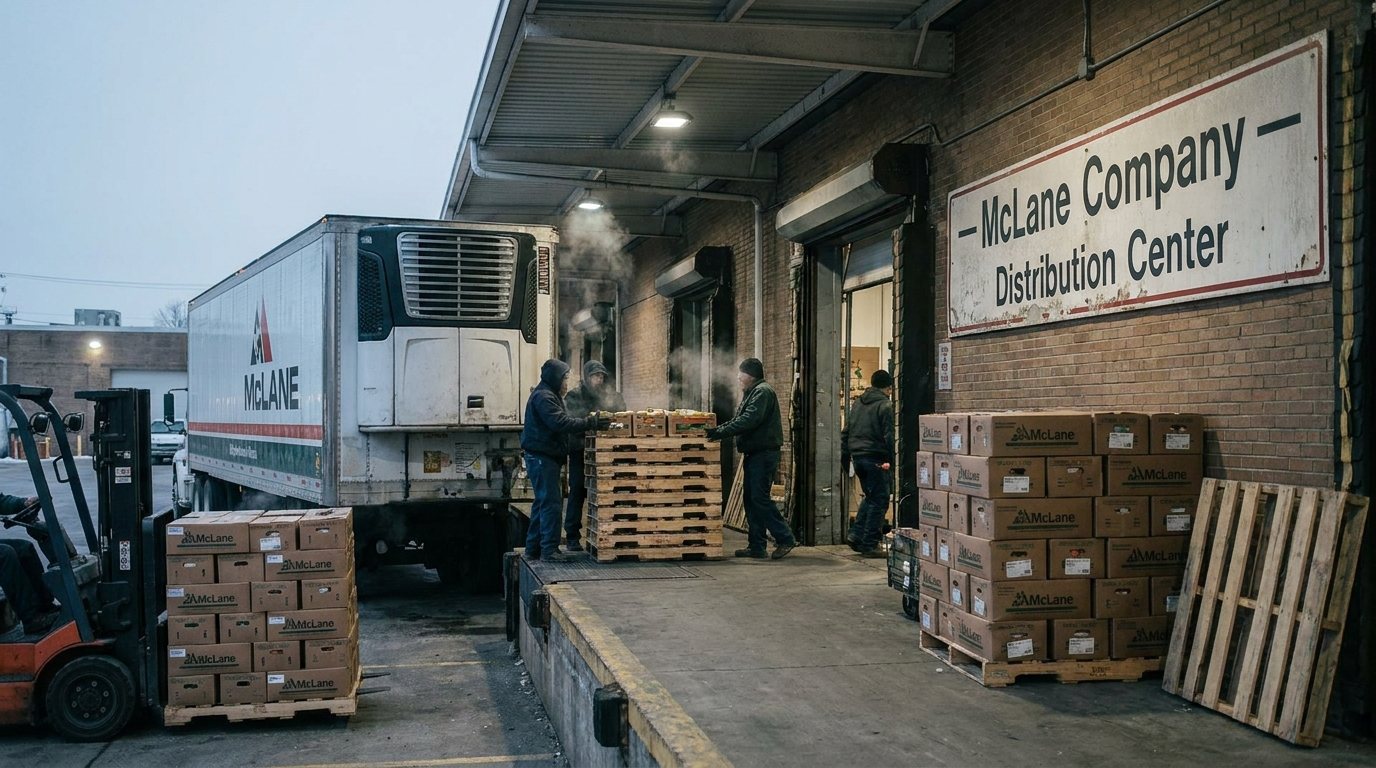
The result, per the company's own account, is a network of more than 80 grocery and foodservice distribution centers (plus one in Brazil) moving over 10 billion pounds of merchandise a year to roughly 110,000 locations, using a fleet that includes more than 6,100 multi-temperature trailers, according to McLane's own site. That multi-temp fleet detail matters more than it sounds: running frozen, refrigerated, and dry goods through the same truck and the same route is the actual engineering problem of foodservice distribution, and it's the reason grocery wholesalers and restaurant suppliers rarely cross into each other's lanes successfully. McLane built the capability to do both under one logistics network instead of running them as separate businesses that happen to share a logo.
Thin margins, enormous volume, quiet ownership
McLane's economics are the least glamorous part of the story and the most instructive. Distribution at this scale runs on volume, not markup. It is not the kind of business Berkshire is known for buying, no brand moat, no pricing power, no consumer mindshare. Buffett doesn't talk about McLane in shareholder letters the way he talks about See's Candy or GEICO, because there isn't a charming story to tell about trailer utilization rates. What McLane offers instead is dependable, unglamorous cash generation from a network that would be brutally expensive for a new entrant to replicate. That is a moat built entirely out of physical infrastructure and route density, which is a less quotable answer but a real one.
Where the next chapter is being written
The clearest signal of where McLane is placing bets right now is a May 2026 partnership with Aurora to pilot autonomous trucks on restaurant-supply-chain routes in Texas, moving from supervised pilots toward driverless long-haul runs. It is a fitting bookend: a company that started with horse-drawn wagons in 1894 is now testing trucks with nobody in the cab, on the same basic promise, get the product to the store reliably and cheaply. McLane is also leaning into supplier-facing programming, its McLane Engage conference returns in August 2026 with an AI-focused keynote, suggesting the next competitive fight in wholesale distribution is as much about who owns the data and automation layer as who owns the trucks.
None of this shows up on a receipt. The convenience store shelf, the restaurant walk-in cooler, the vending machine, all of it depends on a catalog, a route plan, and a truck showing up on time, which is the quiet infrastructure this series keeps coming back to.