
US Foods: How a Blocked Merger Built No. 2 Distributor
US Foods lands on MDM's 2026 Food & Beverage distributor list at $39.4B. A killed Sysco merger, not a signed one, shaped how the company actually grew from there.
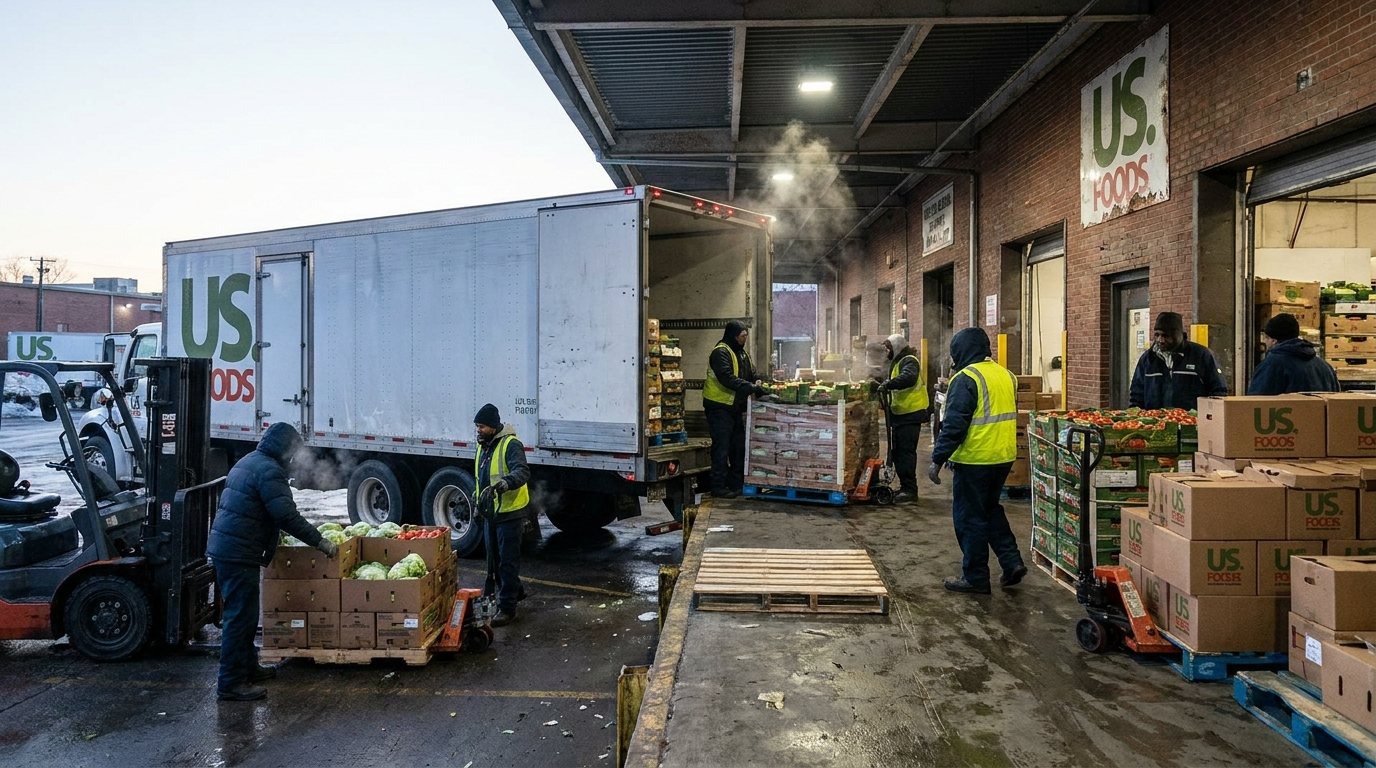
Part of Distributor Playbooks — strategy teardowns of every company on the MDM Top Distributors lists.
US Foods shows up on Modern Distribution Management's 2026 Top Distributors list in the Food & Beverage category at $39.4 billion in fiscal 2025 revenue, the field's clear number two behind Sysco. The more interesting fact isn't the ranking. It's that US Foods got to that size largely because a deal to make it much bigger, by merging with the company ahead of it, got killed by a federal judge in 2015.
A distributor assembled from other distributors
The company's oldest roots go back to John Sexton & Company, a Chicago food distributor founded in 1883. Sexton merged with S.E. Rykoff in 1983 to form Rykoff-Sexton, and around the same era Sara Lee spun off its foodservice division as JP Foodservice, which went public in 1994. Ahold bought the combined business in 2000 for $3.6 billion and renamed it US Foodservice, then sold it to private equity firms Clayton, Dubilier & Rice and KKR for $7.1 billion in 2007, according to Wikipedia's account of the company's history. The US Foods name arrived in 2011.
None of that is unusual for a mid-century distributor. Most of the industry's largest players are stitched together from decades of consolidation. What makes US Foods worth studying isn't the patchwork origin story. It's what happened right after the rebrand.
The merger that didn't happen
In December 2013, Sysco announced it would acquire US Foods for $3.5 billion, a deal that would have combined the two largest broadline foodservice distributors in North America. The FTC sued to block it, and in June 2015 Judge Amit Mehta agreed, ruling that the combined company would control roughly 75 percent of U.S. foodservice distribution and would meaningfully reduce competition, per Wikipedia's summary of the Sysco antitrust case. Sysco walked away from the deal a week later.
That ruling is the hinge of this story. US Foods spent 2013 through mid-2015 negotiating its own absorption into the market leader. When that path closed, the company had to prove, quickly, that it could grow as a strong number two rather than as a division of number one. It went public again in 2016, raising roughly $1 billion, and set about building scale the only way left available to it: buying dozens of smaller distributors, one region at a time, and buying its way into an adjacent channel.
The tuck-in engine and the retail pivot
Since 2010, US Foods has made roughly two dozen acquisitions. Most were modest regional tuck-ins: Renzi Foodservice in 2023, Saladino's Foodservice later that year, IWC Food Service in early 2024. Two were bigger and stranger. SGA Food Group came aboard in 2019 for about $1.8 billion. Smart Foodservice Warehouse Stores followed in March 2020 for $970 million, and it's the one that matters most, because US Foods didn't fold it into the truck-delivery business. It kept it as a walk-in, cash-and-carry warehouse chain and rebranded it CHEF'STORE.
That's the unique strategic choice in this profile: a broadline distributor that also runs its own retail stores, open to anyone who wants to walk in and buy a case of chicken thighs without placing a route order. Sysco doesn't operate anything like it at scale. For the independent restaurants and small operators too small or too unpredictable to justify a scheduled delivery, CHEF'STORE gives US Foods a second way to capture that volume instead of ceding it to club stores and cash-and-carry regional players. It converts a segment the core distribution model handles poorly into a channel built specifically for it.
What the model looks like today
US Foods now serves roughly 250,000 customer locations, with meat and seafood making up about a third of sales and dry grocery, refrigerated and frozen, dairy, supplies, produce, and beverages filling out the rest, per company materials referenced in its Wikipedia entry. The company has built out a technology layer around the core delivery business rather than treating it as an afterthought: the MOXē ordering platform, CHECK Business Tools for cost management, and Menu IQ for recipe-level profitability tracking, described on usfoods.com. Sales reps get backed by dedicated culinary consultants and business solutions specialists, pushing the relationship past order-taking into something closer to operational consulting for the customer's kitchen.
The growth since Dave Flitman took over as CEO in November 2022 has been steady rather than dramatic. Revenue reached roughly $39.4 billion for fiscal 2025, and the company has picked up sizable Defense Logistics Agency contracts worth more than $300 million, according to financial reporting on stockanalysis.com. None of it looks like the outcome of a company that got dealt a setback in 2015. It looks like the outcome of a company that had no choice but to figure out organic and inorganic growth simultaneously, and kept doing both after the excuse to stop had long expired.
The tension worth naming plainly: a strategy built to answer "what do we do since we can't merge with the leader" doesn't automatically stay disciplined once that constraint disappears. Two dozen tuck-ins is a lot of integration work, and a retail banner inside a wholesale distributor is a genuinely different business to run well at the same time. US Foods has managed both without a visible stumble so far, which is its own kind of proof.
Every distributor on this list wins or loses on the parts customers never see: the catalog behind the order, the data behind the catalog, and the trucks, warehouses, or storefronts that get it there on time.