
McMaster-Carr: How the Silent Giant of MRO Wins
McMaster-Carr ranks on six 2026 MDM lists while giving zero interviews. How a 124-year-old family firm built the best catalog in MRO and never explains itself.
Part of Distributor Playbooks — strategy teardowns of every company on the MDM Top Distributors lists.
McMaster-Carr shows up on six different lists in MDM's 2026 Top Distributors report — #5 in Industrial Supply, #3 in MRO, #4 in Fasteners, #3 in Safety, #8 in Fluid Power, #11 in Jan/San — and it will not confirm a single one of those figures. The company does not disclose revenue. It has never done a press interview in recent memory, run an ad, or issued an earnings call. It is also, by wide industry consensus, the best-run catalog operation in American industrial distribution. Those two facts are not in tension. They are the same strategy.
A 124-year-old company still owned by one family
McMaster-Carr traces to 1901, when T.J. McMaster, a former stationary engineer, and F.C. Davis, a former U.S. Navy chief engineer, opened the McMaster-Davis Supply Company in Chicago with $50,000 in capital, according to Wikipedia's company history. Walter S. Carr, an attorney with an engineering background, bought in by 1904, and the name flipped to McMaster-Carr within a few years. The Carr family has held control ever since, through a business now run day-to-day by longtime president and CEO James DeLaney, according to LegalClarity's ownership research.
That is the unusual part worth naming plainly: in a fastener and MRO distribution landscape that private equity has spent two decades rolling up into national platforms, McMaster-Carr has made zero acquisitions of note, taken no outside capital, and never filed for an IPO. It competes against public giants and PE-backed consolidators as a single-family-owned operating company that has simply never needed anyone else's money.
The catalog is the moat
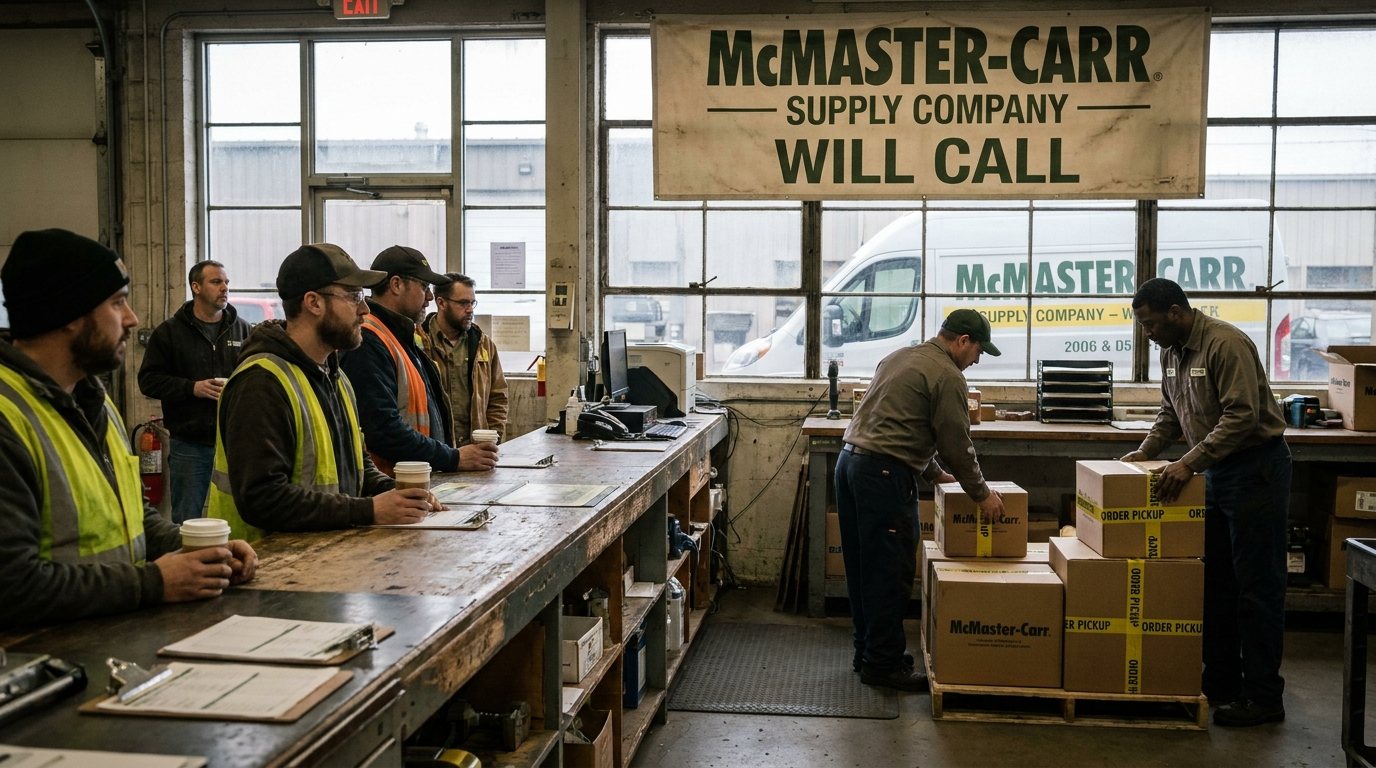
McMaster-Carr's real product is not any single bolt or bearing. It is finding the right one in seconds. The company stocks roughly 700,000 SKUs and fills 98% of orders for same- or next-day delivery, per reporting cited by Accio's 2025 supplier analysis. Every part page reads like it was built by an engineer for an engineer: exact tolerances, load ratings, material certs, CAD downloads, no marketing copy, no upsell banners. Procurement teams and product designers alike treat mcmaster.com as a default reference site the way developers treat Stack Overflow — a place you land on without ever having clicked an ad, because someone linked the part number.
That is the payoff of a print tradition the company has kept alive since its first 506-page catalog in 1908. The annual catalog is now a design-world artifact in its own right, and the website is its digital descendant: obsessively organized, fast, and utterly unbranded in tone. McMaster-Carr spends nothing convincing you it exists. It spends everything making sure that once you land there, you never want to search anywhere else.
Winning through logistics density, not sales reach
McMaster-Carr has no field sales force knocking on plant doors the way a Grainger or a Fastenal onsite rep does. Instead it wins on raw delivery physics: a small number of very large, very automated distribution centers positioned to blanket the country. Historically that meant hubs outside Chicago (Elmhurst), Atlanta, Cleveland, Los Angeles, and Robbinsville, New Jersey. In 2025 the company broke ground on a sixth: an $360 million, roughly 840,000-square-foot regional headquarters and distribution center in Fort Worth, targeted for completion by 2027 and expected to add hundreds of jobs.
It is also mid-expansion at home. McMaster-Carr's Elmhurst campus is being built out toward capacity for roughly 1,900 employees, according to local reporting on the Elmhurst headquarters expansion, and it has renewed and expanded facilities in Ohio and Southern California in the same window. None of this comes with a press tour. It shows up in permit filings, tax-incentive votes, and trade press, because that is the only place McMaster-Carr's growth is ever visible.
| Facility | Region | Status |
|---|---|---|
| Elmhurst, IL | Chicago (HQ) | Expanding toward ~1,900 employees |
| Robbinsville, NJ | Northeast | Established hub |
| Douglasville, GA | Southeast | Established hub |
| Santa Fe Springs, CA | West Coast | Recently renewed lease |
| Aurora, OH | Midwest/East | Recently expanded |
| Fort Worth, TX | South-Central | Under construction, targeting 2027 |
The secrecy is a strategy, not an accident
Most large distributors compete partly on being known: investor days, trade show booths, LinkedIn thought leadership, acquisitions announced in press releases. McMaster-Carr treats all of that as noise it doesn't need. It has no social media presence, gives no interviews, publishes no investor materials, and gates its own website behind a business-account login. As LegalClarity's research puts it, this is a deliberate posture rather than an oversight: staying private and quiet removes any incentive to explain pricing, margin, or sourcing decisions to anyone but the customer placing the order.
The trade-off is real. A private, non-acquisitive McMaster-Carr will never be the distributor that rolls up five regional players in a category to buy scale, the way many of its MRO and fastener-sector peers do. Its growth is organic and self-funded, which is slower by construction. What it buys instead is total control over the one thing its customers actually judge it on: whether the part shows up tomorrow, exactly as specified, with no salesperson required.
The insight
McMaster-Carr's advantage is not its catalog breadth or its delivery network alone. It's that it has never let anyone talk it into becoming a different kind of company. In a channel where scale increasingly comes from M&A, sales headcount, and public-market pressure to show quarterly growth, McMaster-Carr proved a fourth path works too: build the best reference tool in the category, ship faster than anyone expects, and say nothing about any of it.
This profile is part of Distributor Playbooks, a series on the operating models behind the companies that move the industrial economy — because behind every one of them is the unglamorous work of a catalog, a warehouse, and data that has to be right.