
Optimas: The Fastener Roll-Up That Chose to Un-Roll Itself
Optimas spent two decades rolling up fastener makers into a global network, then in 2026 split itself in two. Here is why that bet makes sense.
Part of Distributor Playbooks — strategy teardowns of every company on the MDM Top Distributors lists.
Optimas OE Solutions landed at #9 in Fasteners and #35 in Industrial Supply on Modern Distribution Management's 2026 Top Distributors list, on $577 million in 2025 revenue. The name sounds like a startup. The business underneath it is a century-old fastener supply chain that has been bought, merged, rebranded, and, most recently, cut in half on purpose. That last part is the story worth reading.
A Roll-Up Wearing a New Coat
Optimas the brand is only a decade old, but the businesses inside it trace back much further. According to Optimas's own company history, the lineage runs to 1890 through UK fastener distributor Infast Group and to 1932 through metal-forming manufacturer Barton Cold-Form. Between 2002 and 2008, those companies and several others, including Camille Gergen, MFU Holdings, Walters Hexagon Group, Sofrasar, Quality Screw & Nut, and Distribution Dynamics, were folded together, largely under Anixter International's ownership, into a fastener-and-C-parts platform.
Private equity firm American Industrial Partners bought that platform out of Anixter, and on June 1, 2015 the combined businesses were relaunched under a single name: Optimas. AIP still lists Optimas in its active portfolio, describing it as a provider of integrated supply chain solutions and engineering support to commercial vehicle, luxury automotive, power generation, and agricultural equipment manufacturers. The roll-up kept rolling after the rebrand too: Barton Cold-Form's UK metal-forming operation was folded back in as a subsidiary in 2017, and Circle Bolt & Nut, a seven-branch Pennsylvania distributor, joined in 2018. By 2019 the combined company reported roughly $865 million in sales, 1,300 employees, 5,000 customers, and 4,000 supplier partners.
That is a textbook PE playbook: buy a carve-out, bolt on adjacent distributors, chase scale. Nothing unusual about it. What happened next is.
The Unusual Part: Un-Rolling on Purpose
In February 2026, Optimas announced it was selling its entire international business, the EMEA and Asia-Pacific operations built up over that same acquisition run, to private equity firm Exponent. Per the companies' joint announcement, the divested unit becomes a standalone company called Optimas International, headquartered in Gloucester, UK, while the remaining business keeps the Optimas Solutions name, stays in Wood Dale, Illinois, and focuses exclusively on North and South America. CEO Daniel Harms framed it as a response to supply chains that "must be agile and resilient," arguing the split would mean "faster decision making, greater service flexibility and more effective responses to local market and customer needs."
That is the unique insight this piece wants to name plainly: Optimas spent roughly fifteen years assembling a global fastener network through acquisition, and is now paying to take it apart. Most distributors treat geographic breadth as the prize worth winning. Optimas is betting the opposite, that a fastener supplier's edge lives in how fast it can respond to a single regional customer's line, not in how many continents its logo appears on. The MDM revenue figure this piece opened with, $577 million for 2025, was reported before this split closes, so the Americas-only Optimas that emerges from it will report a smaller number next year by design, not by decline.
Where the Actual Product Lives
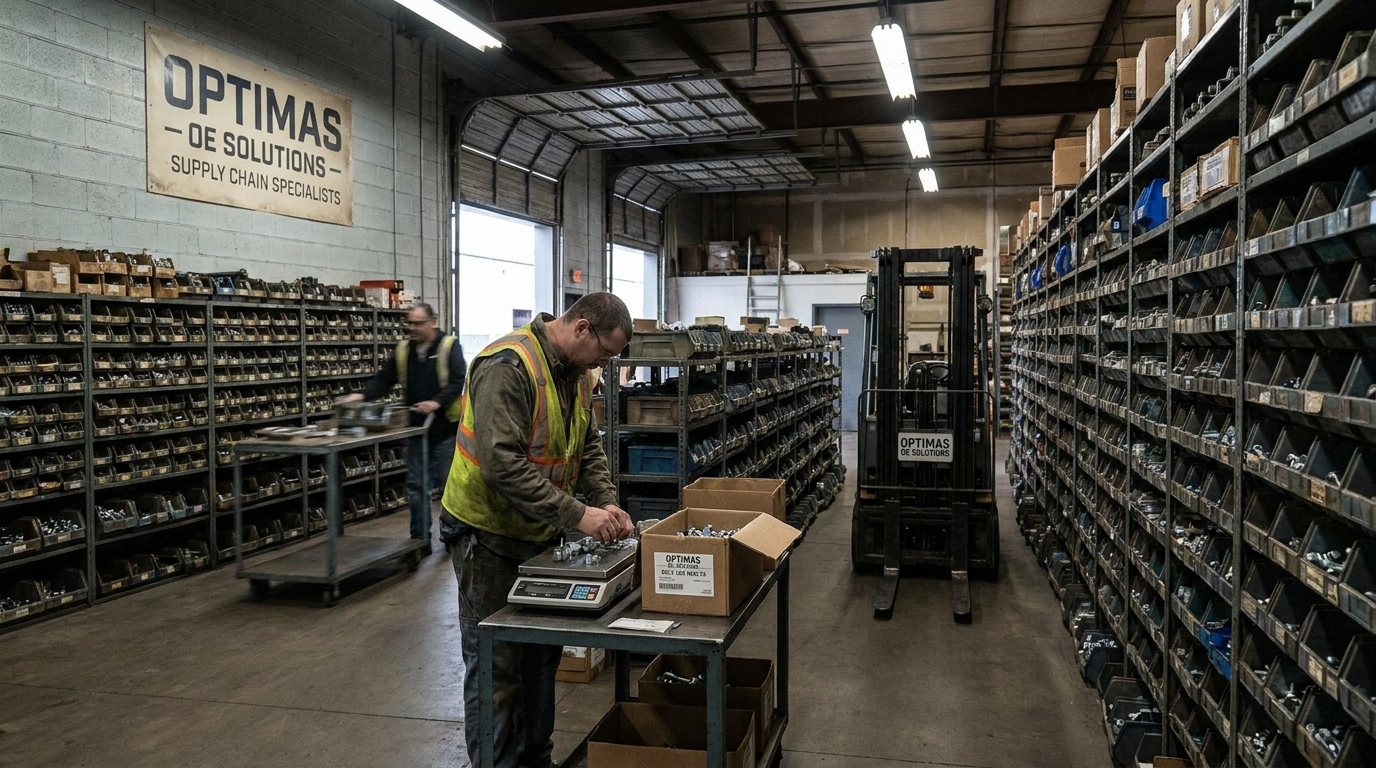
The reason this bet is plausible rather than reckless is that Optimas's real differentiation was never footprint, it was the inventory-management layer wrapped around fastener supply. The company's OptiTech vendor-managed inventory platform uses two purpose-built tools: OptiScale, weight-sensor bins that track part quantities in real time and auto-trigger replenishment orders at preset min and max levels, and OptiRack, an RFID system that reorders stock the moment an empty bin is placed back on a shelf mat. That is a services and data business riding on top of a commodity part.
It also points at why fastener distribution rewards this kind of instrumentation more than most categories. A recurring stat in Optimas's own materials holds that fastener parts account for only about 15 percent of a manufacturer's total supply chain cost for those parts, while the labor to select, manage, and process them eats the other 85 percent. If that ratio is even roughly right across the category, the money isn't in selling bolts cheaper. It's in removing headcount from a customer's receiving dock. A regional operator that can install sensors, tune replenishment logic, and show up in person when a line goes down has more leverage over that 85 percent than a bigger, more distant one does.
The Trade-Off Worth Watching
The honest tension: shedding the international business also gives up the cross-border customer relationships and combined purchasing scale that made Optimas a credible single call for a multinational OEM's global fastener program. The two Optimas entities say they'll still serve shared customers jointly, but jointly is a weaker word than unified. Whether regional speed actually outweighs global reach is the experiment Optimas just decided to run on itself, with a decade of roll-up history as the sunk cost.
Distribution rarely gets remembered for the parts on the shelf. It gets decided by the branch network, the data behind the reorder point, and the catalog nobody outside the industry ever sees. Optimas just bet its next chapter on getting that infrastructure right at a smaller scale, on purpose.