
Pollock Orora: A Family Distributor Sold Twice in Six Years
Pollock survived 100 years as a family business, then changed owners twice in six years. Here is what its ownership churn reveals about JanSan consolidation.
Part of Distributor Playbooks — strategy teardowns of every company on the MDM Top Distributors lists.
Pollock Orora landed at #13 in JanSan on Modern Distribution Management's 2026 Top Distributors report, the annual ranking of North America's largest wholesale distributors. The name on that list is already out of date. By the time MDM published it, the Texas company had been folded into a private equity-owned packaging giant and was mid-rebrand to yet another name. That timing is the story.
A paper company that outlived paper
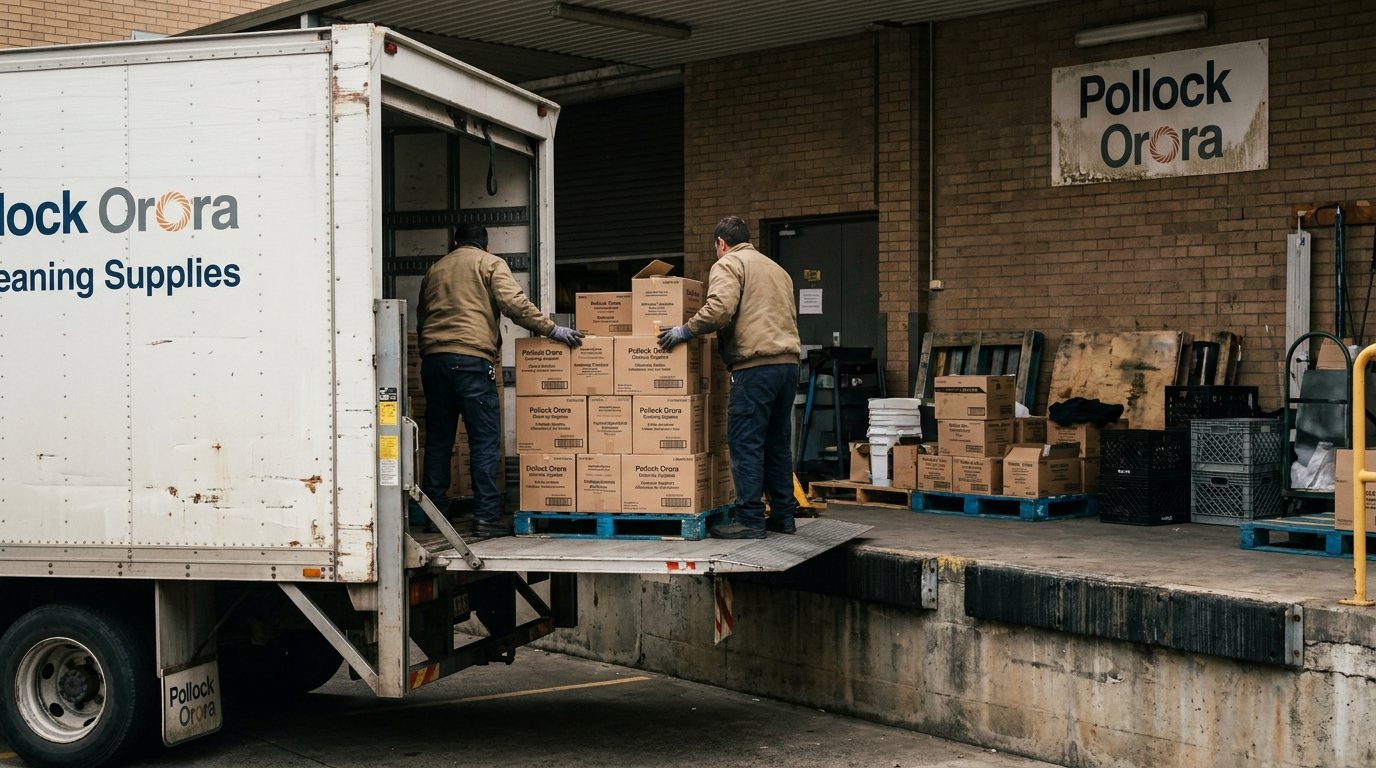
Lawrence S. Pollock started the business in Dallas in 1918, selling paper. It stayed family-run for three generations, growing into what a 2013 anniversary release called "one of the largest family owned supply distribution firms in the country," with Lawrence Pollock III eventually running the company his grandfather founded, according to a company release marking its 95th year. By its centennial in 2018 Pollock had built distribution centers across Texas, California, Georgia, North Carolina and New Jersey, backed by a private fleet running in all 48 states, and had layered janitorial supplies and food-service disposables on top of its packaging roots.
Two categories under one roof
The detail worth naming plainly: Pollock never picked a lane between packaging and JanSan, and that refusal is why it kept showing up on both lists. A retailer shipping product in Pollock corrugate is also, somewhere in the same building, buying mops, liners and hand soap for the warehouse floor. Most distributors specialize in one motion or the other. Pollock built one truck route and one sales force that could sell both, which is a harder thing to run (different vendors, different reorder cycles, different customers on the buying side) but a stickier thing to displace once a customer is on it. It's also why MDM has listed the company under JanSan in some years and packaging and disposables in others — the business genuinely straddles the line, and that ambiguity is a feature of the model, not a filing error.
Sold once, then sold again
That dual-category footprint is exactly what made Pollock attractive to acquirers, twice, in the space of six years. Australia's Orora Limited bought Pollock in November 2018, folding it into its North American packaging arm and renaming it Pollock Orora, as Orora announced at the time. Orora wanted exactly the combination Pollock had spent a century building: a facility-supplies book layered on top of a packaging book, sold to the same accounts.
Five years later, the buyer became the target. Private equity firm Clayton, Dubilier & Rice took Veritiv Corporation — a much larger US packaging, facility-solutions and print distributor — private in a $2.3 billion deal announced in August 2023. Then, in December 2024, that newly private Veritiv turned around and bought Orora's entire North American packaging division — Pollock included — completing what became Veritiv's acquisition of Orora Packaging Solutions. By April 2025, Pollock Orora's social channels were announcing a new name again: Veritiv Pollock.
A century of independence, six years of churn
| Year | Event |
|---|---|
| 1918 | Lawrence S. Pollock founds the company in Dallas as a paper distributor |
| 2013 | Launches PollockDirect.com; celebrates 95 years under third-generation leadership |
| 2018 | Marks its 100th anniversary; acquired by Orora Limited in November, becomes Pollock Orora |
| 2023 | Parent Orora's future buyer, Veritiv, is itself taken private by Clayton, Dubilier & Rice |
| 2024 | Veritiv acquires Orora Packaging Solutions, including Pollock Orora, in December |
| 2025 | Rebrands again, to Veritiv Pollock |
That table is the argument in miniature. A company can survive a full century of paper industry upheaval, the rise of big-box retail, and the entire e-commerce shift on its own terms, and still get swept through two ownership changes in six years once private equity and a strategic buyer decide the JanSan-and-packaging combination is worth owning rather than watching. The MDM #13 ranking measures 2025 revenue booked under a name that had already stopped being the company's own by the time the list went to print.
None of this is a knock on the underlying business. Distribution consolidation rewards exactly the kind of dual-category density Pollock spent 107 years accumulating; it was bought, not liquidated, and it kept its branches, its fleet and its Texas roots through both deals. The tension worth sitting with is structural, not personal: the trait that made Pollock durable as an independent company — breadth across two adjacent categories — is the same trait that made it a logical acquisition target for two different roll-ups in rapid succession. Durability and independence turned out to be two different things.
Every distributor in this series shows up on a public ranking because someone, somewhere, is keeping an accurate catalog, routing a truck, and reconciling a warehouse count. That unglamorous infrastructure is the real subject of the Distributor Playbooks series, and Pollock's three names in seven years are a reminder of how much of it keeps running underneath a changing logo.