
The product-data conversion funnel: where catalogs quietly leak buyers
A stage-by-stage map of where bad product data leaks buyers from impression to purchase to return, plus the exact metric that exposes each leak.

Most retailers optimize the top of the funnel — more traffic, better ads, sharper merchandising — while the leak sits lower down, in the data behind each product page. A catalog with thin, inconsistent, or wrong attributes doesn't fail loudly. It fails quietly, one abandoned session and one unnecessary return at a time. Below is the funnel broken into six stages, the specific data failure that causes the drop at each one, and the metric you can pull this week to see it.
The funnel, stage by stage
| Stage | Data failure | What it costs you | Metric to run |
|---|---|---|---|
| Impression | Thin titles, missing structured attributes | Product never surfaces for the query, marketplace listing, or AI answer that would have converted | Search Console impressions/CTR by page template; marketplace buy-box/search-rank reports |
| Click | Title/snippet mismatch with actual product | Wrong-intent clicks, high bounce, wasted ad spend | Landing page bounce rate segmented by category; paid search Quality Score |
| PDP view | Missing specs, no answer to the buyer's actual question | Session ends on the page with no add-to-cart | PDP-to-cart rate by attribute completeness; on-site search zero-result rate |
| Add-to-cart | No shipping/return/fit information, weak trust signals | Cart abandonment at checkout | Cart abandonment rate segmented by category vs. site average |
| Purchase | (data debt already paid — this is the checkpoint) | Confirms the funnel worked to this point | Conversion rate by category, device, traffic source |
| Keep vs. return | Delivered product doesn't match what the page promised | Refund cost, restocking, lost margin, lost trust | Return rate by reason code, filtered to "not as described" / "wrong size or fit" |
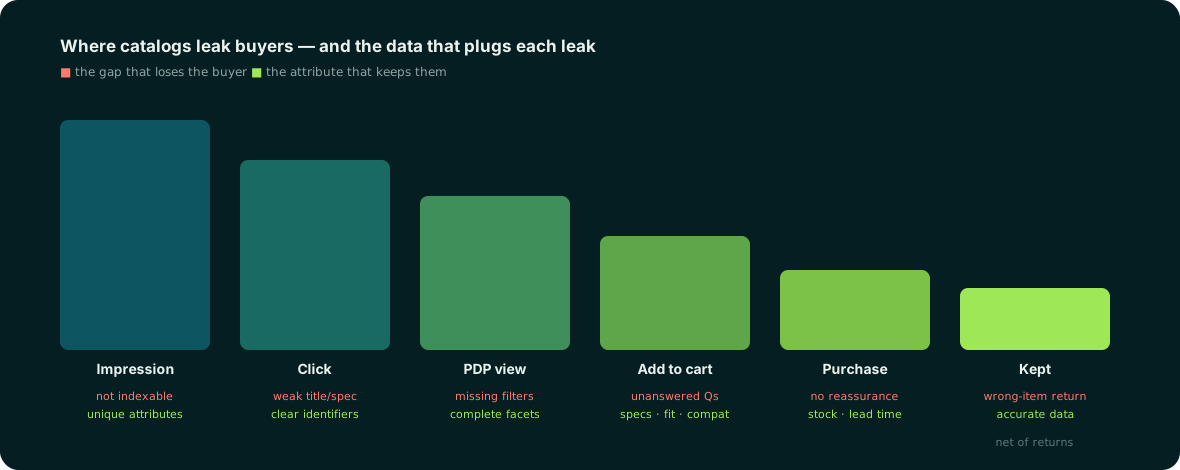
Impression: you can't convert a search you never win
If a product's title, category, and structured attributes are incomplete, it doesn't just rank worse — it often doesn't qualify for the query at all. Marketplaces and search engines match on attributes, not on prose. A drill listed without voltage, chuck size, or battery platform loses every filtered search where a buyer typed those exact terms. The same gap costs you in AI-driven discovery, on-site search, and marketplace buy-box eligibility alike — it's one root cause showing up in three channels.
Run this: pull impressions and click-through rate by page template in Search Console, segmented by attribute-completeness score if you have one. Templates with sparse attributes will show measurably lower impression share for long-tail, spec-heavy queries — the ones with real purchase intent.
Click: the page has to deliver on the promise that got the click
A mismatch between what a snippet or ad promises and what the PDP actually shows produces a fast bounce. This is where sloppy or auto-generated titles hurt — a title that overclaims (or is vague enough to attract the wrong buyer) trades a click for a bounce.
Run this: segment landing-page bounce rate by category and compare against paid Quality Score trends. Categories with recent data cleanup should show bounce improving relative to untouched categories — a clean before/after.
PDP view: this is where most of the leak actually happens
The PDP is the moment of truth, and it's also the stage where product-data gaps do the most damage. Baymard Institute's product-page research has repeatedly found that a meaningful share of sites provide inadequate descriptions and that missing shipping, sizing, and returns information drives direct abandonment — Baymard's product page UX research is worth a full read if you haven't audited against it. Separately, Salsify's 2025 consumer research found that a large share of shoppers have abandoned a sale because titles or descriptions were incomplete or poorly written, reported by 360 Magazine.
On-site search compounds this: buyers who search and hit zero results rarely recover. Well-run search implementations keep zero-result rates in the low single digits; unmanaged catalogs commonly run into the teens, and each of those searches is a buyer telling you, in their own words, what attribute or spec is missing from your catalog — see the zero-result benchmarks from Wizzy's ecommerce search research.
Run this: pull PDP-to-cart rate segmented by an attribute-completeness score (spec count, image count, has-size-chart, has-compatibility-data). Then pull your on-site search zero-result report and cross-reference the top queries against your actual attribute schema — every recurring zero-result query is a missing or unmapped attribute, not a search problem.
Add-to-cart: trust dies in the details
By the time a shopper adds to cart, they've decided they want the product. What kills the order now is uncertainty about fit, compatibility, shipping cost, or return terms. Baymard's checkout research consistently attributes a chunk of cart abandonment to shoppers unable to find total cost, delivery timing, or return policy — information that lives on the product page, not just the cart.
Run this: compare cart abandonment rate for categories with complete shipping/returns/fit data against categories without it. If your PIM has that data but it isn't rendering on the PDP, that's a publishing gap, not a data gap — worth ruling out before you touch the catalog.
Keep vs. return: the leak that happens after the sale
A completed purchase isn't the finish line if the product doesn't match what the page said. Salsify's research found a large majority of shoppers have returned an item due to incorrect product content, and a meaningful share of ecommerce returns cite the item not matching its description, per the same reporting above. Wrong dimensions, missing compatibility notes, or an incorrect material spec don't just cost you the refund — they cost a support ticket, a restocking fee, and a buyer who now double-checks everything you sell.
Run this: pull return reason codes and isolate "not as described," "wrong size/fit," and "doesn't work with my [X]." Rank SKUs by return rate and cross-reference against attribute completeness for that SKU. This is usually the fastest, highest-ROI list in the whole funnel to fix first, because every unit on it is data debt you're paying for twice — once in acquisition cost, once in reverse logistics.
Running the diagnostic on your own catalog
You don't need new tooling to start. Pull PDP-to-cart, cart-to-purchase, and return-by-reason for your ten highest-traffic SKUs and your ten highest-return SKUs. Score each SKU's attribute completeness on a simple 1-5 scale. If the correlation is obvious — thin data, high leak — you've found your priority list without guessing.
That's the throughline: every stage of the funnel has a data question behind it, and every leak has a metric that names it. Your PIM stores the answer to each of those questions; Anglera's job is making sure the answer is actually there, accurate, and complete — scored, gap-filled, and kept current from source documents rather than guessed — so the funnel stops leaking buyers over information that should have been on the page in the first place.