
How R.E. Michel Stayed Family-Run Through 90 Years in HVACR
R.E. Michel ranks #5 on the 2026 MDM HVACR list. Ninety years after a Baltimore oil-burner shop, the Michel family still owns the company outright today.
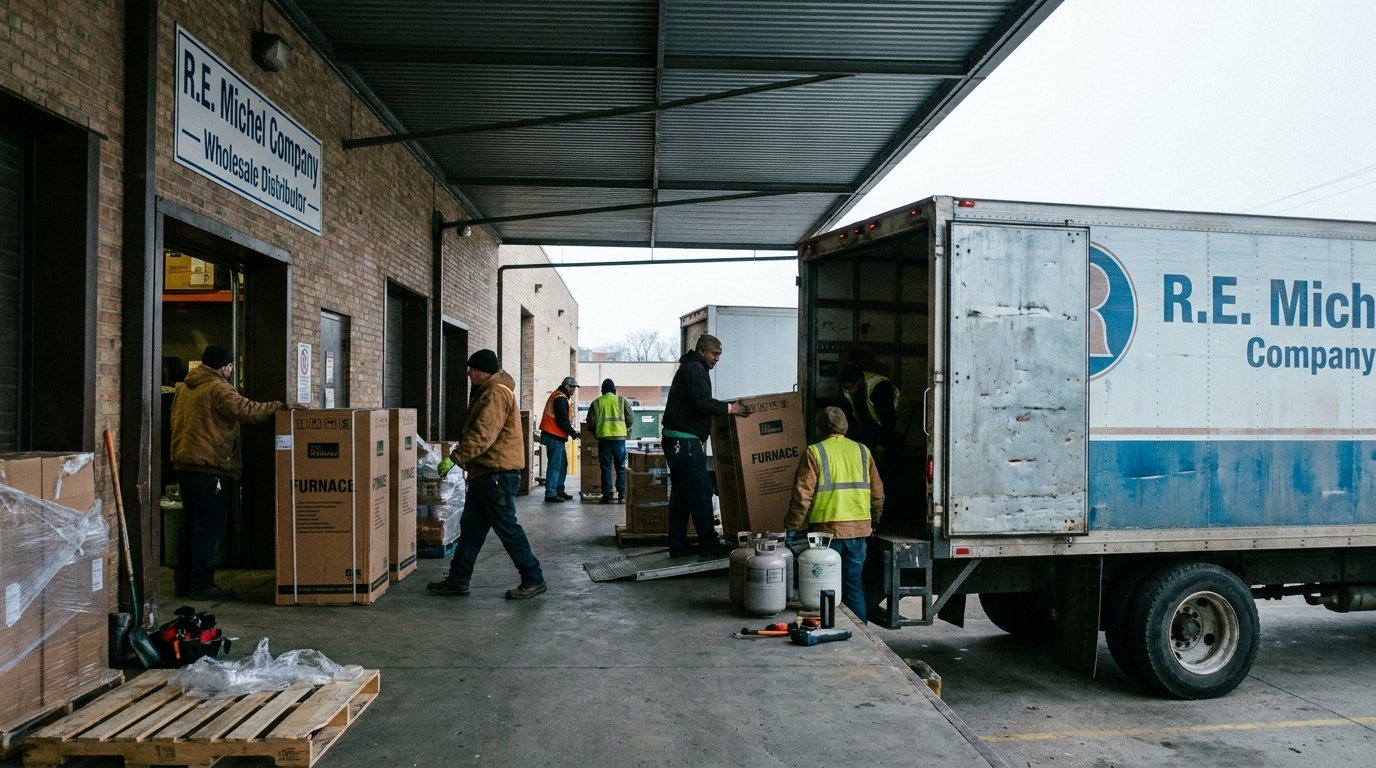
Part of Distributor Playbooks — strategy teardowns of every company on the MDM Top Distributors lists.
R.E. Michel Company sits at #5 on Modern Distribution Management's 2026 Top Distributors list for the HVACR vertical, the trade publication's annual ranking of North America's largest wholesale distributors across 20 product categories. That placement alone would be unremarkable in a sector full of scaled players. What makes it worth a second look is who still signs the checks: ninety years after its founding, R.E. Michel is still owned and run by the Michel family, in an industry where almost everyone else its size has sold, gone public, or been rolled into a private-equity platform.
A Rowhouse Block in Baltimore
The company traces to 1935, when Robert E. Michel and his wife Mary Ellen started selling oil burner parts and supplies out of a small space in the 1000 block of Greenmount Avenue in Baltimore, according to the company's own history page. Robert's brother, J.V. "Bunny" Michel, joined in 1938, and the founding idea was almost embarrassingly simple: sell quality parts at a fair price with dependable service, and repeat that transaction often enough to build something durable. Home heating in 1930s Baltimore ran on oil burners and coal furnaces being converted to oil. R.E. Michel supplied the parts that kept them running, which is a less glamorous business than it sounds and exactly the kind of unglamorous, recurring-need category that compounds over decades.
That founding category still echoes in the company's structure. Two of its listed affiliates are Schwartz Distributing and DLPE, short for Dealers LP Equipment, a business built around propane appliance parts. It is a straight line from oil burners and heating fuel in the 1930s to a modern affiliate still serving the LP-gas trade. Distributors that pivot hard into new categories often lose that kind of institutional memory. R.E. Michel kept it as a subsidiary instead of discarding it.
Three Generations, One Ownership Table
The unique thing about R.E. Michel isn't the branch count or the SKU catalog. It's the cap table. Per the company's own materials, the chairman today is Doc Michel, R.E.'s son, and the president is Robert "Bobby" Michel, R.E.'s grandson. That's three generations of the same family holding the top two seats at a wholesaler that now runs 300-plus branches, employs more than 1,950 people, stocks over 35,000 items from 1,000-plus manufacturers, and ships more than $3 million in product a day out of over a million square feet of central warehouse space.
Trade press has noticed the same thread. A 2019 Butane Propane News profile ran under the headline "Three Generations, One Focus: Customers First." That's the plain insight of this piece: in a distribution category increasingly defined by consolidation, where the biggest players are public companies or private-equity roll-ups chasing scale through acquisition, R.E. Michel has stayed independently family-owned and grown mostly by building, not buying its way to size. It is a strategic choice with real trade-offs. Family ownership means slower access to outside capital, no stock currency for splashy M&A, and succession risk baked into the org chart in a way a professionally managed public company doesn't carry. It also means no quarterly earnings call forcing short-term margin decisions, no private-equity hold period dictating an exit timeline, and a brand that can credibly tell technicians and contractors it has been answering the same phone number, in some form, since before their grandfathers were in the trade.
Growing the Old-Fashioned Way
The clearest recent evidence of that build-don't-buy instinct is physical. In early 2026, R.E. Michel opened a 600,000-square-foot distribution center in Clinton, South Carolina, a facility widely reported by regional outlets as a former sock-manufacturing plant repurposed to stock HVAC and plumbing parts. Multiple South Carolina outlets, including the Post and Courier, covered the reopening and the jobs it created in the Upstate region. That's a company sinking capital into brick-and-mortar throughput capacity rather than into acquiring a competitor's customer list, and it fits the pattern: growth funded by reinvested earnings and organic branch expansion, layered under modern additions like an e-commerce ordering platform, the ESP inventory management program for dealers, a rewards program, and a dedicated technician training facility in Glen Burnie, Maryland.
The Trade-off Worth Naming
None of this is charity or nostalgia. A family-run wholesaler competing against Watsco-scale public consolidators and PE-backed platforms has to win on something other than balance-sheet size, and R.E. Michel's answer looks like density plus continuity: enough branches that a contractor rarely drives far for a part, enough tenure in the business that pricing and service don't whipsaw with ownership changes, and a product mix wide enough (refrigeration, controls, boilers, LP equipment) that one counter visit covers most of a truck's needs. The tension is real. Staying private caps the acquisition firepower that lets a Watsco buy a regional rival outright when it comes up for sale. R.E. Michel has answered that constraint by building capacity itself, one distribution center and one branch at a time, betting that patient reinvestment beats a strategy of counting years by earnings cycles.
Distribution rarely gets written up for its ownership structure, but it should. The parts move through the same trucks and branches either way; who owns the balance sheet is what decides how long a company is willing to wait for the next one to pay off.