
SiteOne Landscape Supply: Rolling Up a $25 Billion Market
SiteOne ranks BM #10 on MDM's 2026 Top Distributors list. How a private-equity carve-out became the landscape industry's only national consolidator.
Part of Distributor Playbooks — strategy teardowns of every company on the MDM Top Distributors lists.
SiteOne Landscape Supply landed at #10 in building materials on Modern Distribution Management's 2026 Top Distributors list, the annual ranking of North America's largest wholesale distributors, on 2025 revenue of $4.7 billion. That placement undersells what SiteOne actually is: the only company that has ever tried to build a national footprint in landscape supply, in an industry where every other competitor is regional at best.
An industry with no other national player
Landscape supply is a roughly $25 billion market in the U.S. and Canada, and it is still highly fragmented — hundreds of independent yards and regional distributors selling irrigation parts, fertilizer, grass seed, hardscapes, and nursery goods to the crews who design and maintain outdoor spaces. SiteOne now runs about 680 branches and four distribution centers across 45 U.S. states and six Canadian provinces. No competitor operates at a fraction of that scale. That is the entire strategy in one sentence: be the only national option in a category built for local operators, and let density do the rest of the work.
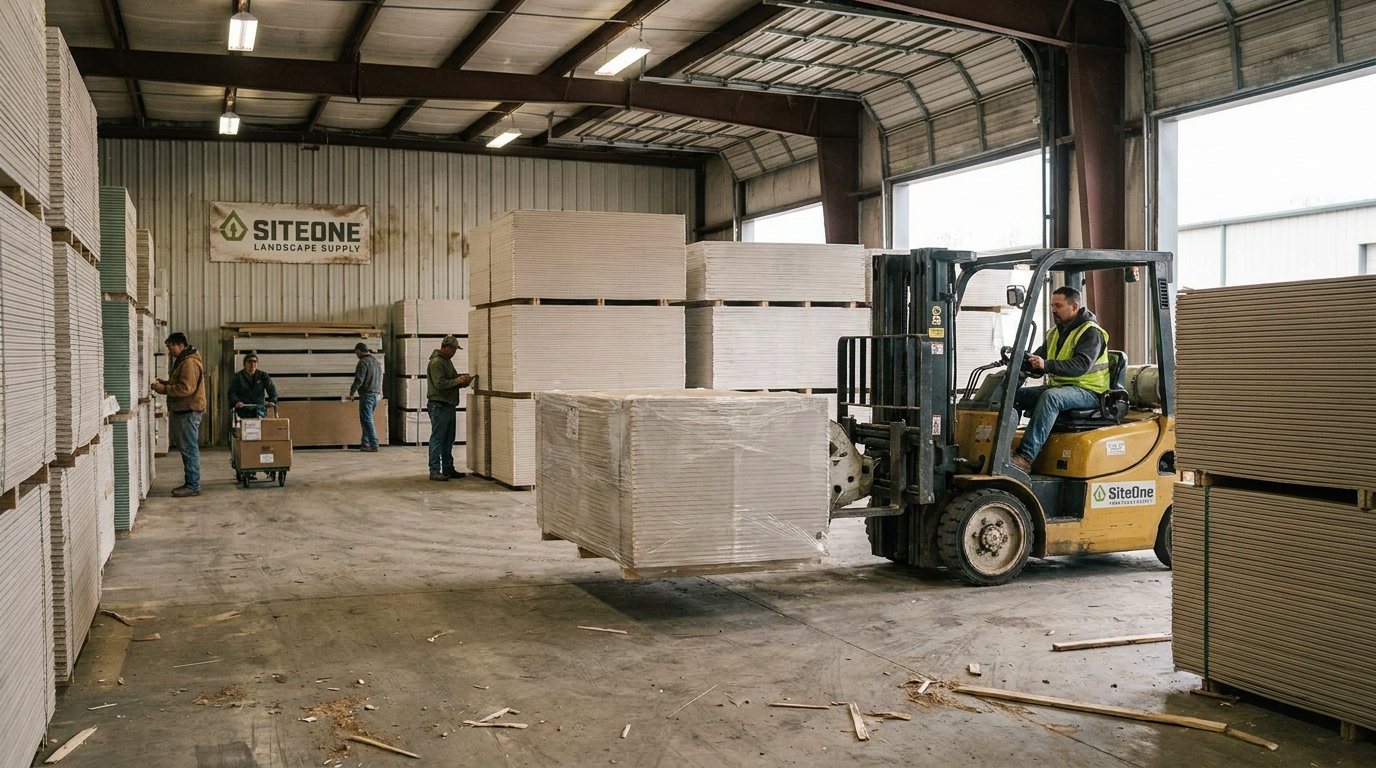
Density matters more here than in most distribution categories because the product itself is bulky, perishable, or both. Mulch, pavers, and bagged goods do not travel well or cheaply. A landscaper needs a yard close enough to load a truck twice a day during peak season. SiteOne's answer was never a flagship superstore model — it was to blanket the map with branches small enough to be useful within a 20-minute drive of a job site, then stock all 100,000-plus SKUs behind a common purchasing and technology backbone so a national account manager can quote the same irrigation controller in Tucson and Toronto.
Built by a roll-up, now running one
Here is the part of the story that does not show up on the company's About page. SiteOne itself is a product of consolidation. It began as John Deere Landscapes, the distribution arm Deere & Co. had assembled through its own acquisitions, until Clayton, Dubilier & Rice bought a 60% stake for $465 million in October 2013, with Deere retaining 40%. The business was renamed SiteOne and went public on the NYSE in May 2016 under the ticker SITE, according to the company's public filings. In other words, SiteOne was itself somebody's roll-up before it became the industry's.
That history matters because SiteOne's current growth engine is the mirror image of its own origin. Instead of one large financial buyer assembling scattered assets, SiteOne is now the buyer of record for dozens of small, often multi-generation family businesses every year — the closest thing the landscape supply industry has to an institutional succession plan. Recent deals show the pattern: Reinders, a fifth-generation family distributor with a dozen locations across Wisconsin, Michigan, Illinois, Indiana, Kansas, and Minnesota, joined SiteOne in March 2026. Bourget Flagstone, a hardscapes distributor serving the Santa Monica and Malibu markets, joined in January 2026. CC Landscaping Warehouse Plus, a nursery and bulk products distributor, joined in November 2025.
None of those deals moves the revenue needle much on its own. That is the point. SiteOne's M&A machine is not built for splashy megadeals; it is built to be the default exit for an aging owner-operator who has spent thirty or forty years building a regional yard and has no obvious successor. A family business that might otherwise close, sell to a generic private-equity roll-up, or get picked apart by liquidation instead keeps its branch, its local reputation, and often its name, while plugging into SiteOne's purchasing scale and logistics network. The company that was assembled by financial engineers in 2013 has turned around and become the preferred landing spot for the exact kind of founder-owned business that assembled it in the first place.
What the growth targets say about the next decade
SiteOne has told investors it is targeting $7 billion to $8 billion in net sales and $900 million to $1 billion in adjusted EBITDA by 2030, against 2025 revenue of roughly $4.7 billion. Closing that gap requires both organic same-branch growth and a steady cadence of tuck-in acquisitions, which is why the company keeps recruiting deal-sourcing talent alongside branch managers — a March 2026 leadership change brought in a new EVP of strategy and development to keep the acquisition pipeline moving.
The tension worth watching is margin discipline while the base gets bigger. Buying dozens of small distributors a year means absorbing dozens of different back-office systems, pricing habits, and local cultures every year, indefinitely. SiteOne's own reporting shows gross margin expanding even as branch count climbs, evidence the integration playbook works, but the math only holds if each new tuck-in gets folded into the common systems fast enough to avoid becoming permanent overhead. Scale is the moat here, but scale acquired one family business at a time is also the hardest kind to keep clean.
Distribution rarely looks glamorous from the outside, but SiteOne's growth is really a bet on the unglamorous machinery underneath it: a shared catalog, a common branch playbook, and enough consistent product data to make thousands of small acquired yards behave like one company. This is one entry in Anglera's Distributor Playbooks series, profiling the operators shaping how the channel actually works.