
Sonepar: How the Largest Electrical Distributor Stays Family-Run
Sonepar ranks #2 in Modern Distribution Management's 2026 electrical list. Its edge is a family-owned roll-up that refuses to rebrand what it buys.
Part of Distributor Playbooks — strategy teardowns of every company on the MDM Top Distributors lists.
Sonepar North America landed #2 on Modern Distribution Management's 2026 Top Distributors list for electrical, and #10 in HVACR, on $19.0 billion in FY2025 North America revenue. Globally it is the largest electrical distributor on earth, with €33.6 billion in sales across 40 countries. It got there by buying dozens of regional distributors and, in almost every case, refusing to put its own name on the door.
The roll-up that won't rebrand
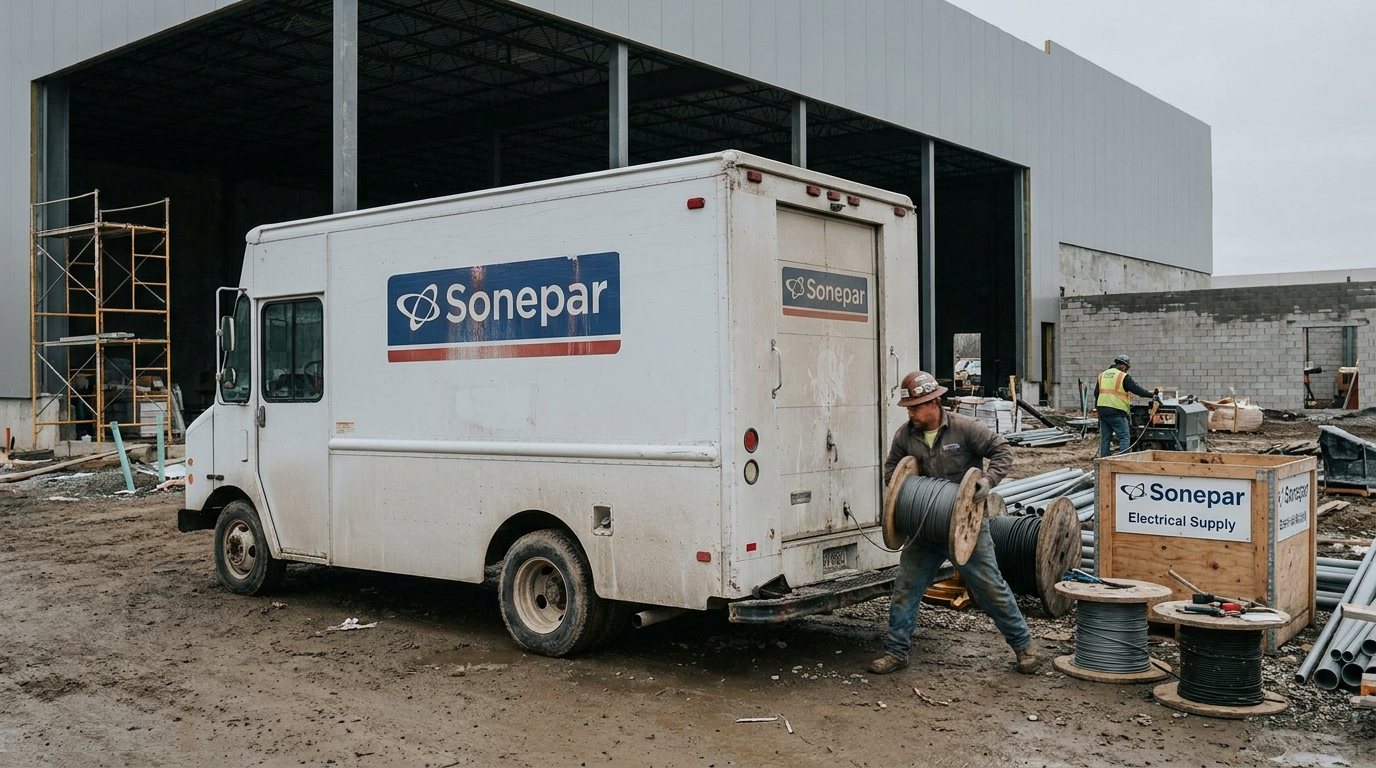
Walk into a branch that belongs to Sonepar and you will not see "Sonepar" on the sign. You will see Irby, Viking Electric, Cooper Electric, Capital Electric, Codale Electric, Summit Electric Supply, QED, OneSource, or one of a dozen other names, each still trading as itself. Sonepar North America runs more than 570 branches across the United States under this multi-brand structure, according to its own company overview, and the parent company treats that fragmentation as the point, not a problem to fix.
Most consolidators in distribution eventually paint over the acquired logo. WESCO folded Anixter into a single identity. Sonepar's doctrine, laid out in its own account of "what makes acquisition and integration successful," is the opposite: identify what the acquired company does distinctively well, whether that is a specialty product line or a knack with small contractors, and protect it rather than homogenize it. The stated rationale is that a regional brand represents decades of accumulated trust with local contractors and utilities, and burning that trust for signage consistency is a bad trade.
Family capital in a sector everyone else took public
Here is the part that would surprise most channel analysts: the world's largest electrical distributor is still privately held by a French family. Sonepar was founded in 1969 by the Coisne and Lambert families, who today govern the company through a holding structure called Colam Entreprendre, per Sonepar's own history. Marie-Christine Coisne-Roquette ran the company from 1998 to 2024, when Philippe Delpech took over as CEO.
Compare that to Sonepar's closest global peers. Rexel trades on Euronext Paris. WESCO is listed on the NYSE. Both answer to public markets on a quarterly cadence, which shapes how aggressively they can integrate an acquisition, how long they can let a regional brand run semi-autonomously, and how much patience they have for a founder-CEO who wants five more years before handing over the keys. Sonepar answers to a family holding company with a multi-generation time horizon. That is very likely why its acquisition playbook can afford to be slow and relationship-heavy in a way a public roll-up's rarely can. The tension is real too: private, family-controlled capital structures can also mean less pressure to disclose, less external scrutiny on capital allocation, and a succession question that public companies solve with a board search rather than a family council.
The acquisition engine, by the numbers
Sonepar's North American growth has not been organic mostly. By its own account, the company completed 21 acquisitions in North America between 2021 and 2024, an average of roughly seven a year, across a sector where most competitors do one or two marquee deals per decade. The company describes its process around five pillars: market intelligence, strategic fit, negotiation, integration, and cultural understanding, with country managers, not headquarters dealmakers, running point on each deal because, as the company puts it, acquisitions "happen in real places, with real people."
The integration ritual is specific enough to be a genuine differentiator rather than boilerplate: a town hall on acquisition day, with both Sonepar's senior leadership and the acquired company's own leadership on stage together, and an explicit view that "an hour with the CEO is worth a dozen annual reports" in judging whether a deal will hold together culturally. That is a distributor treating M&A less like a spreadsheet exercise and more like a courtship that has to survive the morning after.
Betting the utility platform on one 100-year-old brand
The clearest evidence the model works is Irby, a single-location electrical supply house founded in Jackson, Mississippi in 1926 that Sonepar designated as its utility-distribution platform in the United States. A century later, per Sonepar's centennial announcement, Irby runs 58 operations in all 50 states with more than 1,000 associates, has posted double-digit year-over-year growth for nine consecutive years, and still counts Entergy, the utility, as a customer it has served for the full 100 years. Irby's president, Joe Lenoir, credits the run to a plain formula: "we put people first." Whatever the platform strategy cost Sonepar in integration complexity, it bought a brand old enough to have outlasted the utility grid it services twice over, still growing, and still recognizably itself.
That is the trade Sonepar keeps making across its portfolio: give up the tidiness of a single national brand, keep the century of local relationships that come with the name already on the truck.
Distribution's biggest wins rarely show up on a balance sheet as cleanly as an acquisition count. They show up in whether a branch a hundred miles from headquarters still has the right part, the right catalog data, and the right person answering the phone the way it always has. That is the quiet infrastructure this series keeps returning to.