
SRS Distribution: The Roll-Up Home Depot Bought and Kept Rolling
SRS Distribution ranks #3 in building materials on MDM's 2026 list. Owned by Home Depot since 2024, the roofing roll-up just outbid a rival consolidator to buy GMS.
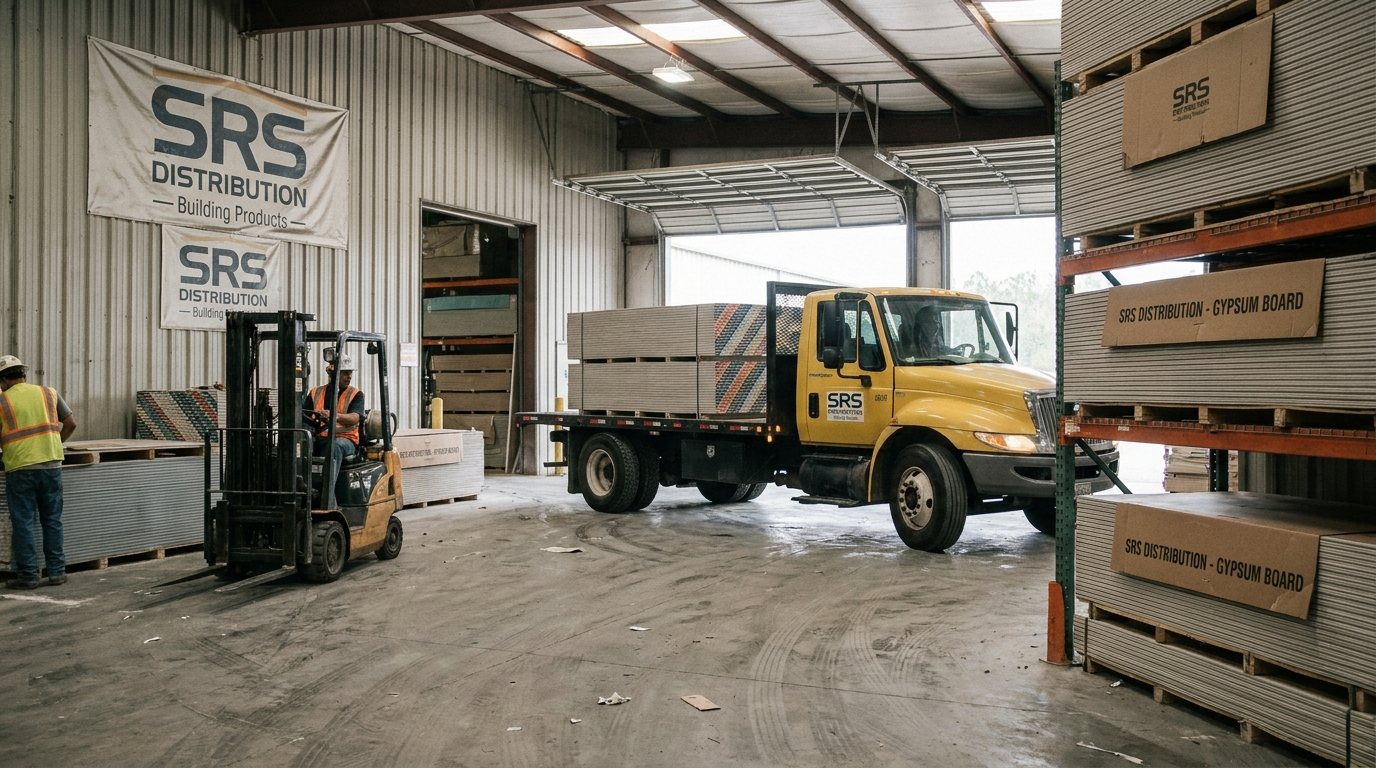
Part of Distributor Playbooks — strategy teardowns of every company on the MDM Top Distributors lists.
SRS Distribution lands at #3 in building materials on Modern Distribution Management's 2026 Top Distributors list, the trade publication's annual ranking of North America's largest wholesale distributors. That alone would make it worth a look. What makes it worth studying is what happened after Home Depot bought the company outright in 2024: SRS didn't slow down. It went out and bought a bigger company than most distributors ever will, beating a rival bidder in the process, using its new parent's checkbook.
A roofing roll-up built to not look like a roll-up
SRS was founded in 2008 in McKinney, Texas, under CEO Dan Tinker, with backing first from Berkshire Partners and, from 2018, Leonard Green & Partners. The playbook was straightforward on paper: buy regional roofing distributors, open new branches, and repeat. What made it work was a choice most consolidators skip. SRS kept the acquired companies' names on the trucks and the buildings.
By the time Home Depot came calling, that patchwork had grown into "a family of distinct local brands encompassing more than 760 locations across 47 states," serving professional roofers, landscapers, and pool contractors, according to SRS's own announcement of the deal. A contractor in Ohio buying from a branch SRS acquired five years ago likely still calls it by its original name and works with the same rep. The holding company stays invisible on purpose. Local trust, once bought, isn't worth spending down for a logo.
That decentralization is the moat. Roofing, pool, and landscape supply are all relationship businesses where the guy who answers the phone at 6 a.m. and gets material to a job site by 7 matters more than which corporate parent signs the paycheck. SRS's bet was that it could buy that local trust at scale without homogenizing it. Two-thirds of its revenue still comes from roofing, with landscape and pool supply splitting the rest roughly evenly.
The acquisition that should not have made sense
Home Depot closed its purchase of SRS on June 18, 2024, for an enterprise value of about $18.25 billion, one of the largest deals in the company's history. Chair and CEO Ted Decker called it "both complementary and additive," and the math backed him up: Home Depot pegged the deal as expanding its addressable market by roughly $50 billion, toward a combined total near $1 trillion, per the companies' joint statement.
The obvious assumption is that once a serial acquirer gets acquired, its own acquisition engine idles. A parent company usually wants integration, cost synergies, one balance sheet doing the buying from then on. That is not what happened.
In mid-2025, GMS Inc., a major distributor of drywall, ceilings, and steel framing, drew an unsolicited offer from QXO, the industrial roll-up run by logistics veteran Brad Jacobs, at $95.20 a share. SRS, still operating as a Home Depot subsidiary, came back with $110 a share, a deal valued at $5.5 billion in enterprise value, and won. The transaction closed September 4, 2025, adding GMS's network and pushing SRS toward roughly 1,200 locations, per Home Depot's completion announcement. Trade press covering the deal, including MDM's own reporting on the GMS transaction, framed it plainly as Home Depot using SRS as its acquisition vehicle in a bidding war against a well-capitalized rival consolidator.
That is the insight worth naming: being acquired didn't retire SRS's playbook, it refinanced it. The unit that grew by buying independents with private-equity money now grows by buying independents with a Fortune 50 retailer's money, and it just used that advantage to out-muscle one of the most aggressive roll-up operators in industrial distribution for a company GMS itself is a serial acquirer through its own L&W Supply network.
The timeline in one table
| Year | Event |
|---|---|
| 2008 | SRS founded in McKinney, Texas, under Dan Tinker |
| 2018 | Leonard Green & Partners buys in alongside Berkshire Partners |
| 2024 | Home Depot completes $18.25B acquisition of SRS (June 18) |
| 2025 | SRS outbids QXO, completes $5.5B acquisition of GMS Inc. (September 4) |
| 2026 | SRS ranks #3 in building materials on MDM's Top Distributors list |
The tension nobody at Home Depot will say out loud
Home Depot has been explicit that SRS branches stay separate from Home Depot stores, no rebranding, no shared floor space, no orange paint. That is deliberate. Professional contractors buy from specialty distributors partly because those distributors are not big-box retail: job-site delivery, trade credit, and inventory depth a retail aisle can't stock. Home Depot needed the professional-trade relationship SRS had built precisely by not looking like Home Depot.
The trade-off is that Home Depot now owns a company whose entire value proposition depends on convincing contractors it is not really part of Home Depot. Every future SRS or GMS acquisition has to thread that same needle: bring the balance sheet of the largest home-improvement retailer on earth to bear on a market that buys from distributors precisely because they aren't retailers. So far, the GMS deal suggests contractors and target companies alike are willing to look past the parent's name as long as the local brand on the truck stays the same.
Distribution rewards move fast in the boring places: which branch has the material in stock, whose truck shows up on time, whose data on that inventory nobody outside the branch has ever needed to think about. SRS built an empire betting that the local name matters more than the parent's, and its new owner is still testing how far that bet can scale.