
How State Electric Supply Stays Independent in a Rolled-Up Trade
State Electric Supply ranks #16 on MDM's 2026 electrical distributor list. Here is how a family-owned house from Huntington, WV competes without selling out.
Part of Distributor Playbooks — strategy teardowns of every company on the MDM Top Distributors lists.
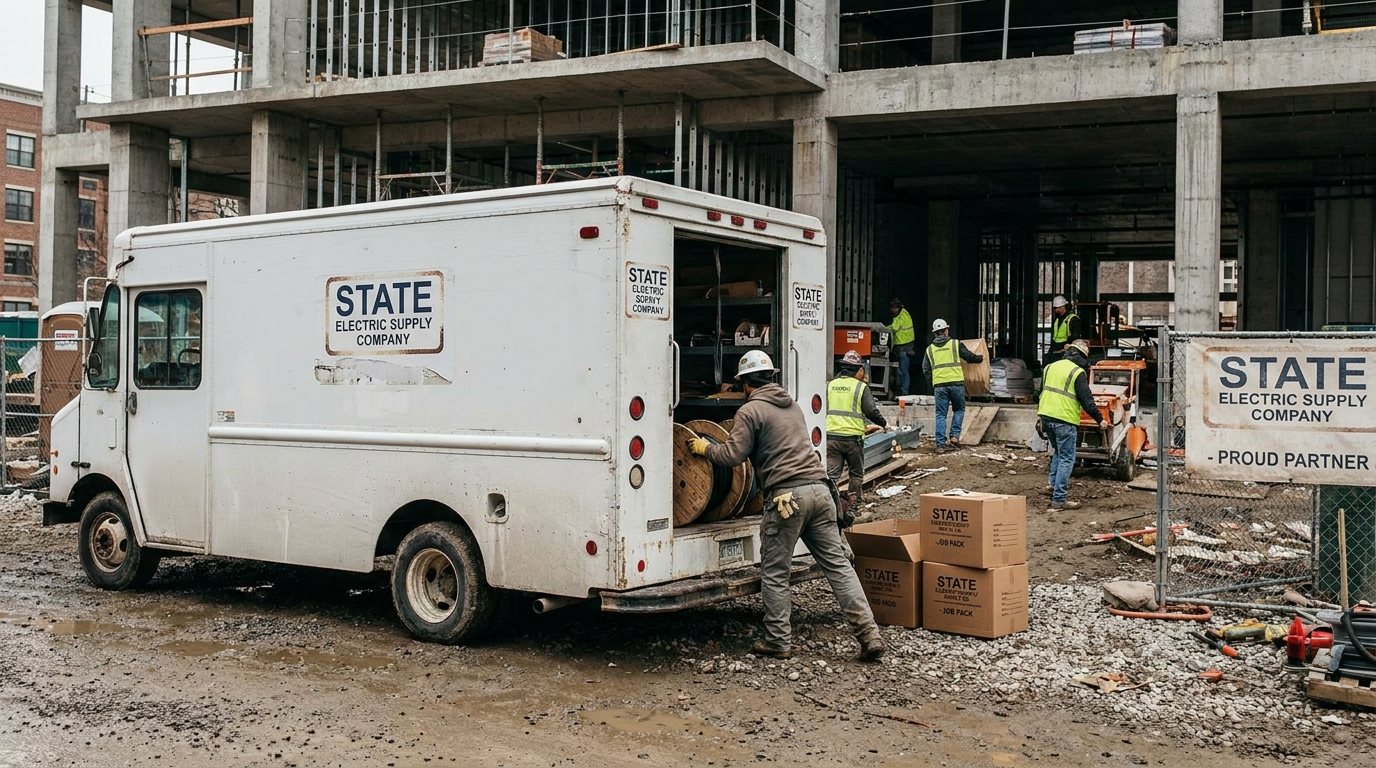
State Electric Supply Company lands at #16 on Modern Distribution Management's 2026 Top Distributors list for electrical, data, and security products, a 12-spot jump from its #28 finish in 2025, and one of the few names on that ranking still owned by the family that started it. The company was founded on June 30, 1952, in Huntington, West Virginia, as a one-truck operation run by Art and Joan Weisberg. Seventy-plus years later it is still private, still headquartered in Huntington, and still growing, which in a category dominated by Sonepar, WESCO, and Rexel roll-ups is the more interesting fact than the rank itself.
The insight: independence funded by a co-op, not a balance sheet
Electrical distribution has consolidated hard over the past two decades. The economics favor scale: national account contracts, vendor rebate tiers, and freight networks all reward the biggest buyer in the room. Most family houses either get bought by a strategic acquirer or bleed share to one.
State Electric took a third path. It is a longtime member of AD, the buying and marketing group founded in 1981 that now claims more than 1,000 independent distributor members, 9,000-plus locations, and upwards of $100 billion in combined annual sales. Through AD, a 42-branch regional house buys rebates, freight terms, and marketing scale closer to what a national competitor gets, without giving up equity, branch-manager autonomy, or the Weisberg name over the door. It is a franchise-like arrangement nobody dresses up as one: no royalty checks, no shared brand, just collective leverage rented by the deal.
That leverage shows up in specific wins, not just balance-sheet math. In 2024, State Electric partnered with fellow AD member Vincent Angel Inc. and manufacturer Encore Wire to supply aluminum tray cable on a large contractor project, the kind of order a national distributor would normally have the fill-rate and shipping guarantees to lock down alone. State Electric's outside sales team leaned on Encore's production capacity and Vincent Angel's local rep coverage to make the same promise. "We have the confidence when we give our customers a ship date with Encore Wire because we know we are going to meet or exceed those expectations," sales rep Matthew Edwards said in the writeup. That is the AD model working as designed: borrowed scale, kept identity.
Growing branches without losing the core
The other half of the strategy is refusing to stay a one-line electrical house. According to Infor's customer profile of the company, State Electric has roughly doubled its branch count, from about 20 locations to more than 40 across seven states, while layering in adjacent divisions: Data Com/Security, Control/Automation, Power Transmission, Services, and Janitorial/Safety. Each new branch does not just sell wire and breakers. It sells five or six category lines out of the same counter, which raises revenue per branch without requiring the company to out-acquire a national competitor.
Distribution is a game where whoever gets the customer's next call wins, and State Electric has spent two decades making sure that call covers more of what the customer needs. It is a slower version of the roll-up strategy the nationals run through acquisition: instead of buying category depth, State Electric built it branch by branch, inside a footprint it already controlled.
Betting on data instead of debt
State Electric has run its ERP on Infor for 25 years, and the more recent additions read like a company trying to compete on information rather than on capital it does not have. It has layered in Infor's AI-driven product-pairing recommendations at order entry, process mining and robotic process automation through Infor Velocity Suite, and a proof-of-delivery system for the freight side of the business. Current job postings for roles like pricing analyst and operations support specialist describe work built around inventory accuracy, freight metrics, and AI-informed pricing decisions, ordinary back-office jobs that used to run on spreadsheets and branch-manager instinct.
None of this is glamorous. It is the unglamorous version of a moat: better fill rates, faster quotes, and tighter freight cost per line, compounding quietly against distributors with more capital but less disciplined data.
The succession question every family distributor eventually answers
State Electric is now in its second generation of ownership, with John Spoor as owner and CEO and, per the company's own account, next-generation leadership already inside the management ranks. Spoor was named a recipient of the National Association of Electrical Distributors' Distinguished Service Award in 2025, the trade group's recognition for career-long contribution to the channel.
The honest tension in this model is scale ceiling, not succession. A buying group closes most of the gap with a national distributor on price and freight, but it cannot fully close the gap on single-source, multi-region fulfillment for the largest national accounts, the kind of contract that increasingly requires one P&L and one delivery promise across 30 states. State Electric's bet is that staying deep and technically sharp in its home region beats chasing that tier of account. So far, seven decades in, the arithmetic has held.
Every distributor on this list runs on the same unglamorous inputs, whatever their ownership structure: a catalog that has to be right, a branch network that has to be staffed, and freight that has to show up on time. State Electric Supply is a reminder that none of those inputs require a national parent company to get them right.