
United Electric Supply: Growth Funded by Employee Ownership
United Electric Supply ranks #39 among electrical distributors on MDM's 2026 list. Its real edge is using ESOP structure as an acquisition currency.
Part of Distributor Playbooks — strategy teardowns of every company on the MDM Top Distributors lists.
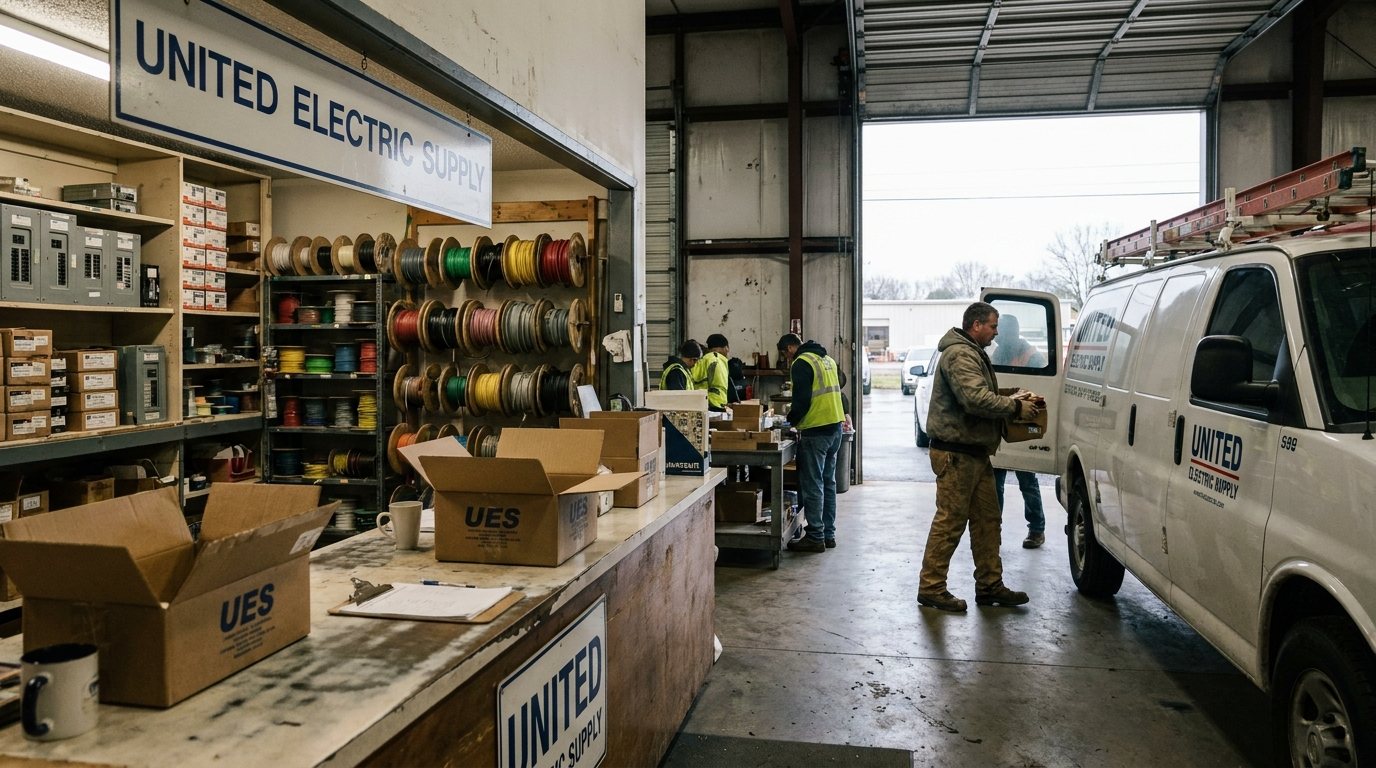
United Electric Supply lands at #39 on the electrical vertical of Modern Distribution Management's 2026 Top Distributors list, the annual accounting of North America's largest wholesale distributors across 20 product categories. The Wilmington, Delaware-based company has spent six decades building a Mid-Atlantic electrical supply business the ordinary way: branches, technical services, supplier relationships. But its growth engine for the last several years has been anything but ordinary, and it says a lot about what independent distributors have left to compete with when private equity and multinational strategics are buying up the category.
A 1965 startup that never sold
United Electric was founded in 1965 and has stayed in Delaware ever since, running Regional Service Centers out of New Castle and Culpeper, Virginia, alongside branches spread across Delaware, Pennsylvania, New Jersey, Maryland, and Virginia. What sets it apart from most sixty-year-old distributors its size is what didn't happen along the way: it never got sold to a strategic buyer, never got rolled into a private equity platform. Instead it converted to a 100% Employee Stock Ownership Plan, and the ESOP is now central to how the company both retains talent and grows.
That distinction matters more than it sounds like it should. Electrical distribution has consolidated hard over the past two decades. Sonepar, WESCO, and Rexel have absorbed dozens of regional and family-owned electrical houses, and PE-backed platforms have rolled up plenty more. Every acquisition removes one more independent brand from the map and usually installs private-equity-style cost discipline in its place. United took the opposite structural bet: instead of selling itself, it started buying others and offering them the ESOP as the reason to join.
Using the ESOP as an acquisition currency
That strategy became explicit in January 2024, when United merged with Kovalsky-Carr Electric, a Rochester, New York, distributor that has served residential, commercial, and industrial customers since 1921. Kovalsky-Carr didn't get absorbed and rebranded. It became a subsidiary that keeps operating under its own name, in its own territory, with its own customer relationships intact.
Then-CEO George Vorwick described the move as part of a "long-term objective to become a multi-regional distributor supporting independent operating brands." Arnold Kovalsky's stated reason for joining was almost entirely about ownership structure: "Being part of United Electric and their ESOP will support our long-term goal to invest in our associates and expand our business."
That is the piece worth naming plainly. United isn't pitching acquisition targets on price or synergy. It is pitching them on a form of exit that lets a founder-owned electrical distributor gain scale, working capital, and succession planning without disappearing into a holding company's branding or a PE firm's hold-and-flip timeline. In a vertical where the alternative exits are usually "sell to a giant" or "sell to a fund," an ESOP-funded holding structure that preserves the acquired company's name is a genuinely different offer. It only works, of course, because United itself has decades of ESOP discipline to point to as proof the model survives leadership transitions and doesn't get sold out from under its employee-owners later.
The company had already used a version of this playbook once before: its 2018 acquisition of Westway Electric Supply brought in Tony Buonocore, Westway's owner, who joined United rather than simply cashing out. Buonocore spent the years since running sales, marketing, and field services, was named President, and in May 2026 becomes President & CEO, succeeding Vorwick.
The succession is the proof, not just an event
Vorwick's own arc underlines the model. He spent 47 years in the electrical industry, rose through sales roles, became CEO in 2009, and in 2024 received the Arthur W. Hooper Award, one of the industry's most senior honors. His retirement, effective May 1, 2026, was handled as a multi-year internal handoff rather than a search: Buonocore moves up from President, Greg Sundberg becomes EVP of Sales after two decades at the company, and Lindsey Cropper continues as Chief Human Resources Officer overseeing what United now describes explicitly as a succession-and-talent-development strategy tied to the ESOP.
That is not incidental color. A company that sells acquisition targets on ownership continuity has to demonstrate it can hand off its own executive suite without disruption or an outside buyer stepping in. United just ran that test in public, promoting from within at every level from CEO down through warehouse management, and used the occasion to restate the ownership pitch rather than treat it as routine.
The technical layer underneath the ownership story
None of this would matter if United were purely a commodity electrical house. It isn't. The company runs an OnPoint Automation division and has been a Schneider Electric EcoXpert partner in Digital Power technologies since roughly 2020, named a 2025 Exemplary Partner for depth in energy management and building electrification work. Its branch teams carry VFD, PLC, and HMI programming capability, motor repair, and lighting design services alongside standard wire and gear distribution — the kind of applications engineering that turns a distributor from an order-taker into a design partner on industrial and commercial projects.
The company also runs a disciplined annual supplier scorecard: its 2026 supplier awards went to Atkore for overall performance and to Schneider Electric and RAB Lighting for second consecutive years in their categories, built from branch, sales, and logistics feedback weighted against the prior year's data. That is vendor management run like a discipline, not a formality, and it is the kind of unglamorous rigor that tends to separate distributors who can absorb an acquisition cleanly from ones who can't.
United Electric's bet is that ownership structure is itself a competitive asset in a category otherwise being consolidated by capital. Whether that scales past a handful of regional mergers is the open question the next few years will answer.
This is part of an ongoing series on the distributors that keep North America's supply chains running, one branch, one catalog, and one data record at a time.