
How Van Meter Stayed Independent for Almost 100 Years
Van Meter Inc. ranks #18 on MDM's 2026 electrical list. Here is how a 97-year-old employee-owned distributor avoided the industry's consolidation wave.
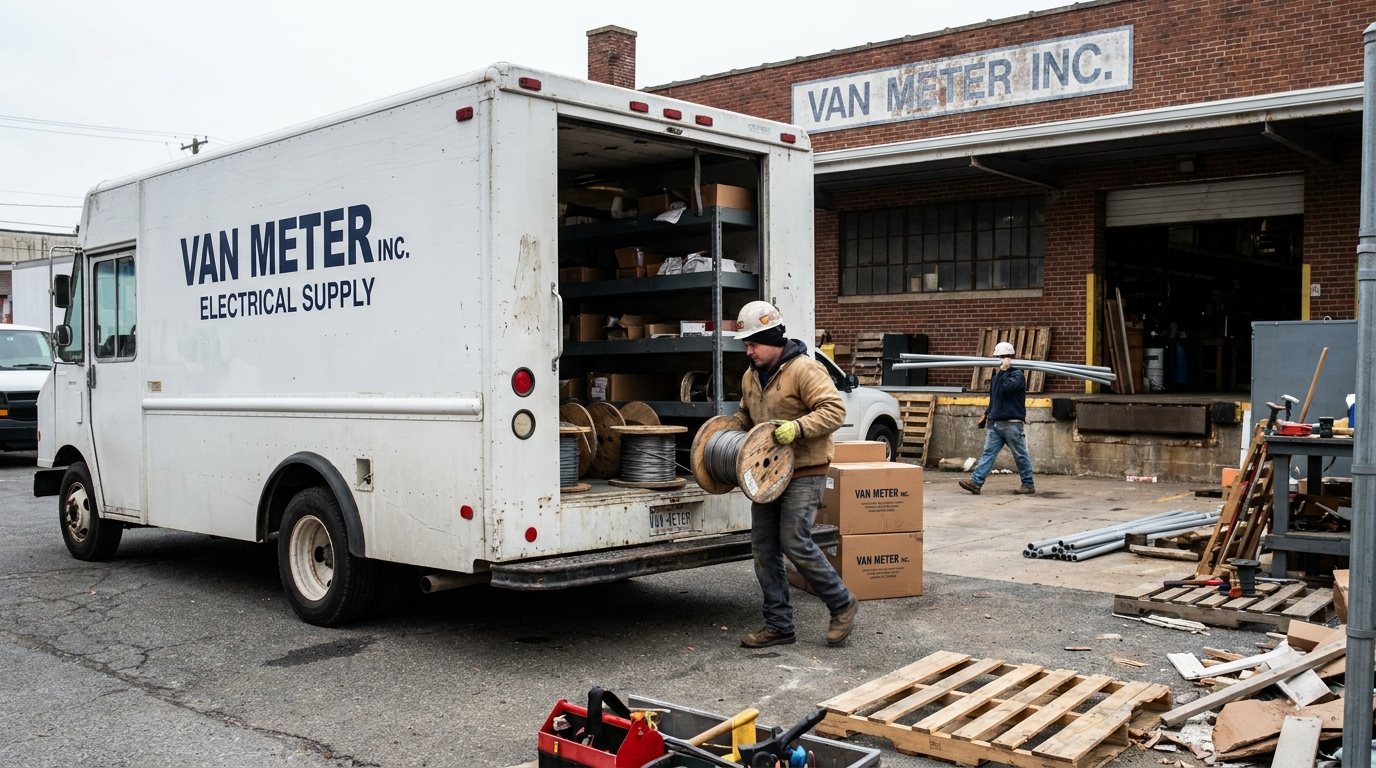
Part of Distributor Playbooks — strategy teardowns of every company on the MDM Top Distributors lists.
Van Meter Inc. lands at #18 on Modern Distribution Management's 2026 Top Distributors list for electrical, one of a shrinking number of names on that ranking that never took a check from private equity or a multinational buyer. The Cedar Rapids, Iowa company has been selling wire, switchgear and now automation hardware since 1928. It is still there because of a decision made decades ago about who would own it next.
A hardware store that outlasted its own century
R.L. Van Meter and R.W. Lemley opened their electrical supply house in downtown Cedar Rapids in 1928, built around a motto that reads like it was written for a different era of customer service: "Service is our first thought." Within a few years they'd wired their own headquarters with fluorescent lighting, reportedly the first building west of the Mississippi to use it, according to Electrical Distributor magazine. That kind of small, provable first is the sort of detail a company keeps in its lobby for a century, and Van Meter has: The History Center in downtown Cedar Rapids ran an exhibit on the company through mid-2024, built around artifacts and interviews with former presidents, per KCRG.
The company crossed its 95th anniversary in 2023 still headquartered in the city where it started, by then running 25 locations across eight states with more than 800 employee-owners. By late 2025 that had grown to 27 locations and 850-plus employee-owners, according to the University of Iowa's Tippie College of Business, which honored CEO Lura McBride with its Oscar C. Schmidt Iowa Business Leadership Award in November 2025. McBride joined Van Meter in 2008, became COO in 2010, and was named president and CEO in 2016, per MDM's coverage of the AD buying group's electrical board.
The insight: ownership never left the building
Electrical distribution has spent the last two decades consolidating into a handful of giants, Sonepar, WESCO, Rexel, each built by buying up regional players like Van Meter. Van Meter took the opposite path. It is 100 percent employee-owned through an ESOP, a structure that functions simultaneously as a retirement plan and a succession mechanism: instead of a founding family selling to a strategic acquirer or a private equity sponsor, ownership transferred internally to the people running the branches and answering the phones. The Corridor Business Journal still lists Van Meter among the region's largest privately held companies and describes it plainly as the nation's 14th largest electrical distributor, still independent, while noting that many of its peers sold or merged over the same stretch of decades.
That is the non-obvious part of this story. Most independent distributors eventually face the same choice: recapitalize with outside money, sell to a national roll-up, or shrink. Van Meter's answer was to make the employees the outside money, gradually, without a change in control that shows up as a press release. It is a quieter kind of consolidation resistance than franchising or a family trust, and it is rare enough in a $200-billion-plus electrical distribution market that it is worth naming as a deliberate strategic choice rather than an accident of geography.
McBride has said as much directly. Discussing a facility consolidation in the Twin Cities, she told Industrial Distribution: "As an employee-owned company, we think in generations, not quarters." That line does real work. A distributor answering to a PE sponsor on a five-to-seven-year fund clock underwrites branch and facility investment differently than one whose owners are also the people who will retire from those branches.
How the model shows up in the operation
The employee-ownership structure is not just a culture slide. It changes what Van Meter can afford to build slowly. The company has kept investing in physical footprint, expanding its Cedar Rapids campus by 60,000 square feet even as e-commerce reshapes distributor economics, per the Tippie College writeup. It has also pushed its catalog well past core electrical: Van Meter's own site organizes its business into automation (controls, enclosures, robotics), datacomm, lighting, power transmission, and safety, alongside traditional electrical supply. Wallet-share expansion within existing branches and customers, rather than acquisition-driven geographic expansion, is the growth lever an employee-owned distributor without outside capital tends to pull.
It also plays in group affiliation rather than pure independence. Van Meter's leadership sits on the electrical board of AD, the buying and marketing group that lets independent distributors pool purchasing scale against Sonepar and WESCO without merging with them, a structural workaround that lets a company stay independently owned while still competing on price with the roll-ups. That combination, employee ownership internally and a buying group externally, is how a 27-location regional distributor keeps showing up on a national top-20 list.
The tension worth naming
The honest trade-off: an ESOP is a patient capital structure, but it is not unlimited capital. Van Meter cannot outbid Sonepar for a target company the way a PE-backed platform can, and its growth will look organic and branch-by-branch rather than acquisition-fueled. For a company whose own materials note it has watched competitors sell or merge around it for most of a century, that appears to be the trade it has consistently chosen. Whether that ceiling ever becomes a floor is the question worth watching the next time MDM updates its rankings.
Every distributor on this list survives on the same unglamorous inputs: a catalog that's actually accurate, a branch network that shows up, and data good enough to trust at 2 a.m. on a job site. Van Meter's version of that just happens to be owned by the people stocking the shelves.