
Wajax: The Grocery Empire That Quietly Built an Industrial Giant
Wajax lands three 2026 MDM Top Distributors placements. Its stranger story: two decades spent inside a Canadian grocery conglomerate's portfolio.
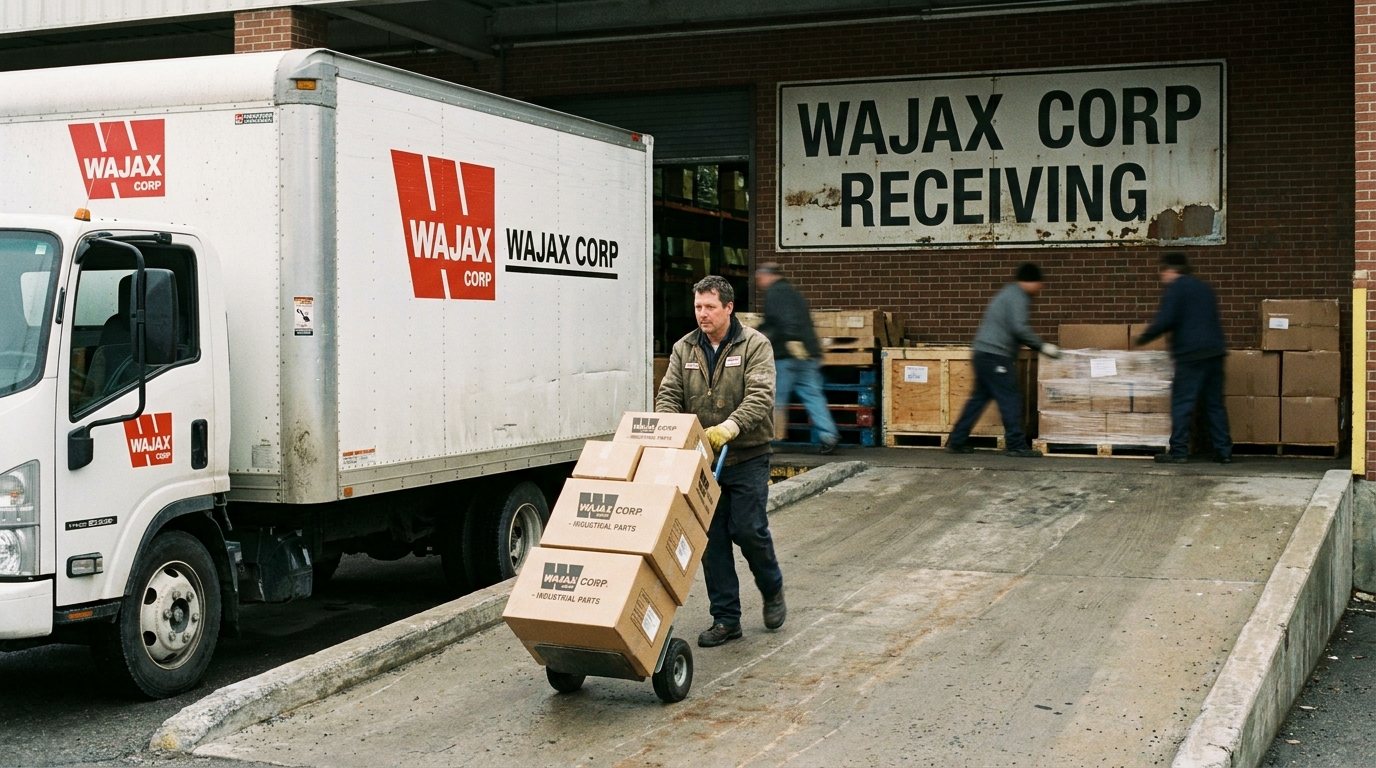
Part of Distributor Playbooks — strategy teardowns of every company on the MDM Top Distributors lists.
Wajax Corporation shows up three times on the 2026 MDM Top Distributors lists — 32nd in Industrial Supply, 20th in MRO, and 4th in Power Transmission, on FY2025 revenue of about $1.5 billion (CAD $2,145.3 million, per Wajax's own annual results; MDM's report prints a narrower $638 million figure covering only Industrial Parts and ERS). What those rankings don't show is that for roughly two decades, one of Canada's largest heavy-equipment and industrial-parts distributors sat inside the investment portfolio of a supermarket company. That's the part of the story worth telling.
A blacksmith shop, a pump, and a merger
Wajax traces its roots to 1858, when a small blacksmith operation opened in Montreal making carriage springs and railcar hardware for a country whose railways were still being laid. The company grew through the eras that defined Canadian industry — rail, then engines, then heavy equipment — long before it had the name it carries today. That name is itself a leftover from a merger: Wajax is a contraction of Watson Jack, a metals and industrial-equipment supplier folded into the business in the 1950s, and the combined company formally adopted the Wajax name at the end of that decade. Wajax's own account still opens with "Since 1858" — a claim few distributors on any MDM list can make.
The Sobeys connection
Here's the part that doesn't show up on the company's About page. For most of the late 20th century and into the 2000s, Wajax was substantially owned by Empire Company Limited — the Stellarton, Nova Scotia holding company that also owns Sobeys, one of Canada's largest grocery chains. According to Empire's own corporate history, Empire built its Wajax stake to 45 percent by 1988, sold down a chunk of shares when Wajax converted to an income trust in 2005, and didn't fully exit until 2011 — the same year the trust reorganized into Wajax Corporation as it's known now.
That's an unusual pairing to hold inside one balance sheet: bagged salad and bearing distribution. It also means Wajax spent its formative decades as a satellite of a food-retail empire's capital allocation decisions rather than an industrial conglomerate's, then was cut loose right as the 2010s commodity and construction cycle began rewarding scaled equipment dealers. The timing reads, in hindsight, less like an escape and more like a maturation: Empire's exit and Wajax's independence arrived in the same year, at the point where the business had grown too large and too industrially specific to keep making sense as a grocer's side investment.
Three segments, one hedge
Today Wajax runs an integrated model across Equipment, Industrial Parts, and Engineered Repair Services (ERS) — new and used machinery sales on one side, bearings, power transmission components, and hydraulics on the other, with in-house repair and field service tying the two together. It carries major OEM lines including Hitachi construction and mining equipment alongside its own private-label parts programs, and operates more than 100 branches across the country with roughly 2,900 employees (stockanalysis.com).
The strategic logic is a hedge, and it shows up directly in the MDM placements: Wajax's Power Transmission ranking (4th) is dramatically stronger than its Industrial Supply ranking (32nd), which tracks with a company that has spent the last several years deliberately growing Industrial Parts and ERS relative to Equipment. Equipment sales rise and fall with mining capex and construction starts. Parts and repair revenue is stickier — a mine or a pulp mill needs bearings and field technicians in downturns as much as in booms. Building out the lower-cyclicality half of the business is the plainest strategic bet Wajax has made in the last decade, and the MDM data is a snapshot of how far along that bet has gotten.
| MDM 2026 category | Wajax rank |
|---|---|
| Power Transmission | 4th |
| MRO | 20th |
| Industrial Supply | 32nd |
A new chapter, hired from outside
In February 2026, Wajax announced that George J. McClean would become President and CEO effective March 3, succeeding longtime chief executive Iggy Domagalski, following a search that started the previous October (Wajax's announcement). McClean isn't a Wajax lifer. His résumé runs through Sonepar Canada, National Tire Distributors, W.W. Grainger, and General Motors — three of those are distribution businesses built on exactly the parts-and-service logic Wajax is trying to lean into harder. Bringing in an outsider with a Grainger and Sonepar pedigree, rather than promoting from within, is a signal about which half of the business the board wants to accelerate.
It's a quiet echo of the Empire years, in a way: once again, Wajax's next chapter is being shaped by someone whose formative experience came from outside the machinery-dealer world entirely. The difference this time is that the outside experience is aimed squarely at the parts-and-service side of distribution, not capital allocation from a grocery boardroom.
Distribution history rarely announces itself. It sits in ownership filings, branch counts, and the quiet decision to grow one segment faster than another — the unglamorous record that companies like Wajax leave behind, one repair order and one parts catalog at a time.