
How Wesco Became the Distributor Wiring the AI Data Center Boom
Wesco tops MDM's 2026 electrical rankings. Here's how a 1922 Westinghouse spinoff turned a merger of equals into the backbone of the AI buildout.
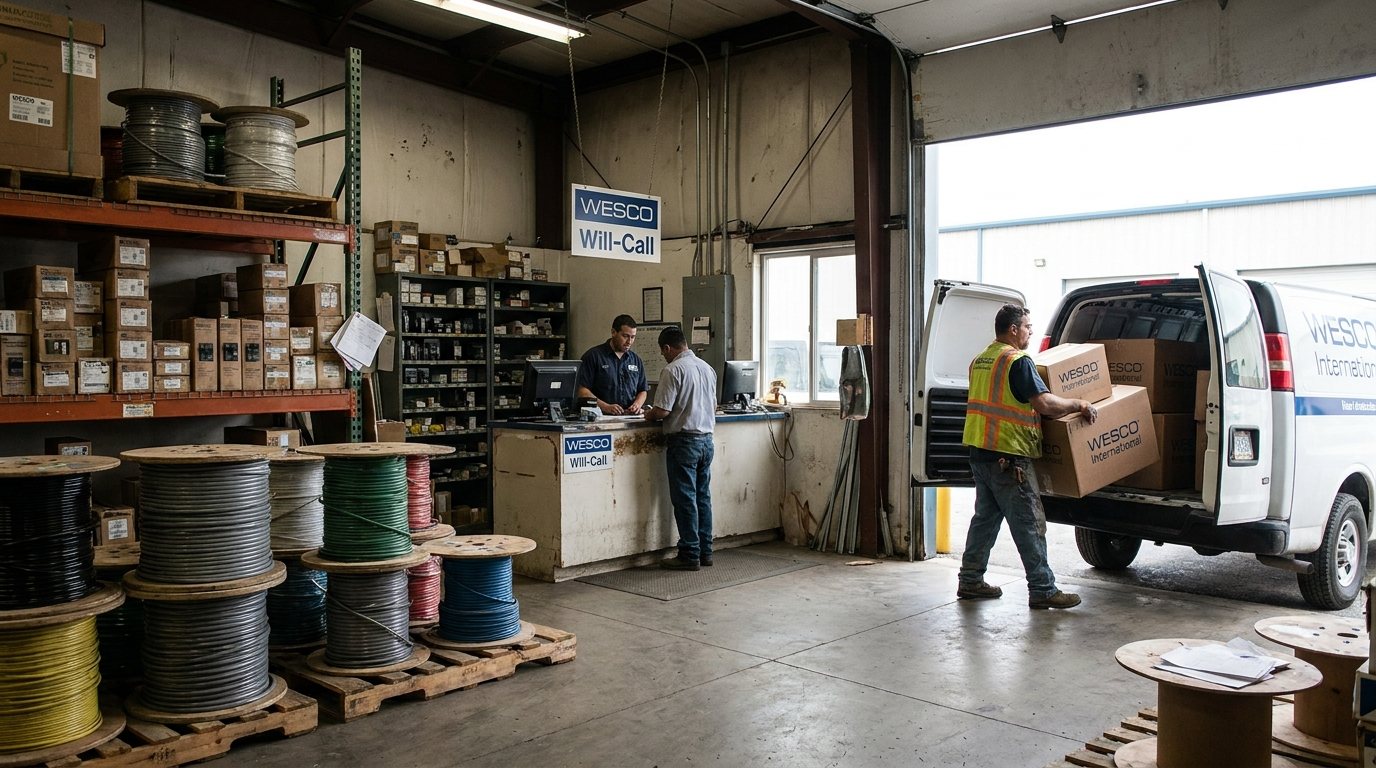
Part of Distributor Playbooks — strategy teardowns of every company on the MDM Top Distributors lists.
Wesco International sits at No. 1 on Modern Distribution Management's 2026 Top Distributors list for electrical, with $23.5 billion in fiscal 2025 revenue, and also lands at No. 13 in industrial supplies and No. 11 in safety, down from No. 5 the year before. Few distributors span that many verticals at that scale. Fewer still started life as another company's captive sales arm and ended up selling the physical guts of the artificial intelligence boom.
Born a subsidiary, not a company
Wesco did not start as an independent business. It began in 1922 as the Westinghouse Electric Supply Company, a Pittsburgh-based unit created to centralize wholesale distribution of Westinghouse's own electrical gear during the postwar electrification rush. For decades it existed to move one manufacturer's product, not to build customer relationships on its own terms. That changed only when Clayton, Dubilier & Rice bought the unit from Westinghouse in 1994 and spun it out as WESCO Distribution Inc., an independent company for the first time in 72 years. The Cypress Group bought it again in 1998 for $1.1 billion and formed the WESCO International holding structure that took the company public on the NYSE in 1999.
That origin matters because it explains a trait Wesco still carries: it behaves less like a scrappy reseller and more like an infrastructure utility, comfortable with long capital cycles, thin-but-steady margins, and multi-year customer contracts rather than transactional selling.
The merger that doubled the company overnight
The single biggest strategic bet in Wesco's modern history was not an acquisition in the usual sense. In January 2020 Wesco agreed to buy Anixter International for roughly $4.5 billion, and closed the deal that June. Anixter was not a bolt-on. It was a company of comparable scale with deep strength in wire, cable, and network infrastructure, and the combination pushed Wesco past $17 billion in revenue overnight, more than 18,000 employees, relationships with over 30,000 suppliers, and a customer base topping 150,000. It was a merger of near-equals executed in the middle of a global shutdown, and it is the reason Wesco's current three-segment structure exists: Electrical & Electronic Solutions, Communications & Security Solutions, and Utility & Broadband Solutions, each descended from a different piece of the combined company's history.
The pivot nobody would have predicted from the name
Here is the part that would surprise anyone who only knows Wesco from its Westinghouse roots: a company born to distribute light bulbs and switchgear for one industrial manufacturer is now, a century later, one of the primary physical suppliers to the AI data center buildout. Wesco's data center sales hit a record $1.2 billion in a single quarter in late 2025, up roughly 60% year over year, and CEO John Engel has said the company is "not even close to seeing a peak in the cycle." That is not organic drift. Wesco built toward it deliberately, buying the systems integrator Rahi Systems for $217 million in 2022 and the data center facility management provider Ascent for $185 million in late 2024. Each deal moved Wesco a step further from "we ship you the cable" toward "we design, integrate, and manage the facility the cable runs through."
That is the unique tension worth naming: Wesco is quietly climbing the value chain from distributor into systems integrator and facility operator, in a channel where its own customers are often electrical contractors and its own suppliers are the manufacturers whose gear it still moves in bulk. Every dollar Wesco earns doing integration and facility management directly is a dollar its contractor customers might otherwise have earned. So far the AI buildout has been large enough that this has looked like expansion rather than conflict. Whether that holds when data center capex cycles cool is the open question a channel analyst would flag.
Scale as the actual moat
Strip away the acquisitions and the moat is simpler: density. Wesco runs roughly 500 branches and ten fully automated distribution centers across North America and internationally, serving over 150,000 active customers. That footprint lets it offer vendor-managed inventory, kitting, pre-fabrication, and project logistics that a regional electrical distributor cannot match on its own, and it is why Wesco shows up not just in the electrical rankings but in industrial supplies and safety as well. Multi-vertical presence of that kind is usually the product of decades of branch build-out plus opportunistic M&A, not a single strategic masterstroke, and Wesco's history bears that out.
| Year | Event |
|---|---|
| 1922 | Founded as Westinghouse Electric Supply Company |
| 1994 | CD&R buyout creates independent WESCO Distribution |
| 1999 | IPO on NYSE |
| 2020 | Anixter merger closes, roughly doubling revenue |
| 2022 | Acquires Rahi Systems, a hyperscale data center integrator |
| 2024 | Acquires Ascent, a data center facility manager |
Wesco's arc, from a manufacturer's captive supply arm to the No. 1 electrical distributor riding the AI buildout, is a reminder that distribution businesses are rarely static. The branches, the catalogs, and the fill rates behind them are what let a hundred-year-old supply company keep finding the next industrial revolution to serve.