
White Cap: The Concrete Distributor Built by Serial M&A
White Cap ranks No. 7 on MDM's 2026 Building Materials list. Here's how a rollup sold twice became North America's concrete-supply consolidator.
Part of Distributor Playbooks — strategy teardowns of every company on the MDM Top Distributors lists.
White Cap lands at No. 7 on Modern Distribution Management's 2026 Top Distributors list for building materials and construction, with additional placements at No. 27 in industrial supply and No. 5 in safety. That three-vertical spread is the tell. White Cap is nominally a concrete and specialty construction distributor, but its real business is buying other distributors, and it has now been bought and rebuilt twice itself.
A pool-coping company that outgrew its name
White Cap's first branch opened in Santa Ana, California in 1976, selling a poured-concrete pool edging product called, fittingly, "white cap." By the 1980s it had six branches and its first full-line catalog. The name stuck long after the pool-coping business became a footnote.
Home Depot bought White Cap in 2004 and folded it into HD Supply, the big-box retailer's wholesale arm. When HD Supply went public in 2013, White Cap rode along as its Construction & Industrial segment. In 2019, HD Supply announced it would spin off that segment as its own public company. Then the pandemic hit, financing markets seized, and HD Supply pivoted mid-process: instead of spinning White Cap out to public shareholders, it sold the business to private equity firm Clayton, Dubilier & Rice for roughly $2.9 billion, merging it with the Sterling Group's Construction Supply Group in a deal CD&R closed in October 2020 (CD&R, MDM). CD&R funds ended up with 65% of the combined company; Sterling and CSG's prior owners held the rest.
That detour matters. White Cap is a company that was built for a public listing, got pulled back from the IPO runway at the last minute, and has operated as a PE-owned rollup ever since. Most distributors on the MDM list are either still founder-run or already public. White Cap is neither. It's five years into a second life as a financial-sponsor platform, and it still hasn't gone public a second time.
The operating model: jobsite, not storefront
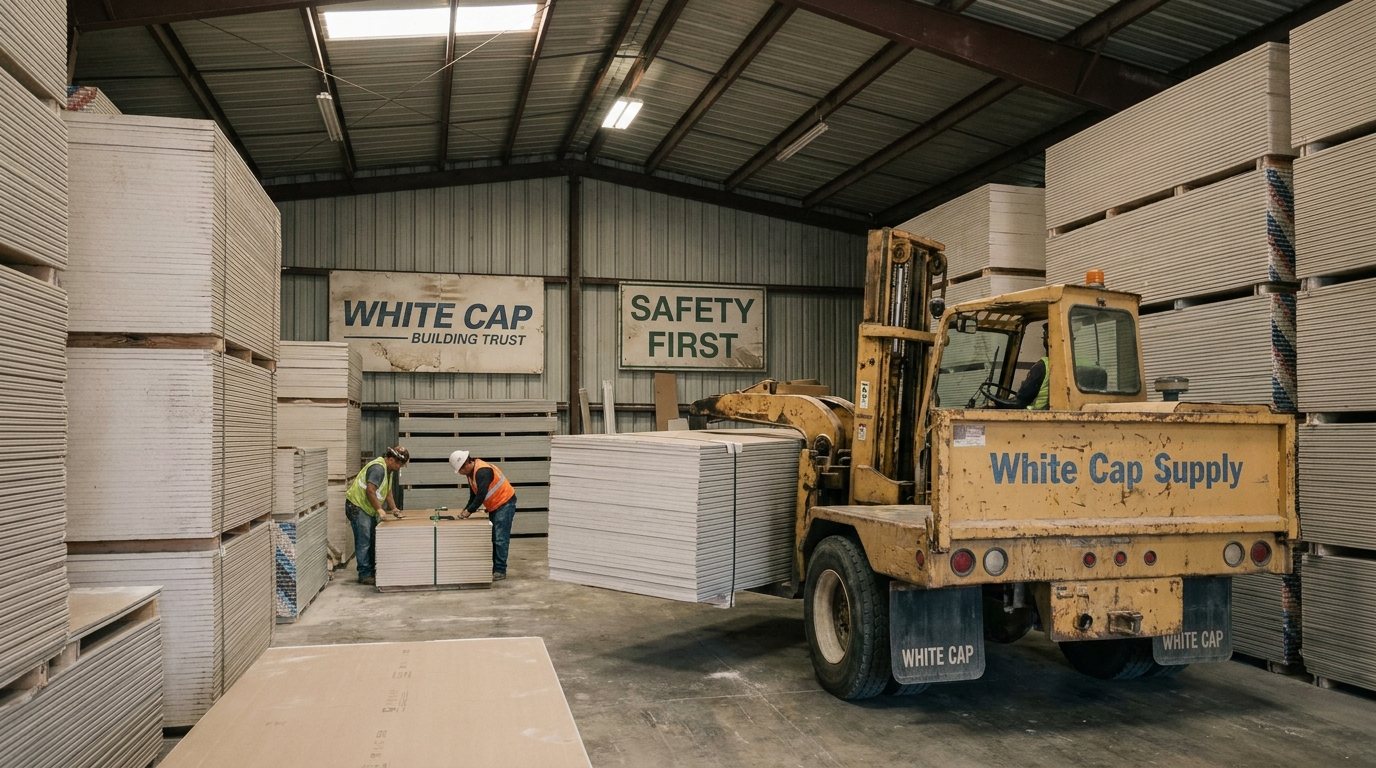
White Cap doesn't compete on retail foot traffic. It runs roughly 500 branches across North America with more than 11,000 employees serving about 200,000 professional contractor accounts, and the branch is a staging point, not a showroom (about.whitecap.com). The company delivers directly to active jobsites, rents forming, shoring, tilt-up and heavy equipment out of dedicated rental centers, and runs more than 30 rebar fabrication facilities that cut and bend rebar to a project's engineering specs rather than shipping stock lengths (whitecap.com/services).
That combination, concrete accessories and chemicals, tools, fasteners, waterproofing, safety gear, plus fabrication and rental, means a contractor can single-source almost everything a concrete pour needs except the cement itself. It's a category-depth play built specifically around one recurring jobsite event: the pour. Depth in a narrow, technical niche is a harder moat to replicate than broad-but-shallow inventory, because it requires fabrication capacity and delivery scheduling that a generalist can't bolt on overnight.
The real engine: buying the fragmentation
Concrete accessories and specialty construction supply is still a regional, often family-owned business in most of North America. White Cap's answer has been relentless tuck-in acquisition. The company closed roughly 14 deals in 2024 and at least 10 more through 2025, a pace of nearly two acquisitions a month sustained for two straight years (Distribution Strategy Group).
Most are small: Jobsite Supply in Indianapolis, Form Tech Concrete Forms across the Southeast and Midwest, Advanced Forming Solutions in Washington state, Anchor Construction Industrial Products across four Canadian provinces. A few reach further. Dayton Superior, acquired in 2024, added engineered concrete accessories and R&D capability rather than just branch count, a signal White Cap wants technical depth, not only density (MDM). The combination with Colony Hardware, a substantially larger deal that closed February 6, 2026, added more than 60 locations in one move and pushed White Cap into adjacent tool and equipment rental territory it did not fully own before (MDM).
| Milestone | Year |
|---|---|
| First branch opens, Santa Ana, CA | 1976 |
| Acquired by Home Depot, folded into HD Supply | 2004 |
| HD Supply IPO; White Cap rides as Construction & Industrial | 2013 |
| Sold to CD&R, merged with Construction Supply Group | 2020 |
| 14+ tuck-in acquisitions | 2024 |
| Colony Hardware deal announced; 10+ acquisitions | 2025 |
| Colony Hardware combination closed (60+ locations) | 2026 |
The tension worth naming
The strategic bet is that a PE-owned rollup can out-consolidate a fragmented, technical niche faster than the niche's remaining independents can defend it, and that doing so twice, once inside a public conglomerate, once inside a private equity fund, produces a company that's better at integration than either parent alone. It's a real advantage: White Cap's playbook for absorbing a 20-person regional forming-and-shoring shop is now a repeatable motion, not an occasional event.
The trade-off is equally real. A company that has been sold twice in twenty years and is currently five-plus years into a private equity hold is, structurally, a company for sale again eventually. Every regional owner selling into White Cap today is betting the platform's next ownership transition, whenever it comes, won't disrupt the service model they're joining. So far, the acquisition pace suggests the market is making that bet anyway.
Distribution rewards the boring things done relentlessly. White Cap's version of that is jobsite delivery scheduled to the hour and a rebar spec cut to the drawing, at a scale most of its acquisition targets could never reach alone.