
How Wholesale Electric Supply Stayed Family-Owned for 76 Years
Wholesale Electric Supply is #31 on MDM's 2026 Top Distributors electrical list. Here's how three generations of one Houston family kept it that way.
Part of Distributor Playbooks — strategy teardowns of every company on the MDM Top Distributors lists.
Wholesale Electric Supply Co. of Houston lands at #31 on the electrical vertical of the 2026 MDM Top Distributors list, a five-spot slide from its #26 finish in 2025, Modern Distribution Management's annual ranking of North America's biggest wholesale distributors. MDM lists the company's revenue as undisclosed, which fits: this is a 76-year-old private company that has never had to answer to a public market, a private equity sponsor, or an acquirer. It is still owned by the family that started it, and that fact alone makes it an outlier in its own industry.
A hardware-store beginning
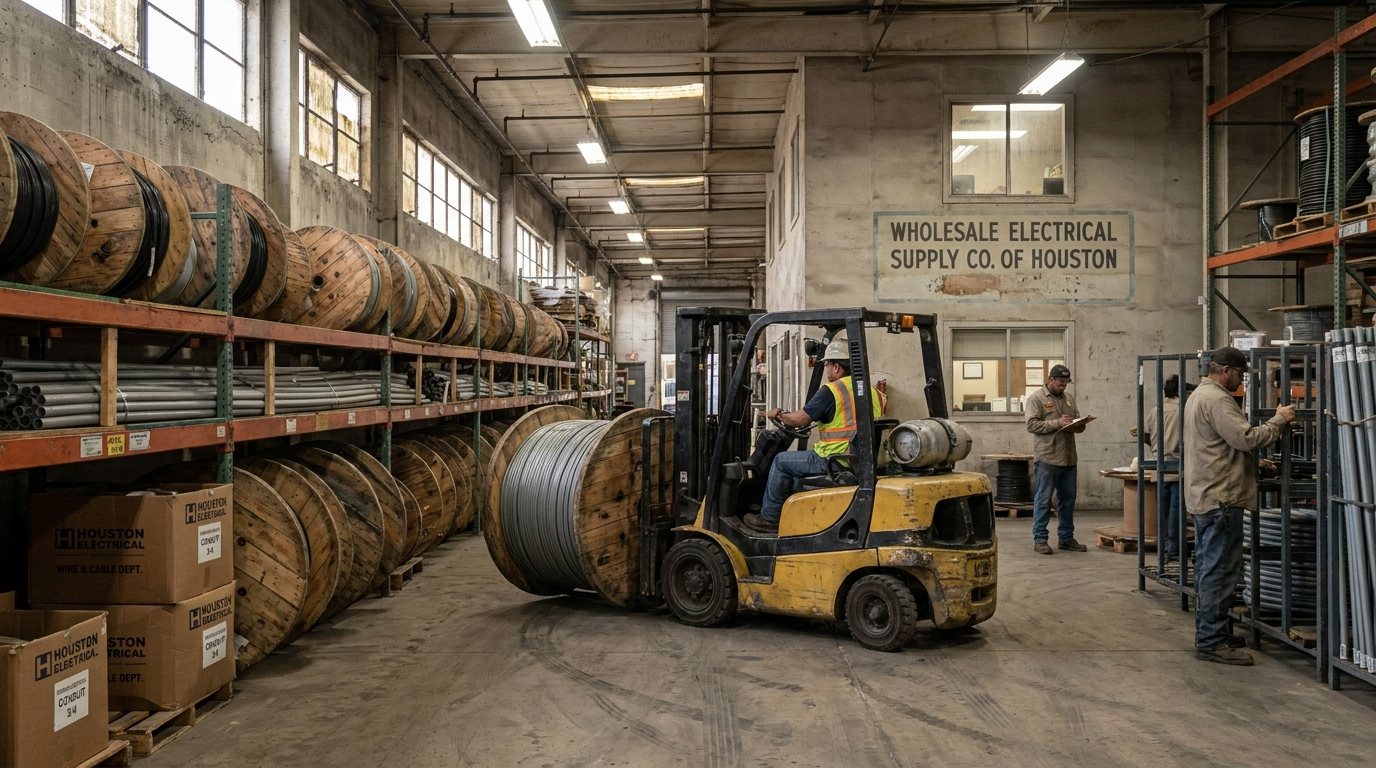
Clyde and Marjorie Rutland opened Wholesale Electric Supply in 1949 in a 10,000-square-foot building on McKinney Avenue in Houston, with a metal shed out back and a gas pump for the delivery trucks, according to the company's own timeline. It was a Gulf Coast electrical house serving contractors and the refineries and chemical plants that were turning Houston into an industrial capital. The company moved twice in its first 25 years, each time into a bigger building on Gulf Freeway, and by 1974 it had 50 employees and its first forklift.
That slow, self-funded expansion is itself a tell. Nothing about the early growth reads like a company chasing scale for its own sake. It reads like a family business plowing profit back into the next building.
The bet that actually differentiated it
The pivotal decision came in 1979, when Wholesale Electric built what it calls a Construction Materials Management System, or CMMS, to run material logistics for an Eastman Kodak capital project in Kingsport, Tennessee. Instead of just selling wire and conduit off a branch shelf, the company embedded itself inside a capital project's procurement and construction workflow: tracking engineered cable quantities, staging material on-site, and reporting status back to the general contractor's accounting and construction teams. According to the CMMS program's own site, it has since run on more than 350 projects worth billions of dollars in capital spend, domestically and abroad.
That single bet explains almost everything unusual about how this company grew. Rather than compete branch-for-branch against national electrical distributors, Wholesale Electric built a second, parallel growth engine: temporary outposts that appear wherever a large capital project needs one, then close when the project is done. The timeline reads like a project ledger, not a real-estate strategy: a CMMS office opened in Gladstone, Queensland in 2010 for an LNG-adjacent project, another in Kitimat, British Columbia the same year, a partnership in Basrah, Iraq in 2013, satellite operations in Singapore, the Philippines, and Thailand in 2015. Most of those were later closed once the underlying project wrapped, the same way a job trailer gets hauled off a finished site. So were several permanent-looking U.S. branches, in Lafayette, Pascagoula, and Joliet.
That is the non-obvious insight here: Wholesale Electric Supply's footprint is not a map of markets it has permanently entered. It is a map of capital projects it has served, most of them tied to Gulf Coast and international petrochemical and LNG buildouts. A 2023 Department of Energy LNG export docket lists the company's Houston address in connection with the Lake Charles LNG project, one more data point in a long pattern of showing up wherever Gulf Coast energy infrastructure gets built.
The ownership handoff nobody had to force
The other hard chapter in the story is a quiet one. Clyde Rutland died in 2011, Marjorie in 2012. Rather than sell to a strategic buyer or a private equity roll-up, the founders' daughter, Pam McKellop, and her family bought out all remaining shares to keep the company private, according to the company's founders page. Pam had already been serving as vice president and chairman of the board for years by that point, a detail confirmed in a 2014 IMARK Group trade profile. Today her son, Rick McKellop II, is executive vice president, putting a third generation in company leadership.
That succession matters more than it might look. The electrical distribution sector has consolidated hard over the past two decades. Sonepar, WESCO, Rexel, and Border States between them account for a large share of U.S. electrical distribution revenue, and most of the names that used to compete with them independently have been acquired, gone public, or converted to employee ownership. Wholesale Electric Supply did none of those things. It stayed a closely held family company through a founder-generation death, which is exactly the moment most family businesses get sold.
What the model actually looks like today
| Milestone | Year |
|---|---|
| Founded, McKinney Ave, Houston | 1949 |
| CMMS program launched (Eastman Kodak project) | 1979 |
| First electrical distributor to earn ISO certification | 1986 |
| WBENC women-owned certification | 1999 |
| Founders pass away; McKellop family buys remaining shares | 2011-2012 |
| 75th anniversary; 16th branch opens, Corpus Christi | 2024 |
Sixteen branches today, concentrated in Texas and Louisiana with a long tail of project-driven international sites, is a modest number next to the national players it's ranked alongside. But the MDM #31 electrical ranking measures revenue scale, not branch count, and a company that has spent 45 years embedding itself inside the procurement systems of billion-dollar capital projects doesn't need a store on every corner to move volume. It needs to be the vendor a project's engineering and construction teams already trust before the first cable order goes out.
The women-owned certification, held continuously since 1999, is worth noting for the same reason the family ownership is: it is not a marketing overlay bolted on for a supplier-diversity program. Pam McKellop has run the company's board since before she owned it outright. The credential describes who has actually been in charge.
This is part of Anglera's Distributor Playbooks series, an ongoing look at the companies that define North American distribution. Every branch, every catalog line, and every capital-project material list eventually depends on data someone has to get right.