
Würth Industry North America: A Roll-Up That Stayed a Federation
Würth Industry North America ranks No. 2 in fasteners on MDM's 2026 list. Its real edge is patient family ownership and a roll-up that never merged its brands.
Part of Distributor Playbooks — strategy teardowns of every company on the MDM Top Distributors lists.
Würth Industry North America enters Modern Distribution Management's 2026 Top Distributors report ranked No. 2 in fasteners, No. 12 in industrial supplies, No. 10 in safety, and No. 17 in MRO. Four top-twenty finishes across four different verticals is an unusual spread for a company most people still describe with one word: screws. The more interesting story is what sits underneath those rankings, an American distribution network built almost entirely through acquisition that has never once folded its targets into a single national brand.
The German parent nobody has to please
Adolf Würth started selling screws out of a 170-square-meter annex in Künzelsau, Germany, in the summer of 1945, borrowing an ox cart to move inventory in an occupied country with almost no supply chain to speak of. He died in 1954. His son Reinhold took over the business at nineteen, with his mother Alma helping run it, and spent the next four decades turning a two-person wholesaler into what is now the largest fastener distributor in the world, a group of more than 400 companies employing roughly 87,000 people worldwide.
The detail that matters for a strategy read is what Reinhold Würth did with his own ownership stake. In 1987 he moved his shares into a set of family foundations rather than keeping them in his personal name, then stepped away from day-to-day management in 1994, handing the Advisory Board chairmanship to his daughter Bettina Würth in 2006, according to Würth Group's corporate history. The company stayed private. No IPO, no private equity sponsor, no fund with a five-to-seven-year clock. That structure is the quiet advantage running underneath everything Würth Industry North America does in the U.S. market: it can buy a company and never have to think about how or when to sell it.
A roll-up that refuses to become one company
Würth Industry North America itself dates to the mid-1990s, starting with the acquisition of Würth Revcar Fasteners in Roanoke, Virginia, and building outward from there through Indiana, Minnesota, Texas, and beyond before consolidating into a Greenwood, Indiana headquarters in 2016. In the years since, the acquisitions have kept coming: Atlantic Fasteners for construction services, Fasco Fasteners, and on the safety side Northern Safety & Industrial's 2021 purchase of ORR Safety, a $125 million Louisville company with four distribution centers and 250-plus employees serving rail, auto, and government accounts.
What almost none of those targets got was a rebrand. Northern Safety & Industrial still operates as Northern Safety & Industrial. ORR Safety still operates as ORR Safety. Würth Action Bolt kept its name. This is the opposite of the Fastenal or Grainger playbook, where every acquired branch eventually disappears into one storefront and one part number system. WINA runs as a federation, a holding structure of more than 110 locations under allied brand names, each retaining its customer relationships and often its sales culture, while sharing back-office logistics, a fastener engineering bench, and increasingly a common technology layer underneath. For a customer, the practical effect is that Würth's scale is mostly invisible. You buy from ORR Safety or Northern Safety and never think about who owns the paperwork.
The trade-off is real. A federated model sacrifices the brand equity and pricing leverage that comes from telling every buyer "you're buying from the biggest name in the category." It bets instead that acquired sales teams and regional trust survive better intact, and that the holding company's job is capital and infrastructure, not identity. In a sector where roll-ups usually mean rapid consolidation into one name, Würth has been rolling up American fastener and safety companies for thirty years and mostly still looks, from the customer's side of the counter, like dozens of separate ones.
Where the field sales force actually earns its keep
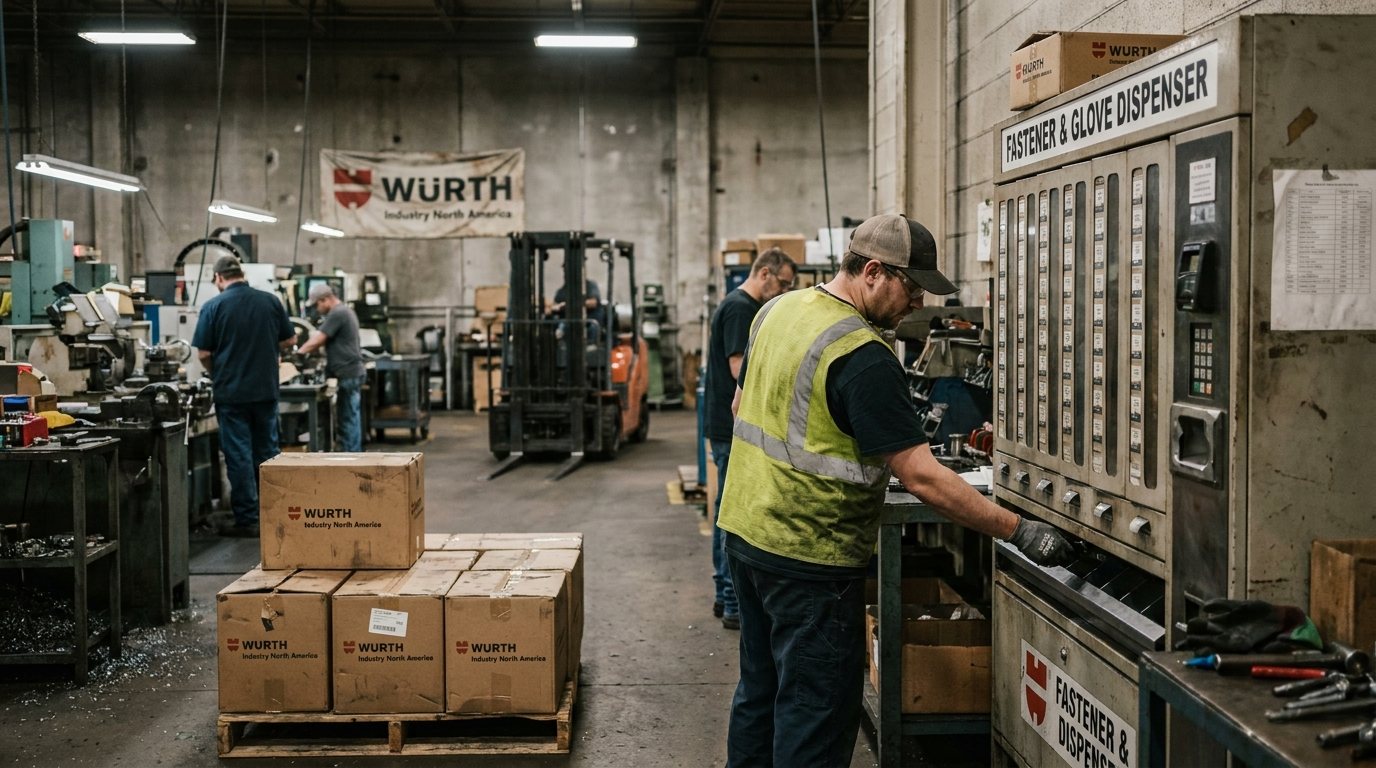
Underneath the acquisitions sits the piece of the model Würth invented before most competitors had a name for it: putting a technical rep and a bin of parts directly on the customer's production floor. The group's ORSY vending machines and Kanban replenishment racks, extended into digital Kanban and RFID-tagged bins in recent years, turn a fastener order from a purchasing decision into an automatic one. Würth's 2020 agreement to nationally distribute Markforged 3D printers alongside its digital Kanban rollout is the same instinct applied to a newer problem: once a rep is embedded inside a customer's plant managing consumables, adding a printer for on-demand jigs and low-volume parts is a natural upsell rather than a new sales motion.
A table of scale, not a headline number
Würth Industry North America's own U.S. revenue isn't broken out publicly, which is why MDM lists it as not disclosed even while ranking the company by unit volume and market presence. The parent Würth Group, by contrast, is happy to publish a number: preliminary 2025 group sales of roughly $24.3 billion, up 2.3 percent from 2024. That asymmetry, a global parent that reports proudly and a North American division that stays quiet, fits a company built for the long run rather than the next earnings call.
| MDM 2026 Vertical | WINA Rank |
|---|---|
| Fasteners | #2 |
| Industrial Supplies | #12 |
| Safety | #10 |
| MRO | #17 |
Distribution rewards the companies willing to own the boring middle: the bin on the shop floor, the part number nobody else wants to stock, the truck that shows up on schedule regardless of who owns the name on the door.