All comparisons
Works with Agility PIMPIM platforms

Anglera + Agility PIM

The bottom line

Keep Agility PIM as the system that models your B2B catalog and publishes it to web, EDI and print. Add Anglera to complete those records from supplier spec sheets, with a citation on every value, written back through Agility's API.

Agility PIM and Anglera solve different halves of the problem — this page is about the seam between them.
The frame for this comparison

Product data is a practice, not a project.

Agility PIM and Anglera work on the same record from opposite ends: Agility decides how a product is modeled, approved and published, and Anglera is the standing practice that goes to the supplier's documents and brings back the value each attribute is waiting for.

01

Ground it

Mine every spec from every source.

Every value traced to a document you can open. The catalog is only as honest as what it was built from.

02

Align it

Aim the catalog at the buyer who actually buys.

Grounded data still loses if it answers questions nobody asked. Alignment is what turns specs into conversion.

03

Keep it alive

Product data is a practice, not a project.

Markets move, suppliers reissue, buyers change what they ask for. A catalog that is right in March is wrong by August unless something is watching.

Capability by capability

Where Agility PIM stops.

Scored against public documentation. Grouped by the three acts — so you can see which ones Agility PIM leaves on your desk.

01

Ground it

Mine every spec from every source.
Source mining
Where does it get specs from?
Agility PIMLimited

Ingests supplier files and feeds; PDF spec mining not documented

AngleraYes

PDFs, spec tables, drawings, manuals, images, sites

Schema discovery
Does it find attributes that aren't in your schema yet?
Agility PIMYour team

Data model set in workshops; team adds attributes

AngleraYes

Proposes fields your schema never had

Governed vocabulary
Does it turn messy free-text into a governed pick list?
Agility PIMLimited

Business rules and data quality routines; team defines values

AngleraYes

Normalizes and governs allowed values, versioned

Taxonomy & classification
Can it classify every SKU into your hierarchy?
Agility PIMLimited

Unlimited parallel taxonomies; auto-classification not documented

AngleraYes

Auto-classifies; channel and marketplace mapping

Citations & provenance
Can you see where any given value came from?
Agility PIMLimited

Auditable supplier loads; per-value source citation not documented

AngleraYes

Every value cites its source doc and page

02

Align it

Aim the catalog at the buyer who actually buys.
Buyer personas
Is the content written for your buyer, or generically?
Agility PIMLimited

Versioned content per customer segment and locale

AngleraYes

B2B specifier and B2C shopper enriched differently

Review, search & social signals
Does it learn what buyers ask from the live market?
Agility PIMYour team

Not documented; team brings search and review findings

AngleraYes

Reviews, search, competitor rails, social — fed back

Copy & SEO
Does it write original, channel-ready copy?
Agility PIMYes

AI generates names, descriptions and SEO-oriented content

AngleraYes

Original copy per persona and channel

Product imagery
Can it produce usable images for SKUs that lack them?
Agility PIMLimited

Manages images, video and documents; generation not documented

AngleraYes

Generates studio-grade imagery for photoless SKUs

03

Keep it alive

Product data is a practice, not a project.
Continuous re-enrichment
What happens when the market moves after go-live?
Agility PIMYour team

Rule-based workflow triggers; team drives re-enrichment

AngleraYes

Re-enriches on its own after go-live

Quality scoring
Does it score its own output and track catalog health?
Agility PIMYes

Completeness analytics; publishing gated on data-complete rules

AngleraYes

Scored against your standards; nothing publishes below bar

Write-back
Does enriched data land back in your system of record?
Agility PIMYes

Publishes to web, marketplaces, EDI and InDesign print

AngleraYes

Writes back to PIM, ERP, warehouse, commerce

API, MCP & webhooks
Can your own tools and agents drive it headlessly?
Agility PIMYes

RESTful API with full read/write; MCP not documented

AngleraYes

API, webhooks, and MCP servers

Who does the work
Does it do the work, or help your team do it?
Agility PIMYour team

Software platform; your team owns the enrichment work

AngleraYes

Anglera owns the work; review is a guardrail

KeyYesships itLimitedlimited or gatedYour teamyour team still does itNodoesn't do itAnglera differentiator
What “buyer signals” actually means

Six signals sitting in your market right now.

“Buyer signals” is the emptiest phrase in this category, so here is the literal thing. Each of these is an observation from a live market, the gap it exposes, and the field that gets created as a result.

Review signal·Product reviews on an electrical distributor's storefront

"Bought 40 of the 6-inch wafer downlights for a remodel. About half flicker at low end on the dimmers already in the wall. Had to swap dimmers on a second trip."

The record carries lumens, wattage and selectable CCT, but nothing about how the driver dims or which controls were tested. That lives in the manufacturer's dimmer compatibility chart, so the contractor learns it on site and the return reads as a defect.

Field createddimming_method, plus minimum_dim_level_percent and a reference to the tested-dimmer listForward-phase (TRIAC / incandescent) | Reverse-phase (ELV) | 0-10V | Non-dimmable; minimum dim level as an integer percent; taken from the manufacturer's compatibility chart, not the cut sheet headline.
Search signal·Internal site search on a foodservice equipment distributor's storefront

Queries like "r290 reach in 2 door" and "hydrocarbon prep table 48" return the whole refrigeration category, because refrigerant appears only inside the spec sheet PDF.

Refrigerant type is not a structured attribute, so there is nothing to facet on and nothing to send to a channel that asks for it. Operators replacing equipment for a specific refrigerant scroll every reach-in by hand.

Field createdrefrigerant_type, plus refrigerant_charge_ozASHRAE designations: R-290 | R-600a | R-134a | R-404A | R-448A | R-449A; charge as a number in ounces; system of record is the unit data plate and the manufacturer spec sheet.
Marketplace signal·Customer procurement catalog feed (contractor e-procurement via EDI)

A run of cut-resistant work gloves bounces from a contractor's procurement catalog that requires a cut rating. The record says "high cut protection"; the manufacturer's certification sheet says ANSI A4.

Cut protection exists as marketing prose instead of a rated value, so the customer's required field has nothing to receive and the items stay off the buyer's approved list until someone reads certification sheets.

Field createdansi_cut_level, plus en388_cut_ratingANSI/ISEA 105 cut levels A1 to A9; EN 388 cut letter A to F; values from the glove's certification sheet, not the catalog description.
Why catalogs rot

Complete against the model you built at go-live

Agility's analytics let a team spot missing attributes and incomplete ranges in real time, and its workflow triggers can hold a product back until the data is complete. That is real discipline. But complete means complete against the data model and taxonomies agreed in the implementation workshops. A year later a manufacturer switches a cooler line to a new refrigerant, a contractor customer's procurement catalog starts requiring a glove cut rating, and electricians keep asking which dimmers a downlight works with. None of those questions has a field, so every record still passes the gate. A distributor's catalog drifts next to a well-run PIM not because the data is wrong, but because the model stopped moving while suppliers and buyers kept going. Keeping it current is weekly work: propose the field, fill it from the spec sheet with a citation, push it back into Agility.

Messy in, governed out.

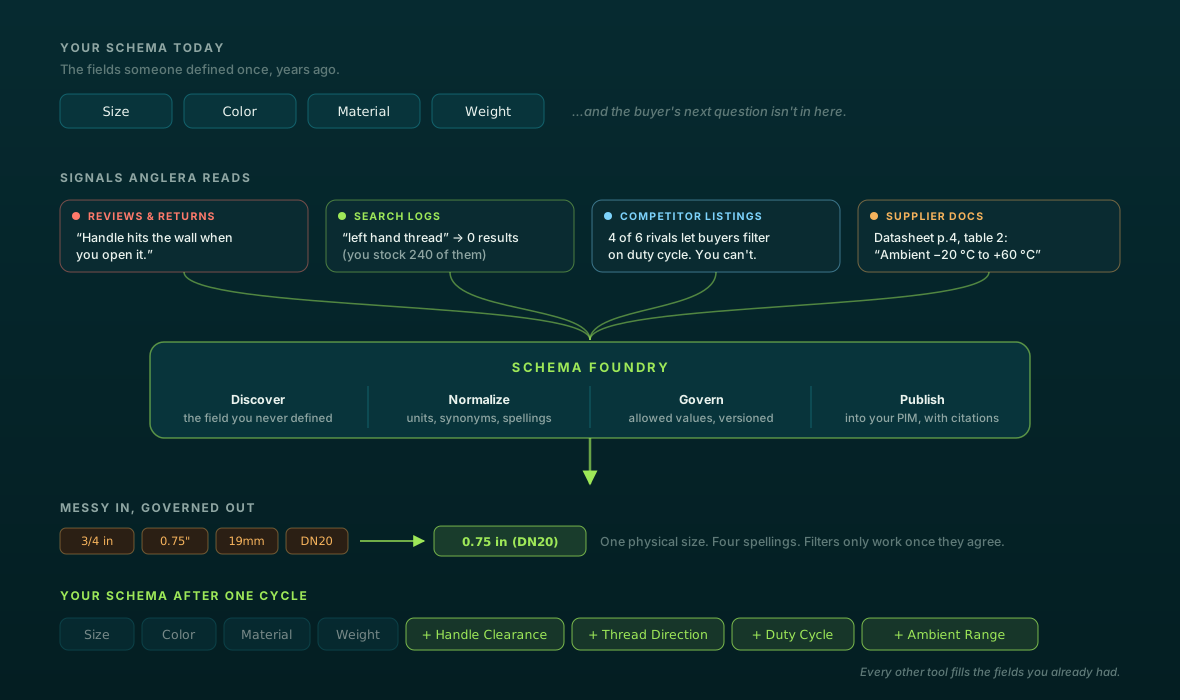
Values are normalized into a governed, versioned set of allowed values — so a filter works, and keeps working after the next import.

Nominal Size
3/4 in0.75"3/4"19mm3/4 inchDN20
0.75 in (DN20)

Six suppliers, six spellings, one physical size. Filters only work once they agree.

Finish
BlkblackBLACK MATTEMatte BlkRAL 9005
Black — Matte

Free text makes a colour filter useless. A governed value makes it a facet.

Material
SS316316 StainlessStainless Steel 316A4 Stainless
Stainless Steel — 316 / A4

Same alloy, four vocabularies, plus a trade name. Buyers search all of them.

And the part nobody else does

We don't just fill the template you handed us.

Filling the fields you defined has an invisible ceiling: a catalog can hit 100% complete and still miss the attribute that loses the sale, because completeness is measured against a schema someone drew years ago. Schema Foundry reads competitor listings, buyer searches, review complaints and your supplier docs, and proposes the fields you never defined — which is where Agility PIM stops.

How Schema Foundry works
Schema Foundry: signals from reviews, search logs, competitor listings and supplier documents reveal attributes missing from your schema; the Foundry discovers, normalizes and governs them, so your schema ends the cycle with more fields than it started with.

What Agility PIM does

Agility PIM, from insightsoftware (formerly Agility Multichannel), is a single-tenant cloud PIM for manufacturers, distributors and retailers. It models complex B2B catalogs with parallel taxonomies and inherited attributes, onboards supplier data through a governed integration module, and publishes one master record to web, marketplaces, EDI feeds and print through an in-house Adobe InDesign connector.

Pricing: Annual subscription per instance. Its UK G-Cloud 14 listing shows £48,000 to £100,000 an instance a year, with no free trial; other pricing is by quote.

Agility PIM website

When Agility PIM is the right call

Distributors, wholesalers and manufacturers with deep B2B catalogs, many locales and a live print catalog program, who want parallel taxonomies, role-based workflows, governed supplier onboarding and an in-house InDesign connector in one PIM.

We'd rather tell you here than in month three of an implementation.

Capability verdicts reviewed against Agility PIM's public documentation on October 16, 2026. Vendors ship quickly — if something here is out of date, tell us and we'll correct it.

See it on your own SKUs.

Bring one category and your supplier files. In 30 minutes you'll see it enriched — complete, structured, and consistent enough to launch on — plus the attributes your schema didn't have yet.

Book a demo