All comparisons
Works with ASAP NetworkSyndication & feeds

Anglera + ASAP Network

The bottom line

Both, and in that order. Pull the ASAP files for the line-card brands you carry — free-to-$180-a-year for import-safe titles, spec blocks and ACA fitment is the cheapest publishable baseline in the aftermarket, and rebuilding it by hand is indefensible. Then add Anglera for the two things a shared network structurally cannot do: cover the brands and private label that were never on the line card, and turn a file that four thousand other dealers received into content written for your buyer and owned by you.

ASAP Network and Anglera solve different halves of the problem — this page is about the seam between them.
The frame for this comparison

Product data is a practice, not a project.

ASAP's question is whether a clean, import-safe file exists for a brand a dealer asked for — titles written for a consumer, bullets, a spec block, ACA fitment, images and install docs, re-indexed overnight when the brand pushes a change. Anglera's question is whether every SKU on YOUR item file, the line-card brands and the several hundred numbers that were never on it, carries the bolt pattern, the friction compound, the backspacing and the emissions status that the buyer actually filters on — and whether that listing reads like a shop that knows the vehicle rather than like the same paragraph four thousand storefronts published this morning. One is a delivery, repeated per brand. The other is a practice, repeated every time a supplier reissues, a model year drops, or buyers start asking a question your schema has no field for.

01

Ground it

Mine every spec from every source.

Every value traced to a document you can open. The catalog is only as honest as what it was built from.

02

Align it

Aim the catalog at the buyer who actually buys.

Grounded data still loses if it answers questions nobody asked. Alignment is what turns specs into conversion.

03

Keep it alive

Product data is a practice, not a project.

Markets move, suppliers reissue, buyers change what they ask for. A catalog that is right in March is wrong by August unless something is watching.

Capability by capability

Where ASAP Network stops.

Scored against public documentation. Grouped by the three acts — so you can see which ones ASAP Network leaves on your desk.

01

Ground it

Mine every spec from every source.
Source mining
Where does it get specs from?
ASAP NetworkLimited

Structures what brands submit; does not mine outside sources

AngleraYes

PDFs, spec tables, drawings, manuals, images, sites

Schema discovery
Does it find attributes that aren't in your schema yet?
ASAP NetworkNo

Fields follow ACES/PIES and the brand file

AngleraYes

Proposes fields your schema never had

Governed vocabulary
Does it turn messy free-text into a governed pick list?
ASAP NetworkLimited

ACA reference databases govern covered brands

AngleraYes

Normalizes and governs allowed values, versioned

Taxonomy & classification
Can it classify every SKU into your hierarchy?
ASAP NetworkLimited

Category sync on import; your tree stays yours

AngleraYes

Auto-classifies; channel and marketplace mapping

Citations & provenance
Can you see where any given value came from?
ASAP NetworkNo

Brand-supplied record; no per-value citation

AngleraYes

Every value cites its source doc and page

02

Align it

Aim the catalog at the buyer who actually buys.
Buyer personas
Is the content written for your buyer, or generically?
ASAP NetworkNo

One file per brand, identical for every member

AngleraYes

B2B specifier and B2C shopper enriched differently

Review, search & social signals
Does it learn what buyers ask from the live market?
ASAP NetworkNo

No review or search signal read back into records

AngleraYes

Reviews, search, competitor rails, social — fed back

Copy & SEO
Does it write original, channel-ready copy?
ASAP NetworkLimited

Consumer titles, HTML descriptions, bullets — network-wide

AngleraYes

Original copy per persona and channel

Product imagery
Can it produce usable images for SKUs that lack them?
ASAP NetworkLimited

Distributes brand image links plus Shopify image tooling

AngleraYes

Generates studio-grade imagery for photoless SKUs

03

Keep it alive

Product data is a practice, not a project.
Continuous re-enrichment
What happens when the market moves after go-live?
ASAP NetworkLimited

Brand edits index overnight; covered brands only

AngleraYes

Re-enriches on its own after go-live

Quality scoring
Does it score its own output and track catalog health?
ASAP NetworkNo

No completeness scoring of your catalog found

AngleraYes

Scored against your standards; nothing publishes below bar

Write-back
Does enriched data land back in your system of record?
ASAP NetworkLimited

Imports into Shopify and X-Cart, not into a PIM

AngleraYes

Writes back to PIM, ERP, warehouse, commerce

API, MCP & webhooks
Can your own tools and agents drive it headlessly?
ASAP NetworkLimited

Developer page and token-based integration; no MCP found

AngleraYes

API, webhooks, and MCP servers

Who does the work
Does it do the work, or help your team do it?
ASAP NetworkLimited

ASAP builds covered brands; the tail is your team

AngleraYes

Anglera owns the work; review is a guardrail

KeyYesships itLimitedlimited or gatedYour teamyour team still does itNodoesn't do itAnglera differentiator
What “buyer signals” actually means

Six signals sitting in your market right now.

“Buyer signals” is the emptiest phrase in this category, so here is the literal thing. Each of these is an observation from a live market, the gap it exposes, and the field that gets created as a result.

Search signal·site-search logs on an independent truck-accessory dealer's storefront

"will this fit with a 2 inch level" and "fits leveled 2019 ram 1500" recur against wheel and tire listings. The network file carries ACES fitment for the stock vehicle only, and the lift and leveling context lives in a paragraph, if anywhere.

Fitment answers the factory truck. It cannot answer the modified one, which is what most of this catalog is actually sold to.

Field createdSuspension lift required (inches) and max tire diameter at stock ride heightLift requirement in half-inch steps, 0 to 6+; tire diameter in inches, measured to overall diameter
Review signal·one- and two-star reviews and return reasons on a hub-and-bearing assembly

"Doesn't have the ABS ring, had to reuse the old one and it wouldn't seat" and "no ABS sensor port on this one" appear repeatedly, against a record whose bullets describe bearing type and load rating.

Whether the assembly integrates an ABS tone ring is the deciding fact for half the buyers and a return for the other half, and there is no field for it.

Field createdABS tone ring integrated (yes / no / not applicable)Three-value enum, with sensor-port present captured as a separate boolean
Competitor signal·the top four organic results for a cold-air intake part number

Every listing runs the same brand-supplied description. The one outranking the rest added a CARB EO number, a 50-state legality flag, and a note on whether the factory MAF housing transfers.

Emissions legality decides the purchase in several states and is nowhere in the shared record, so the dealer who added it took the query.

Field createdCARB EO number and emissions legality (50-state / 49-state / off-road only)EO number as a validated string; legality as a three-value enum tied to it
Supplier signal·the installation PDF linked from a network record for a leaf-spring add-a-leaf kit

The instructions specify the required U-bolt length, that longer U-bolts are not included, and a re-torque interval at 500 miles. The distributed record carries the PDF as a link and none of those facts as fields.

The three questions the counter answers by phone all day are inside a document the storefront links to and no filter can read.

Field createdU-bolts included (boolean), required U-bolt length, re-torque intervalU-bolt length in inches; re-torque interval in miles, with a null for none specified
Social signal·a diesel-truck owners group and two model-specific forums

Threads about a lift-pump upgrade keep converging on whether the kit reuses the factory fuel-basket sending unit and whether a fuel-pressure sensor delete is needed to avoid a code.

The buying objection is a compatibility question the brand never wrote down, so every dealer publishing the brand file is silent on it.

Field createdReuses factory sending unit (yes / no) and check-engine mitigation requiredBooleans plus a short controlled list of mitigation types (none / sensor relocation / tuner)
Marketplace signal·eBay Motors and Amazon listings for the same brake-pad part number

Marketplace copies of the record surface the friction material as "ceramic" in the title only. Buyers filtering for low-dust or towing-rated pads never reach the listing, and the same part sits under three different part-type labels.

Friction compound, dust rating and towing suitability are merchandising attributes the shared record leaves as adjectives inside a title.

Field createdFriction compound, low-dust rated, tow/haul ratedCompound normalized to ceramic | semi-metallic | organic | carbon-metallic; the two ratings as booleans
Why catalogs rot

Four thousand dealers, one paragraph

ASAP's economics are honest and they work: brands submit a line, ASAP structures it once against Auto Care Association standards, and every member who requests it pulls the same record with a click. That is why dealer membership is free and the community catalog is fifteen dollars a month. It is also, precisely, the ceiling. The company's own description of its dealers is 'our receivers,' and receivers all receive the same thing — your product page for a set of coilovers is word for word the page of every other network dealer stocking them, and none of you has a differentiation signal to give a search engine or an answer engine that must pick one. When four thousand listings say the same sentence, ranking falls back to price and domain authority, and the dealer with the biggest ad budget wins a query you both deserved. Then look at the edges of the roster. Three hundred and three brands is a genuine line card, weighted toward performance, off-road, diesel and restoration, and it is not your line card: the private label you built the margin story on, the regional brand you took on last spring, the hard-parts numbers your counter sells all day, and the legacy part numbers customers still call in — none of those have a file waiting, because no manufacturer submitted one. Direct-brand access also runs through manufacturer approval, so your catalog's completeness is partly a function of which brands said yes. A shared network is a very good way to stop re-keying spreadsheets. It is not, and structurally cannot be, the reason someone buys the part from you.

Messy in, governed out.

Values are normalized into a governed, versioned set of allowed values — so a filter works, and keeps working after the next import.

Nominal Size
3/4 in0.75"3/4"19mm3/4 inchDN20
0.75 in (DN20)

Six suppliers, six spellings, one physical size. Filters only work once they agree.

Finish
BlkblackBLACK MATTEMatte BlkRAL 9005
Black — Matte

Free text makes a colour filter useless. A governed value makes it a facet.

Material
SS316316 StainlessStainless Steel 316A4 Stainless
Stainless Steel — 316 / A4

Same alloy, four vocabularies, plus a trade name. Buyers search all of them.

And the part nobody else does

We don't just fill the template you handed us.

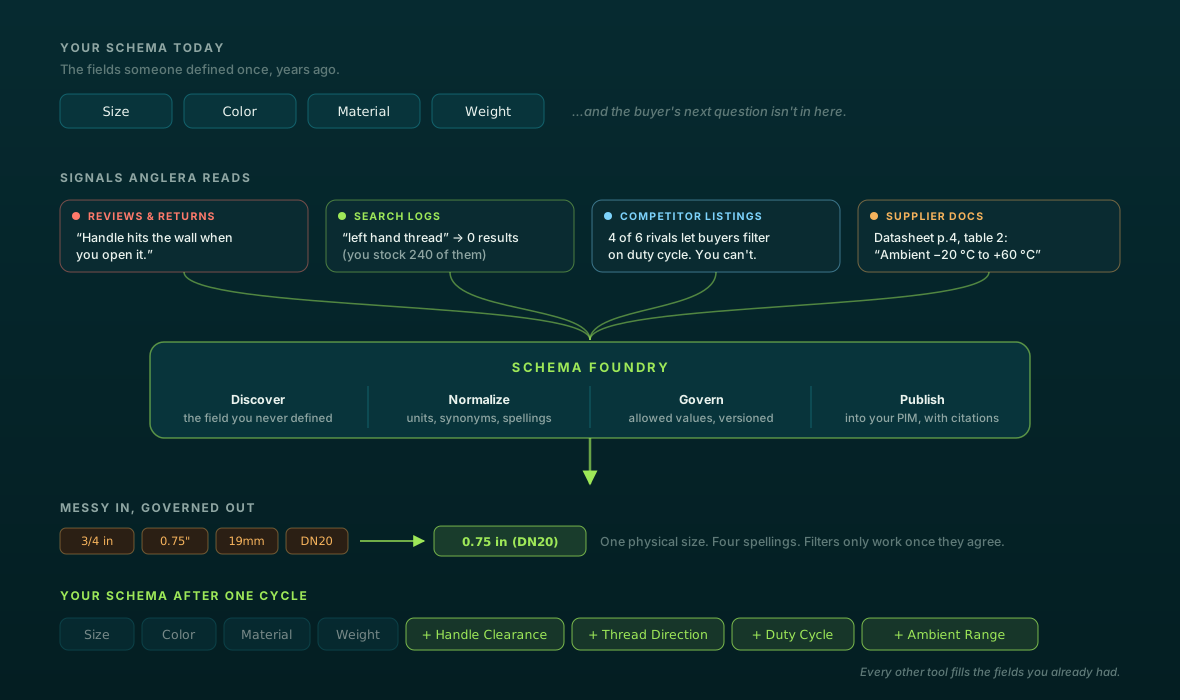
Filling the fields you defined has an invisible ceiling: a catalog can hit 100% complete and still miss the attribute that loses the sale, because completeness is measured against a schema someone drew years ago. Schema Foundry reads competitor listings, buyer searches, review complaints and your supplier docs, and proposes the fields you never defined — which is where ASAP Network stops.

How Schema Foundry works
Schema Foundry: signals from reviews, search logs, competitor listings and supplier documents reveal attributes missing from your schema; the Foundry discovers, normalizes and governs them, so your schema ends the cycle with more fields than it started with.

What ASAP Network does

ASAP Network is an automotive aftermarket product-data network founded in 2014 that sits between parts brands and the dealers who sell them. Brands hand ASAP their product line; ASAP stores it, structures it against Auto Care Association standards, and turns it into what it calls ecommerce-ready files — consumer-friendly titles, HTML descriptions, feature and benefit bullets, spec sections, verified fitment, image links and installation documents, formatted so an import will not break. Dealers join free, request a brand's data, and once the manufacturer approves the request they pull that brand's entire line into their storefront with a click; the fitment data drives year/make/model pickers, VIN lookup and on-page fit validation. Distribution runs through a Shopify app and an X-Cart integration, plus token-based access for developers. The line card carries 303 brands — 219 direct brands and 84 under a Community Sponsored Brand program, where dealers rather than manufacturers fund the data build for $15 to $18 a month. LinkedIn lists the company at 2 to 10 employees and the network at over 4,000 dealers and distributors; the site cites over 9,000 dealers and retailers.

Pricing: Dealer membership is free: 'There is no current membership fee to become a member.' Direct-brand data is unlocked per brand once the manufacturer approves the dealer's request. The Community Sponsored Brand catalog is a dealer-funded subscription at $18/month billed quarterly ($54/quarter) or $15/month billed annually ($180/year), with unlimited downloads across the sponsored brands. Manufacturer-side pricing is not published.

ASAP Network website

When ASAP Network is the right call

Independent speed shops, off-road, diesel and restoration dealers running Shopify or X-Cart who carry brands on ASAP's line card, have no data team, and need a fitment-accurate storefront live in weeks. Free dealer membership with per-brand manufacturer approval, plus a $15-a-month community catalog, is a per-SKU cost no build-it-yourself project touches — and the fit validation that stops a wrong-part return pays for itself on its own.

We'd rather tell you here than in month three of an implementation.

Capability verdicts reviewed against ASAP Network's public documentation on August 20, 2026. Vendors ship quickly — if something here is out of date, tell us and we'll correct it.

See it on your own SKUs.

Bring one category and your supplier files. In 30 minutes you'll see it enriched — complete, structured, and consistent enough to launch on — plus the attributes your schema didn't have yet.

Book a demo