All comparisons
An alternative to Atronous AIAI enrichment tools

Anglera vs Atronous AI

The bottom line

Buy Atronous if your catalog is consumer goods headed to Amazon, Walmart or Wayfair and the job is channel compliance. Buy Anglera if you're a distributor or manufacturer with 50k-500k SKUs from messy supplier feeds.

Both claim to enrich product data. This page is about where that claim stops.

The frame for this comparison

Product data is a practice, not a project.

Atronous and Anglera are aimed at the same job on day one — turn a vendor PDF into a record that clears a retailer's rules — so the honest comparison is about day ninety: what happens after the first pass, when the channel adds a required attribute, the mill quietly changes a blend, and the extraction that was approved in March is still sitting in the feed.

01

Ground it

Mine every spec from every source.

Every value traced to a document you can open. The catalog is only as honest as what it was built from.

02

Align it

Aim the catalog at the buyer who actually buys.

Grounded data still loses if it answers questions nobody asked. Alignment is what turns specs into conversion.

03

Keep it alive

Product data is a practice, not a project.

Markets move, suppliers reissue, buyers change what they ask for. A catalog that is right in March is wrong by August unless something is watching.
Capability by capability

Where Atronous AI stops.

Scored against public documentation. Grouped by the three acts — so you can see which ones Atronous AI leaves on your desk.

01

Ground it

Mine every spec from every source.
Source mining
Where does it get specs from?
Atronous AIYes

Mines PDFs, spreadsheets, images, line drawings, CAD files

AngleraYes

PDFs, spec tables, drawings, manuals, images, sites

Schema discovery
Does it find attributes that aren't in your schema yet?
Atronous AINo

Fills values into 400+ prebuilt category schemas

AngleraYes

Proposes fields your schema never had

Governed vocabulary
Does it turn messy free-text into a governed pick list?
Atronous AIYes

Normalizes to per-category vocabularies; versioned rule changelog

AngleraYes

Normalizes and governs allowed values, versioned

Taxonomy & classification
Can it classify every SKU into your hierarchy?
Atronous AIYes

Retailer taxonomy alignment, 400+ categories, GS1 validation

AngleraYes

Auto-classifies; channel and marketplace mapping

Citations & provenance
Can you see where any given value came from?
Atronous AILimited

Claims source-to-output traceability; no per-value citations shown

AngleraYes

Every value cites its source doc and page

02

Align it

Aim the catalog at the buyer who actually buys.
Buyer personas
Is the content written for your buyer, or generically?
Atronous AINo

No B2B versus B2C persona tailoring documented

AngleraYes

B2B specifier and B2C shopper enriched differently

Review, search & social signals
Does it learn what buyers ask from the live market?
Atronous AINo

Monitors marketplace rules, not search or review signals

AngleraYes

Reviews, search, competitor rails, social — fed back

Copy & SEO
Does it write original, channel-ready copy?
Atronous AIYes

Generates marketplace titles, descriptions, SEO content

AngleraYes

Original copy per persona and channel

Product imagery
Can it produce usable images for SKUs that lack them?
Atronous AILimited

Classifies, quality-checks, resizes and crops; no generation

AngleraYes

Generates studio-grade imagery for photoless SKUs

03

Keep it alive

Product data is a practice, not a project.
Continuous re-enrichment
What happens when the market moves after go-live?
Atronous AILimited

Tracks marketplace rule changes; delivery remains run-based

AngleraYes

Re-enriches on its own after go-live

Quality scoring
Does it score its own output and track catalog health?
Atronous AIYes

C-score quality metric; free data quality assessment

AngleraYes

Scored against your standards; nothing publishes below bar

Write-back
Does enriched data land back in your system of record?
Atronous AIYes

Delivers validated attributes to PIM, ERP, commerce

AngleraYes

Writes back to PIM, ERP, warehouse, commerce

API, MCP & webhooks
Can your own tools and agents drive it headlessly?
Atronous AIYes

REST API and webhooks; no MCP server found

AngleraYes

API, webhooks, and MCP servers

Who does the work
Does it do the work, or help your team do it?
Atronous AILimited

Automated pipeline delivers; customer team reviews and owns

AngleraYes

Anglera owns the work; review is a guardrail

KeyYesships itLimitedlimited or gatedYour teamyour team still does itNodoesn't do itAnglera differentiator
What “buyer signals” actually means

Six signals sitting in your market right now.

“Buyer signals” is the emptiest phrase in this category, so here is the literal thing. Each of these is an observation from a live market, the gap it exposes, and the field that gets created as a result.

Review signal·Marketplace reviews on upholstered accent and dining chairs

Three reviews in a row say the chair arrived fully built in one carton and would not clear a 32-inch doorway. One is blunt: "the listing tells you the seat height, not the box."

Assembled dimensions get published because they sit on the spec sheet. Carton dimensions and assembly state live on the pack list, so the attribute that actually drives the return — will it get into the room — is the one nobody carries forward.

Field createdassembly_state, plus carton_length_in / carton_width_in / carton_depth_in captured per shipped cartonassembly_state: Fully assembled | Legs attach only | Partial assembly | Full assembly required | Tool-free assembly
Search signal·Internal site search on a medical/dental distributor catalog

Recurring zero-result queries: "chemo tested nitrile exam glove", "D6978 glove 3.5 mil", "powder free latex free exam glove size XL". The catalog ranks these on box count and cuff length.

Glove records carry size, color, mil thickness and case pack — everything the vendor price file happens to contain. The buying decision hinges on ASTM D6978 chemotherapy-drug permeation testing and powder status, which live in the manufacturer's test summary PDF, so they never reach the attribute set that search reads.

Field createdchemo_drug_tested_astm_d6978 (Yes / No / Not stated), tested_drug_list, powder_status, glove_materialpowder_status: Powder-free | Powdered. glove_material: Nitrile | Latex (natural rubber) | Vinyl | Neoprene | Polyisoprene
Marketplace signal·Walmart Seller Center item feed rejections on a men's apparel expansion

A flannel shirt bounces with "Fabric Content percentages must total 100." The supplier spec sheet says "brushed cotton flannel, midweight" — a marketing phrase, no percentages. The mill's actual construction is 60% cotton / 40% polyester.

A plausible reading of that spec sheet produces "100% Cotton," which satisfies the sum-to-100 rule and is false. The record needs a fiber breakdown pulled from the mill construction sheet or the sewn-in care label, governed to the generic fiber names the FTC's Textile Rules require — not to whatever adjective the vendor's catalog reached for.

Field createdfabric_content — repeating fiber/percentage pairs summing to 100, held per component (shell, lining, trim)fiber_name: Cotton | Polyester | Rayon | Viscose | Nylon | Spandex | Wool | Linen | Acrylic | Modal | Lyocell (FTC generic fiber names; brand names such as Tencel or Lycra map to the generic term and ride along in fiber_brand)
Why catalogs rot

Rot starts the day after the handoff

Extraction is a dated act. Atronous reads the vendor PDF, spreadsheet, image, line drawing or CAD file, learns the retailer's taxonomy and writes it onto your CSV template for you to review and approve, validates across 400+ product categories, and delivers verified data to PIMs, ERPs and commerce platforms through APIs and webhooks. It says plainly it is not a PIM. That is the same lane Anglera works in, so the argument is not about the first pass — it is about the date on it. Walmart adds a required attribute in Q3. A mill swaps a 60/40 cotton-poly for 100% polyester and reissues the spec sheet under the same style number. Someone approves "Frame: Solid Wood" on a piece that is rubberwood with a walnut veneer, and the approval becomes the record. A validator compares a value to a rule; the rule has no opinion about whether the source moved. The fields stay full, the feed keeps passing, and the listing stops describing the product. The question is who notices when a filled column goes false, and what re-runs when it does.

Messy in, governed out.

Values are normalized into a governed, versioned set of allowed values — so a filter works, and keeps working after the next import.

Nominal Size
3/4 in0.75"3/4"19mm3/4 inchDN20
0.75 in (DN20)

Six suppliers, six spellings, one physical size. Filters only work once they agree.

Finish
BlkblackBLACK MATTEMatte BlkRAL 9005
Black — Matte

Free text makes a colour filter useless. A governed value makes it a facet.

Material
SS316316 StainlessStainless Steel 316A4 Stainless
Stainless Steel — 316 / A4

Same alloy, four vocabularies, plus a trade name. Buyers search all of them.

And the part nobody else does

We don't just fill the template you handed us.

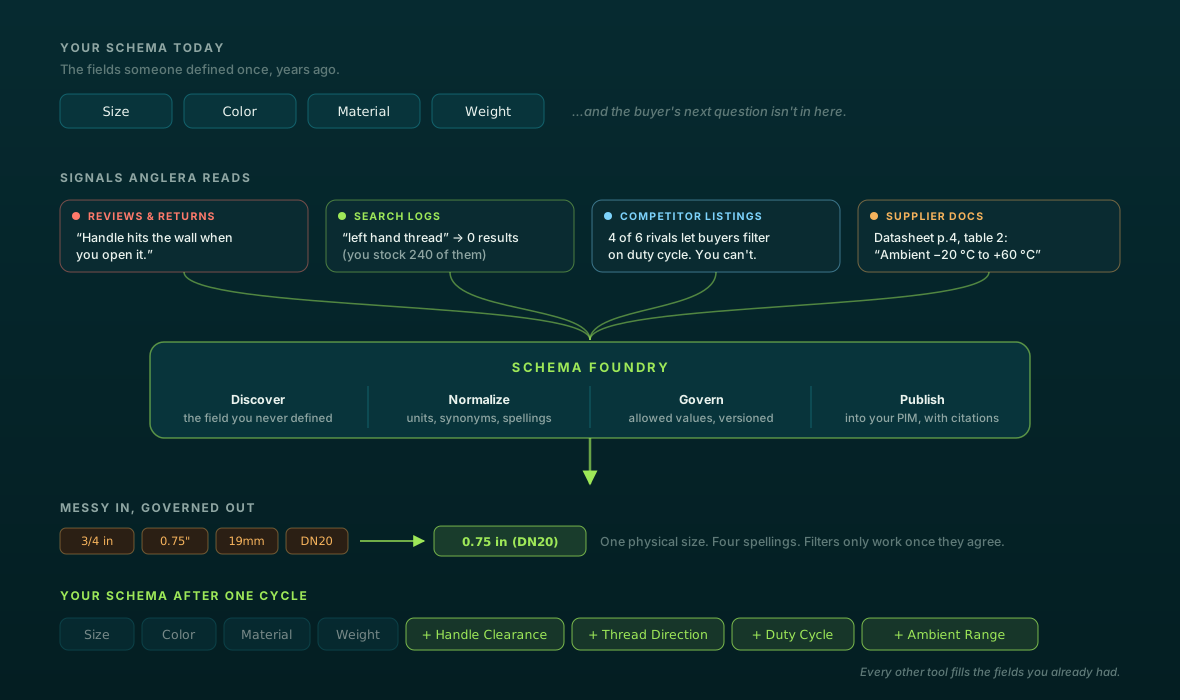
Filling the fields you defined has an invisible ceiling: a catalog can hit 100% complete and still miss the attribute that loses the sale, because completeness is measured against a schema someone drew years ago. Schema Foundry reads competitor listings, buyer searches, review complaints and your supplier docs, and proposes the fields you never defined — which is where Atronous AI stops.

How Schema Foundry works
Schema Foundry: signals from reviews, search logs, competitor listings and supplier documents reveal attributes missing from your schema; the Foundry discovers, normalizes and governs them, so your schema ends the cycle with more fields than it started with.

What Atronous AI does

Atronous AI is a product data intelligence platform that extracts product information from sources like PDFs, spreadsheets, and images, generates missing attributes with AI (including image-recognition models that detect size, color, and material from photos), and delivers validated, marketplace-ready listings. It targets brands and retailers selling across channels like Amazon, Walmart, Shopify, and Wayfair, with 40+ connectors including PIMs such as Salsify and Pimcore. Founded in 2020 by ex-Walmart, Uber, and Robinhood leaders, launched publicly in 2023, and named in Forrester's 2026 NRF Innovators Report.

Atronous AI website

When Atronous AI is the right call

Brands and retailers pushing consumer SKUs to marketplaces: image-based attribute extraction, 400+ prebuilt retailer category schemas, GS1 validation, and marketplace rule tracking.

We'd rather tell you here than in month three of an implementation.

Capability verdicts reviewed against Atronous AI's public documentation on July 14, 2026. Vendors ship quickly — if something here is out of date, tell us and we'll correct it.

See it on your own SKUs.

Bring one category and your supplier files. In 30 minutes you'll see it enriched — complete, structured, and consistent enough to launch on — plus the attributes your schema didn't have yet.

Book a demo